
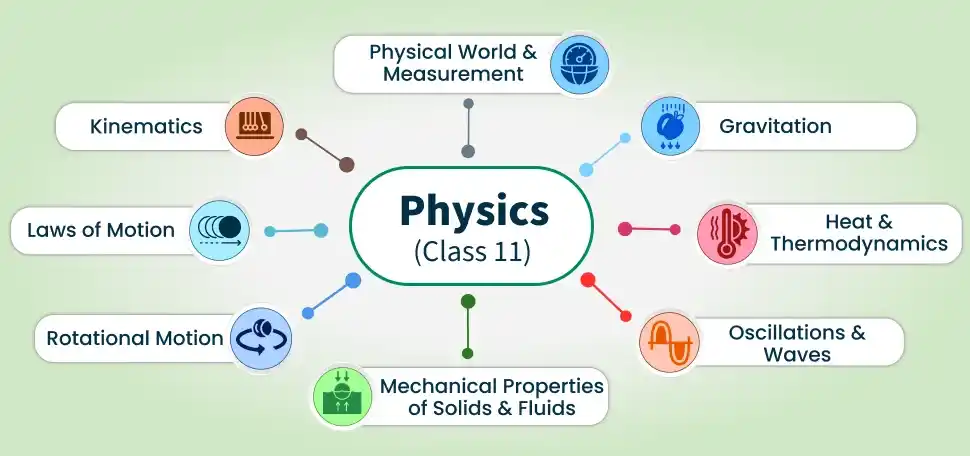
Class 11 Physics introduces the fundamental principles that explain how the physical world works. It covers essential topics such as motion, forces, energy, gravitation, thermodynamics, waves, and properties of matter, forming the foundation for advanced studies in physics.
Units and Measurement
Introduces the need for standardized measurement in physics through SI units and other systems of units. Covers measurement of length, area, volume, and density; dimensional analysis for formula verification; significant figures; rounding rules; and detailed study of systematic and random errors to improve experimental accuracy and precision.
- System of Units
- Length Measurement
- Measurement of Area, Volume and Density
- Rounding Numbers
- Dimensional Analysis
- Significant Figures
- Errors in Measurement
Motion in a Straight Line
Presents a detailed study of one-dimensional motion using graphical and basic calculus methods. Explains displacement, velocity, acceleration, equations of uniformly accelerated motion, relative motion, and interpretation of position–time and velocity–time graphs, along with practical analysis of stopping distance and human reaction time.
- Frame of Reference
- Distance, Displacement, Speed & Velocity
- Uniform & Non-Uniform Motion
- Position-Time Graph
- Instantaneous Velocity & Speed
- Velocity-Time Graph
- Velocity-Position Graph
- Acceleration
- Acceleration-Time Graph
- Galileo’s Law of Odd Numbers
- Equations of Motion (Graphical + Calculus Method)
- Relative Motion in One Dimension
- Stopping Distance and Reaction Time
Motion in a Plane
Extends kinematics to two and three dimensions using vector algebra. Covers vector addition and resolution, dot and cross products, projectile motion, uniform circular motion, centripetal acceleration, and relative motion in a plane, providing mathematical tools essential for analyzing real-life multidimensional motion.
- Scalars & Vectors
- Vector Operations
- Dot and Cross Product
- Position & Displacement Vectors
- Average Velocity
- Motion in Two Dimensions
- Relative Motion in Two Dimensions
- Projectile Motion
- Uniform Circular Motion
- Centripetal Acceleration
- Motion in Three Dimensions
Laws of Motion
Develops Newton’s laws of motion with emphasis on inertia, force, momentum, and impulse. Includes conservation of momentum, equilibrium of particles, frictional forces, motion on inclined planes, dynamics of circular motion, and motion in vertical circles, supported by conceptual explanations and numerical applications.
- Contact and Non-Contact Forces
- Inertia
- Newton’s First Law of Motion
- Impulse
- Linear Momentum of a System of Particles
- Newton’s Second Law of Motion
- Law of Conservation of Momentum
- Equilibrium of a Particle
- Newton’s Third Law of Motion
- Friction—Types and Factors Affecting Friction
- Static and Kinetic Friction
- Motion on a Rough Inclined Plane
- Problems Based on Friction Formula
- Centripetal vs Centrifugal Force
- Dynamics of Circular Motion
- Problems on Dynamics of Circular Motion
- Motion in a Vertical Circle
Work, Power and Energy
Explains work done by constant and variable forces, kinetic and potential energy, conservative and non-conservative forces, and the work–energy theorem. Covers conservation of mechanical energy, power, spring potential energy, and detailed treatment of collisions in one and two dimensions.
- Introduction to Work
- Work Done by a Constant Force and a Variable Force
- Conservative and Non-Conservative Forces
- Work-Energy Theorem
- Kinetic Energy
- Potential Energy
- Potential Energy of a Spring
- Forms of Energy and Law of Conservation of Energy
- Difference Between Work and Energy
- Power
- Collision
- Collision in One Dimension
- Collision in Two Dimensions
System of Particles and Rigid Body
Introduces motion of systems of particles through center of mass concepts and conservation of linear momentum. Discusses center of gravity, application of Newton’s laws to multi-particle systems, and lays the foundation for rotational motion and rigid body dynamics.
- Introduction to Rigid Body
- Centre of Mass
- Centre of Mass of Different Objects
- Motion of Centre of Mass
- Newton’s Laws for a System of Particles
- Linear Momentum of a System of Particles
- Law of Conservation of Linear Momentum
- Centre of Gravity
Rotational Motion
Provides a comprehensive study of rotational kinematics and dynamics, including angular displacement, velocity, acceleration, torque, angular momentum, and moment of inertia. Covers parallel and perpendicular axis theorems, equilibrium of rigid bodies, principle of moments, and rolling motion without slipping.
- Relation Between Angular Velocity and Linear Velocity
- Angular Acceleration
- Rigid Body Rotation
- Kinematics of Rotational Motion
- Torque
- Angular Momentum
- Angular Momentum About a Fixed Axis
- Moment of Inertia
- Parallel Axis Theorem
- Perpendicular Axis Theorem
- Radius of Gyration
- Dynamics of Rotational Motion
- Equilibrium of Rigid Bodies
- Principle of Moments
- Rolling Motion
Gravitation
Explores Newton’s universal law of gravitation and its application to planetary motion. Discusses gravitational field and potential, variation of acceleration due to gravity, orbital and escape velocity, satellites, Kepler’s laws, orbital energy, and the physical explanation of weightlessness.
- Introduction to Gravitation
- Universal Law of Gravitation
- Newton’s Law of Gravitation
- Gravitational Constant
- Acceleration Due to Gravity
- Variation of Acceleration Due to Gravity
- Gravitational Field
- Gravitational Potential
- Gravitational Potential Energy
- Escape Velocity
- Orbital Velocity
- Satellites
- Kepler’s Laws of Planetary Motion
- Weightlessness
- Orbital Velocity and Energy of Satellite
Mechanical Properties of Solids
Examines elastic behavior of solids through stress–strain relationships and Hooke’s law. Discusses Young’s modulus, shear modulus, bulk modulus, Poisson’s ratio, stress–strain curves, and calculation of elastic potential energy stored in stretched or compressed materials.
- Elastic Behavior of Materials
- Elasticity and Plasticity
- Stress and Strain
- Hooke's Law
- Stress-Strain Curve
- Young's Modulus
- Shear Modulus and Bulk Modulus
- Poisson's Ratio
- Elastic Potential Energy
- Stress, Strain and Elastic Potential energy
Mechanical Properties of Fluids
Studies properties of fluids, including pressure variation with depth, buoyant force, Pascal’s and Archimedes’ principles, streamline and turbulent flow, Reynolds number, Bernoulli’s theorem and its applications, viscosity, Stoke’s law, and surface tension with practical examples.
- Fluid Pressure
- Variation of Pressure With Depth
- Devices to Measure Atmospheric Pressure
- Pascal’s Law
- Hydraulic Machines
- Problems on Pascal's Law
- Archimedes’ Principle
- Streamline and Turbulent Flow
- Reynolds Number
- Bernoulli’s Principle
- Bernoulli's Equation
- Applications and Limitations of Bernoulli's Law
- Viscosity
- Stokes' Law
- Surface Tension
Thermal Properties of Matter
Explains temperature scales, heat and thermal expansion of solids and liquids, calorimetry, latent heat during phase changes, and mechanisms of heat transfer—conduction, convection, and radiation. Also includes the greenhouse effect and Newton’s law of cooling.
- Heat and Temperature
- Scales of Temperature
- Ideal Gas Equation and Absolute Temperature
- Thermal Expansion
- Heat Capacity
- Specific Heat Capacity
- Calorimetry
- Change of State of Matter
- Latent Heat
- Heat Transfer
- Conduction
- Problems on Heat Conduction
- Convection
- Radiation
- Greenhouse Effect
- Newton's Law of Cooling
Thermodynamics
Introduces thermodynamic state variables and equations of state, the zeroth and first laws of thermodynamics, the relationship between heat, work, and internal energy, various thermodynamic processes, heat engines, the second law of thermodynamics, and the distinction between reversible and irreversible processes.
- Introduction to Thermodynamics
- Zeroth Law of Thermodynamics
- Zeroth Law of Thermodynamics
- Thermodynamic State Variables and Equation of State
- Heat, Internal Energy and Work
- First Law of Thermodynamics
- Specific Heat Capacity
- Thermodynamic Processes
- Isothermal Process
- Adiabatic Process
- Isobaric Process
- Isochoric Process
- Heat Engine
- Second Law of Thermodynamics
- Reversible and Irreversible Processes
Kinetic Theory
Describes the molecular nature of matter and behavior of gases using kinetic theory. Derives gas laws, explains the ideal gas equation, calculates RMS speed and mean free path, and connects microscopic molecular motion with macroscopic thermodynamic properties like pressure and temperature.
- Molecular Nature of Matter
- Behaviour of Gas
- Ideal Gas Equation and Absolute Temperature
- Deduction of Gas Laws
- Kinetic Theory of Gases
- Mean Free Path
- Specific Heat Capacity
Oscillations
Analyzes periodic motion with detailed treatment of simple harmonic motion, including displacement, velocity, acceleration, restoring force, and energy relations. Covers the simple pendulum, the relation between SHM and circular motion, and the behavior of damped and forced oscillations.
- Oscillatory and Periodic Motion
- Simple Harmonic Motion
- Displacement in SHM
- Velocity and Acceleration in SHM
- Force Law for SHM
- Energy in SHM
- Time Period of SHM
- Some Systems Executing SHM
- Simple Pendulum
- Relationship of SHM & Uniform Circular Motion
- Damped Oscillations
- Forced Oscillations
Waves
Develops fundamental concepts of wave motion, including transverse and longitudinal waves, wave parameters, wave equations, speed of travelling waves, superposition principle, reflection, standing waves, energy transport, and the Doppler effect in sound and light.