
Reynolds Number is a dimensionless quantity that represents the ratio of inertial forces to viscous forces in a flowing fluid.
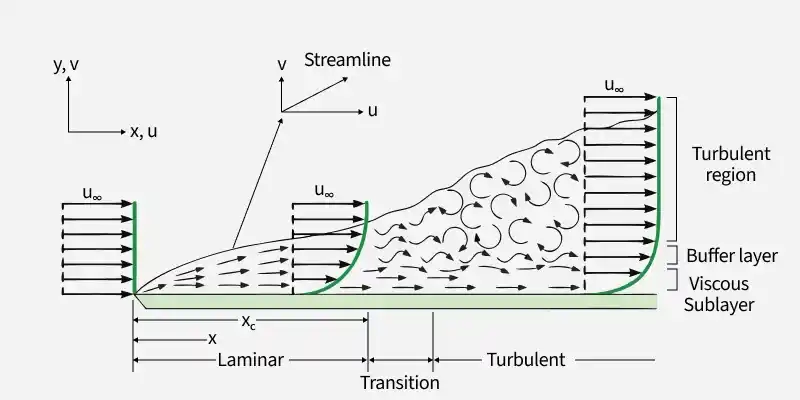
- It is used to predict the nature of fluid flow, indicating whether the flow will be laminar (smooth and orderly) or turbulent (irregular and chaotic).
- It plays a fundamental role in fluid mechanics for analysing flow behaviour in pipes, around objects, and in open channels.
Re = \frac{\text{inertia forces}}{\text {viscous forces}}
Re = \frac{\rho V D}{\mu} where,
Re = Reynolds number
ρ = Density of the fluid
V = Velocity of flow
D = Diameter of the pipe
μ = Dynamic viscosity of the fluid
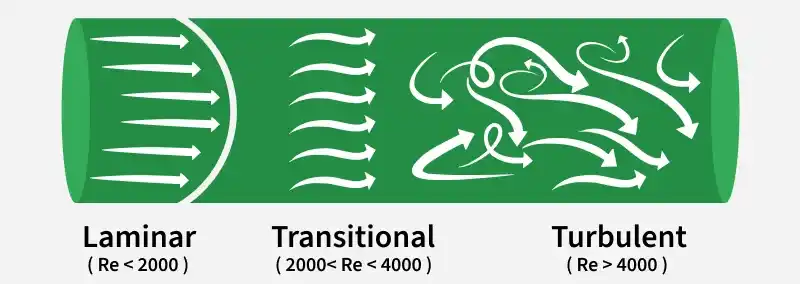
The flow through the pipe is said to be turbulent if the computed Reynolds number is high. The flow is said to be laminar if the Reynolds number is low. These are acceptable numerical values, while laminar and turbulent flows are often grouped within a range.
Laminar flow has a Reynolds number less than 2000, while turbulent flow has a Reynolds number greater than 2000.
Solved Problems
Question 1: Water (ρ = 1000 kg/m³, μ = 0.001 Pa·s) flows through a 4 cm diameter pipe at 1.5 m/s. Determine the Reynolds number and state the nature of the flow.
Solution: Given
D = 4 cm = 0.04 m
Re = \frac{\rho V D}{\mu}
Re = \frac{1000 \times 1.5 \times 0.04}{0.001}
Re = \frac{60}{0.001}
Re = 60000 Flow is Turbulent (Re > 2000)
Question 2: Glycerine (ρ = 1260 kg/m³, μ = 1.49 Pa·s) flows through a pipe of diameter 0.02 m with velocity 0.3 m/s. Find the Reynolds number and classify the flow.
Solution:
Re = \frac{\rho V D}{\mu}
Re = \frac{1260 \times 0.3 \times 0.02}{1.49}
Re = \frac{7.56}{1.49}
Re \approx 5.07 Flow is Laminar (re < 2000)
Question 3: Oil (ρ = 850 kg/m³, μ = 0.08 Pa·s) flows in a pipe of diameter 5 cm. The flow is just at the critical condition (Re = 2000). Find the critical velocity.
Solution: D = 5 cm = 0.05 m
V = \frac{Re \times \mu}{\rho D}
V = \frac{2000 \times 0.08}{850 \times 0.05}
V = \frac{160}{42.5}
V \approx 3.76 \, \text{m/s}
Question 4: Air (ρ = 1.2 kg/m³, μ = 1.8 × 10⁻⁵ Pa·s) flows through a 2 cm diameter tube. Determine the maximum velocity for laminar flow.
Solution: For laminar flow, Re < 2000
D = 2 cm = 0.02 m
V = \frac{Re \times \mu}{\rho D}
V = \frac{2000 \times 1.8 \times 10^{-5}}{1.2 \times 0.02}
V = \frac{0.036}{0.024}
V = 1.5 \, \text{m/s}
Unsolved Problems
Question 1: Water (ρ = 1000 kg/m³, μ = 0.001 Pa·s) flows through a pipe of diameter 0.06 m with a velocity of 1.2 m/s.Find the Reynolds number and determine the type of flow.
Question 2: Oil (ρ = 850 kg/m³, μ = 0.09 Pa·s) flows in a pipe of diameter 0.08 m. If the Reynolds number is 1500, calculate the velocity of flow.
Question 3: Air (ρ = 1.18 kg/m³, μ = 1.9 × 10⁻⁵ Pa·s) flows through a tube of diameter 0.025 m at 8 m/s. Calculate the Reynolds number and state whether the flow is laminar or turbulent.
Question 4: Glycerin (ρ = 1260 kg/m³, μ = 1.2 Pa·s) flows through a pipe of diameter 0.015 m. Find the maximum velocity for which the flow remains laminar (Take critical Reynolds number = 2000).