
Rigid body rotation is the motion of a solid object when it moves in a circular path around a point or an axis, with all its parts maintaining a fixed distance from each other. This motion can be of two types:
- Rotation about a fixed axis, where the body rotates around an axis that remains in the same position and direction (like a hinged door).
- Rotation about a fixed point, where the body spins around a single point (like a child’s spinning top).
Angular Velocity
Angular velocity is the rate at which an object rotates, meaning how quickly its angular position changes with time. For example, a motorcycle moving in a circular track or a merry-go-round both exhibit angular motion. If a body rotates about a fixed axis, the angle it covers (θ) keeps changing with time, and this rate of change is called angular velocity, denoted by ω. For uniform rotation, the average angular velocity is used,
\omega = \frac{\Delta \theta}{\Delta t}
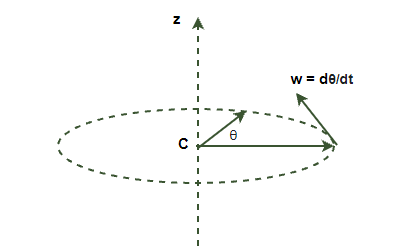
while for non-uniform rotation, instantaneous angular velocity is defined as:
Angular Momentum
Angular momentum is the rotational equivalent of linear momentum. Just as force is needed to produce linear motion, torque is required to produce rotational motion. In rotational dynamics, many quantities like displacement, velocity, and acceleration have their corresponding forms, and angular momentum plays a role similar to linear momentum.
Consider a particle moving around a point. If its position vector from the origin is r and its linear momentum is p, then its angular momentum is given by:
This represents the cross product of the position vector and linear momentum. The magnitude of angular momentum is given by:
where θ is the angle between r and p.
The relationship between torque and angular momentum can be understood by differentiating angular momentum with respect to time:
Since
Thus, torque is equal to the rate of change of angular momentum.
For a system of multiple particles, the total angular momentum is the vector sum of the angular momentum of all individual particles:
Torque
Torque is the rotational equivalent of force and is also known as the moment of force. It is responsible for producing angular acceleration in a body, meaning it changes the rotational state of the body. For example, when you open or close a door, you are applying torque, causing the door to rotate about its hinges. In simple terms, the force that causes a body to rotate in circular motion is called torque.
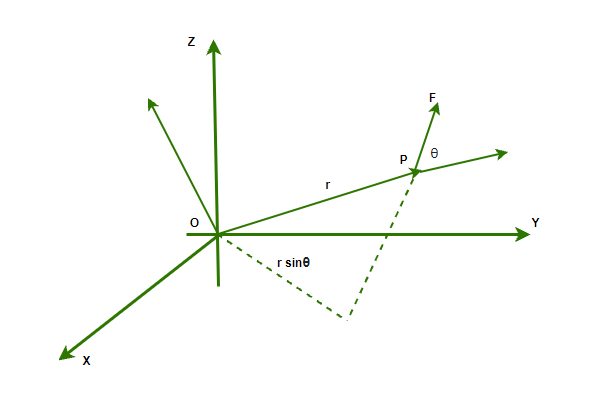
Consider a particle located at a position vector r from the origin, and a force F acting on it. The torque acting on the particle is given by:
Torque is a vector quantity. Its magnitude is given by:
where r is the magnitude of the position vector and θ is the angle between the force and the position vector. The term r sinθ represents the perpendicular distance of the force from the axis of rotation.
The dimensions of torque are:
Solved Problems
Question 1: A force of 10 N is applied at a distance of 2 m from the axis of rotation. The angle between the force and position vector is 90°. Find the torque.
Solution:
\tau = Fr \sin\theta Given:
F = 10 N
r = 2 m
θ = 90°
\tau = 10 \times 2 \times \sin(90^\circ)
\tau = 10 \times 2 \times 1
\tau = 20 N.m
Question 2: Find the angular momentum of the system of two particles revolving around the origin at a distance of 10m with a linear momentum of 100Kg/s and 20 Kg/s.
Solution: Angular Momentum is given by,
l = rpsin(θ)
Given: r = 10 m, p1 = 100Kgm/s, p2 = 20Kgm/s and the angle is a right angle.
Since the system consists of two particles. The total angular momentum will be the sum of the angular momentum of these particles.
l = rp1 + rp2
l = (10)(100) + (10)(20)
l = 1000 + 200
l = 1200
Question 3: Find out the torque on the door if a force of 10N is applied on the door 0.5m from the hinge.
Solution: Torque is given by,
τ = F × r sinθ
Where r is the perpendicular distance of the force from the rotational axis.
Given: r = 0.5m and F = 10N.
Plugging the values in the equation,
τ = F × r
⇒ τ = 10 × 0.5
⇒ τ = 5 N-m
Question 4: Find out the torque on the door if a force of 100N is applied on the door 0.5m from the hinge.
Answer:
Torque is given by,
τ = F × r sinθ
Where r is the perpendicular distance of the force from the rotational axis.
Given: r = 0.5m and F = 100N.
Plugging the values in the equation,
τ = F × r
⇒ τ = 100 × 0.5
⇒ τ = 50 N-m
Question 5: An object performing a circular motion catches a speed of 40rad/s in 4 seconds. Find the angular displacement of the object in the process.
Answer:
Let ω0 denote the initial angular velocity and ω denote the final angular velocity.
Given: ω0 = 0 , ω = 40 and t = 4.
For finding out the value of “a”, the first equation of motion can be used.
ω = ω0 +αt
Plugging the values into this equation,
40 = 0 + α(4)
⇒ α = 10
For finding out the distance, a third equation of motion will be used.
ω2 = ω02 +2α(θ)
⇒ 402 = 0 + 2(10)(θ)
⇒ 1600 = 20(θ)
⇒ 80 = (θ)
Unsolved Problems
Question 1: A force of 20 N is applied at a distance of 0.3 m from the axis at an angle of 60°. Find the torque.
Question 2: A particle of linear momentum 80 kg m/s is at a distance of 1.5 m from the origin. The angle between r and p is 45°. Find its angular momentum.
Question 3: An object starts from rest and rotates with a constant angular acceleration and reaches 30 rad/s in 6 seconds. Find the angular displacement.
Question 4: A particle of mass 5 kg moves in a circle of radius 2 m with a speed of 10 m/s. Find its angular momentum about the centre.
Question 5: A rotating body has an initial angular velocity of 5 rad/s and angular acceleration of 3 rad/s². Find the angular displacement after 4 seconds and the final angular velocity.