
Physical quantities are classified as scalars and vectors. Scalars have only magnitude (e.g., mass, time, temperature), while vectors have both magnitude and direction (e.g., displacement, velocity, force). This distinction is fundamental for describing motion and analysing physical systems.

Scalar Quantities
A scalar quantity is a physical quantity that has only magnitude and no direction.
- It is described by a single numerical value, typically with units.
- Scalars represent quantities where direction is not relevant, such as temperature, mass, time, and energy.
- They can be added, subtracted, multiplied, and divided using standard arithmetic operations.
- Scalars are easier to work with compared to vector quantities since they don’t require considering directions or components.
Examples of Scalar Quantities
There are below some examples of scalar quantities:
- Temperature
- Mass
- Time
- Distance
- Speed
- Energy
- Area
- Volume
- Density
- Electric Charge
These quantities can be measured using instruments such as thermometers, scales, stopwatches, rulers, speedometers, and wattmeters.
For example, if a car travels 100 kilometers in 2 hours, its average speed can be calculated as 50 kilometers per hour (km/h) by dividing the distance traveled by the time taken.
Vector Quantities
A vector quantity is a physical quantity that has both magnitude and direction.
- It is described by both a numerical value and a specified direction, often represented as an arrow or in component form.
- Vectors are used to represent quantities where direction is important, such as displacement, velocity, force, and acceleration.
- They can be added, subtracted, and multiplied using vector-specific operations, such as the dot product and cross product.
- Vectors require consideration of both magnitude and direction, making them more complex to work with compared to scalar quantities.
Examples of Vector Quantities
There are below some examples of vector quantities:
- Velocity
- Acceleration
- Force
- Displacement
- Momentum
- Thrust
- Pressure
- Electric Field
- Magnetic Field
- Weight
- Impulse
- Drag Force
- Lift Force
- Angular Velocity
- Linear Momentum
Vector quantities are used in many fields of science and engineering, such as mechanics, electromagnetism, fluid dynamics, and quantum mechanics. They are essential for describing the behavior of physical systems and making predictions about their future states.
For example, if a car is traveling at a velocity of 50 km/h towards the east, its velocity can be represented as a vector with an arrow pointing to the right (east) and a length of 50 km/h.
Also Read, Difference between Scalar and Vectors
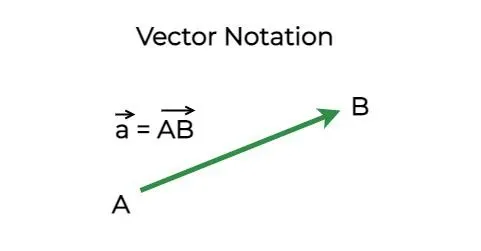
Vector Notation
Vector notation is a way or notation used to represent a quantity that is a vector, through an arrow (⇢) above its symbol, as shown below:
Equality of Vectors
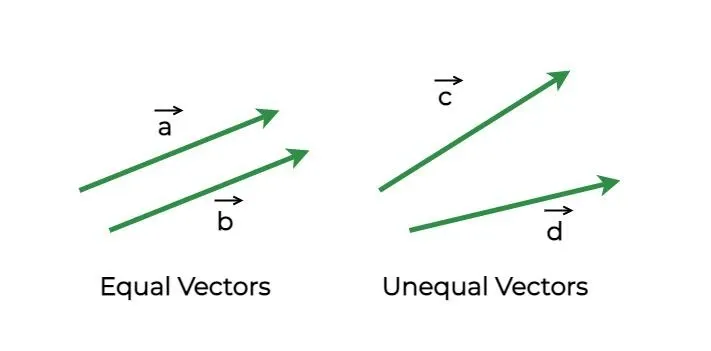
Two vectors are considered equal when they have the same magnitude and the same direction. The figure below shows two vectors that are equal; notice that these vectors are parallel to each other and have the same length. The second part of the figure shows two unequal vectors, which, even though they have the same magnitude, are not equal because they have different directions.
Multiplication of Vectors with Scalar
Multiplying a vector a with a constant scalar k gives a vector whose direction is the same but the magnitude is changed by a factor of k. The figure shows the vector after and before it is multiplied by the constant k. In mathematical terms, this can be rewritten as,
|k\vec{v}| = k|\vec{v}| if k > 1, the magnitude of the vector increase while it decreases when the k < 1.

Addition of Vectors
Vectors cannot be added by usual algebraic rules. While adding two vectors, the magnitude and the direction of the vectors must be taken into account.
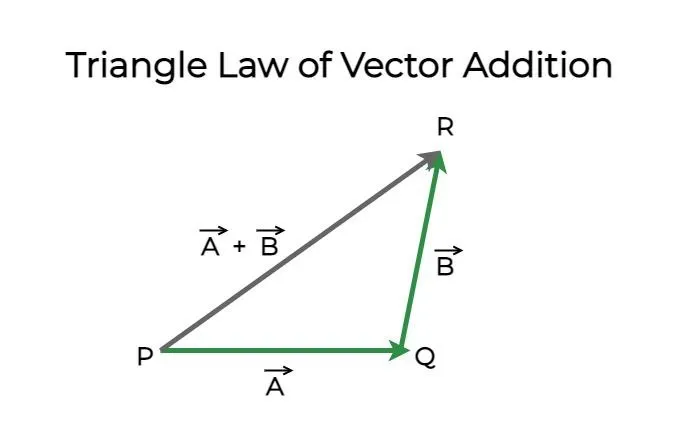
Triangle law is used to add two vectors, the diagram below shows two vectors "a" and "b" and the resultant is calculated after their addition. Vector addition follows commutative property, this means that the resultant vector is independent of the order in which the two vectors are added.
\vec{a} + \vec{b} = \vec{c} \vec{a} + \vec{b} = \vec{b} + \vec{a} - (Commutative Property)
Triangle Law of Vector Addition
Consider the vectors given in the figure above. The line PQ represents the vector "p", and QR represents the vector "q". The line QR represents the resultant vector. The direction of AC is from A to C.
Line AC represents,
\vec{p} + \vec{q} The magnitude of the resultant vector is given by,
\sqrt{|p|^2 + |q|^2 + 2|p||q|cos(\theta)} θ represents the angle between the two vectors. Let φ be the angle made by the resultant vector with the vector p.
tan (\phi) = \dfrac{q\sin\theta}{p + q\cos\theta} The above formula is known as the Triangle Law of Vector Addition.
Parallelogram Law of Vector Addition
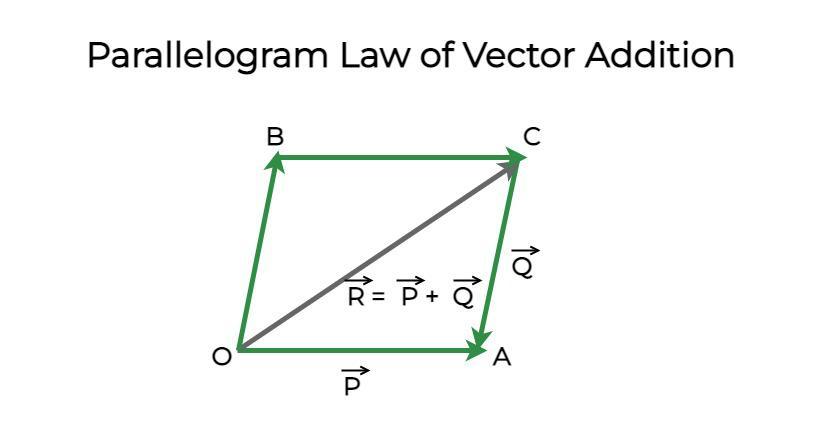
This law is just another way of understanding vector addition. This law states that if two vectors acting on the same point are represented by the sides of the parallelogram, then the resultant vector of these vectors is represented by the diagonals of the parallelograms. The figure below shows these two vectors represented on the side of the parallelogram.
Tensor Quantity
A tensor quantity a physical quantity that requires magnitude and more than one direction for its complete description and whose components obey specific transformation laws under change of coordinate system.
Momentum Flux
Momentum flux refers to the rate at which momentum is transported across a surface. Since momentum is a vector quantity, describing its transport involves more than just magnitude and direction.
To completely specify momentum flux, two independent directions must be considered:
- The direction of the momentum component being transported
- The direction of the surface across which the momentum flows
Because of this dual directional dependence, momentum flux cannot be represented by a scalar or a vector.
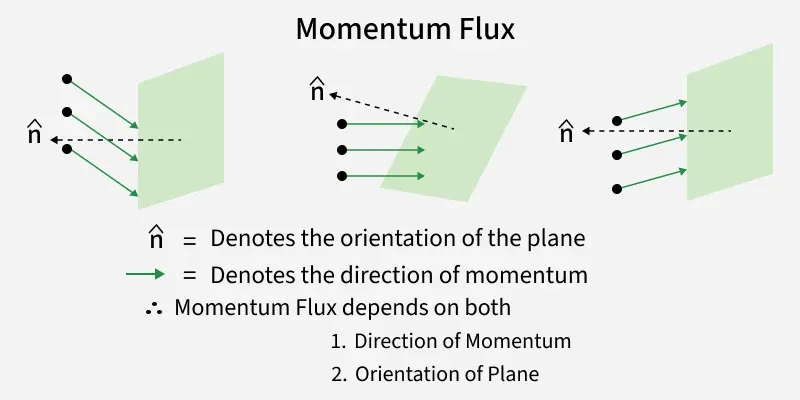
Eg:- Water Particles passing through a plane of area then momentum flux tells us how much momentum is being carried through a surface by a moving fluid or particles every second.
"Momentum itself is a vector and Momentum flux depends on both the direction of the Momentum and the orientation of the plane through which the particles are passing."