
Stress and strain are fundamental concepts in physics that describe how objects respond to external forces. When a force is applied to an object, such as stretching, compressing, twisting, or shearing, it may change its shape or size. This change is called deformation. Stress measures the applied force per unit area, while strain measures the resulting change in shape or dimensions of the object.
Stress
When a deforming force is applied to a body, internal restoring forces develop within it to resist the deformation. Stress is defined as the restoring force per unit area of the body and is denoted by the Greek letter σ (sigma).
Stress can also be defined as the deforming force per unit area acting on the body, since the restoring force is equal and opposite to the applied deforming force.
The stress formula is given as
Stress = \frac{\text {Deforming force (F)}}{\text {Area of the body (A)}}
In terms of symbolism, stress and strain can also be expressed as follows:
σ = \frac{F}{A} where,
σ is the Stress
F is the Force Applied
A is the Area Application of Force
Unit and Dimension
The unit of stress is N/m² or Nm⁻², and another unit is Pascal (Pa).
The dimensional formula of stress is [ML⁻¹T⁻²].
Stress is a scalar quantity, i.e., it has only magnitude.
Stress Types
- Normal Stress
- Tensile stress
- Compressive Stress
- Tangential Stress or Shearing Stress
- Bulk stress, volume stress, or Hydraulic Stress
1. Normal Stress
Normal stress is the restoring force per unit area acting perpendicular to the surface of a body. It is of two types: tensile stress and compressive stress.
When a force is applied perpendicular to the cross-sectional area of a wire or rod, it changes the length and volume of the body. The stress produced under such a perpendicular force is called normal stress.
2. Tensile Stress
When two equal and opposite forces are applied to stretch a circular rod, a restoring force develops perpendicular to its cross-sectional area. The stress produced under this stretching force is called tensile stress.
Thus, tensile stress is defined as the force per unit area acting perpendicular to the cross-section of a body that tends to increase its length.
3. Compressive Stress
When two equal and opposite forces are applied at the ends of a rod to shorten its length, the stress produced is called compressive stress. It is defined as the force per unit area acting perpendicular to the cross section of a body that tends to decrease its length. In both tensile and compressive stress, the net external force on the body remains zero, yet deformation occurs; therefore, both are collectively known as longitudinal stress.
4. Tangential Stress or Shearing Stress
When two equal and opposite forces act tangentially on the opposite faces of a body, one face gets displaced relative to the other, causing a change in shape without changing its volume. The stress developed in this case is called tangential stress or shear stress. It is defined as the force acting parallel to the surface per unit area of that surface.
5. Bulk Stress or Volume Stress or Hydraulic Stress
When an object is immersed in a fluid (liquid or gas), the fluid exerts pressure on all its surfaces. This uniform pressure decreases the volume of the object without changing its shape. The stress produced in this case is called bulk stress or hydraulic stress.
Various types of stress that we encounter are,
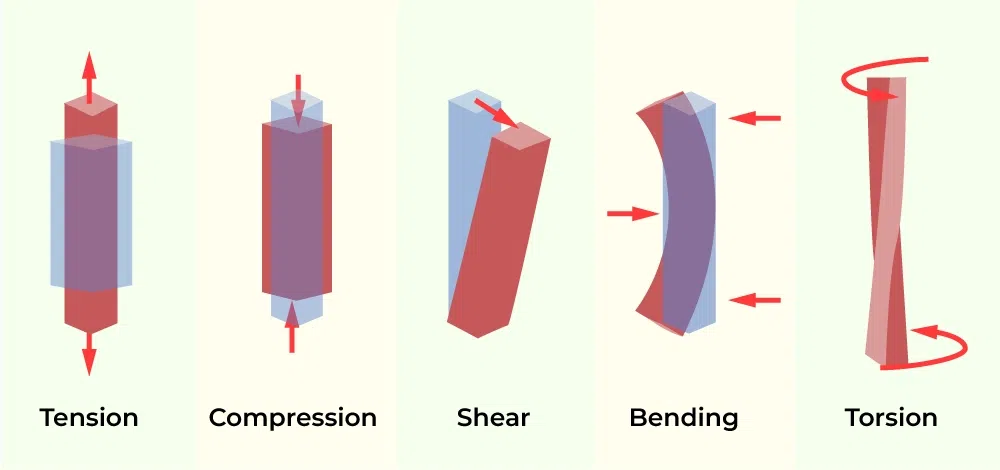
Strain
Strain is defined as the ratio of the change in shape, length, or volume of a body to its original dimensions. It is denoted by the Greek letter ϵ (epsilon). Strain represents the amount of deformation produced in a body in the direction of the applied force relative to its original size.
Strain Formula
The relationship for deformation in terms of a solid's length is given below:
Strain (ϵ) = \frac{\text {Change in the configuration (δl)}}{\text {Original configuration(L)}}
ϵ = \frac{δl}{L} where,
ϵ is the Strain due to applied Stress
δl is the Change in Length
L is the Original Length of materialNOTE :- Strain is unit less because it is the ratio of two similar quantities. Hence, it is a dimensionless quantity.
Strain Types
There are three types of strain:
- Longitudinal Strain
- Volume Strain
- Shear Strain
A. Longitudinal Strain
This type of strain is called longitudinal strain and occurs when a body is subjected to tensile or compressive stress. It is defined as the ratio of the change in length to the original length of the body. If a rod of original length L undergoes a change in length ΔL.
\text {Longitudinal strain} = \frac{\text {Change in length (△L)}}{\text {Original length (L)}}
B. Volume Strain
This type of strain is produced when the body is under bulk stress or hydraulic stress. Longitudinal strain, or original length, is defined as the rate of change in volume to the original volume of the body.
If △V is the change in volume or V₀ - V, where V₀ is the original volume and V is the volume of the body under bulk stress.
\text {Volume strain} = \frac{- △V }{V}
A negative sign shows that volume decreases when the body is under bulk stress.
C. Shear Strain
Shear strain is produced when a body is subjected to tangential or shearing stress. It is defined as the angle (θ) through which a face of the body is displaced from its original position when shear stress is applied.
tanθ = \frac{x}{L}
What is elasticity?
In solids, particles are held together by intermolecular forces. When an external force is applied, these internal forces change, causing deformation in the material.
Elasticity is the property of a material by which it regains its original shape and size after the removal of the deforming force. A perfectly elastic body would completely recover its original form once the force is removed; however, such materials are only ideal concepts. In reality, for example, quartz and phosphor bronze are close to perfectly elastic materials, with quartz fiber being nearly perfectly elastic.
A plastic body does not regain its original shape after the deforming force is removed. A perfectly plastic body (also an ideal concept) would show no recovery at all. In practice, materials recover partially, but substances like paraffin wax and wet clay are close to perfectly plastic materials. Plasticity is therefore the property by which a material fails to return to its original configuration after deformation.
Hooke’s Law
In the 19th century, while studying springs and elasticity, English scientist Robert Hooke noticed that many materials exhibited a similar property when the stress-strain relationship was studied. There was a linear region where the force required to stretch the material was proportional to the extension of the material, known as Hooke’s Law.
Hooke’s Law states that the strain of the material is proportional to the applied stress within the elastic limit of that material.
Mathematically, Hooke’s law is commonly expressed as:
F = –k.x
where
F is the force,
x is the extension in length
k is the constant of proportionality known as the spring constant in N/m.
Elastic Modulus
Elastic modulus, commonly known as Young's modulus, measures a material's stiffness or rigidity. It quantifies a material's ability to deform under stress and then return to its original shape. In other words, it specifies how much a material expands or compresses in response to a given force. Elastic Modulus is given as
\text {Elastic Modulus} = \frac{Stress}{Strain}
Elastic Moduli of Materials
The following table lists Young’s modulus, shear modulus, and bulk modulus for common materials.
Material | Young’s modulus (E) in GPa | Shear modulus (G) in GPa | Bulk modulus (K) in GPa |
|---|---|---|---|
Glass | 55 | 23 | 37 |
Steel | 200 | 84 | 160 |
Iron | 91 | 70 | 100 |
Lead | 16 | 5.6 | 7.7 |
Aluminium | 70 | 24 | 70 |
Related Articles:
Solved Problems
Question 1: A body is under tensile stress; its original length was L m. After applying tensile stress, its length becomes L/4 m. Calculate the tensile strain applied to the body.
Solution: Given that,
The original length is L m.
The change in the length = L - L/4 = 3L/4
Since, the Longitudinal strain = change in length/original length =△L/L
Longitudinal strain = (3L/4)/L
Longitudinal strain = 0.75
Question 2: A copper wire of length 2.5 m has a percentage strain of 0.012% under a tensile force. Calculate the extension in the wire.
Solution: Given that, The original length is 2.5 m
Strain = △L/L = 0.012 %
Strain = 0.012/100
△L = (0.012/100) x 2.5
△L = 0.3 mm
Question 3: Given the deforming force as 150 N applied on a body of area of cross-section as 10 m2. Calculate the stress in the body.
Solution: Given that,
Stress = Deforming force / Area of the body
Stress = F/A
Stress = 150/10
Stress = 15 N/m2
Question 4: A steel wire of original length 3 m elongates by 1.5 mm under a tensile force. Calculate the longitudinal strain produced in the wire.
Solution: Given
Original length, L = 3m
Extension, ΔL = 1.5 mm = 1.5 × 10 − 3 m
Longitudinal strain =
\frac{\Delta L}{L} Strain =
\frac{1.5 \times 10^{-3}}{3} Strain = 5 × 10⁻⁴
Question 5: A body experiences a stress of 2×10⁸ N/m2. If the Young’s modulus of the material is 2×10¹¹ N/m2. Calculate the strain produced in the material.
Solution: Given
Stress σ=2 × 10⁸ N/m2
Young’s modulus E = 2×10¹¹ N/m2
E = \frac{Stress}{Strain}
Strain = \frac{Stress}{E}
\text{Strain} = \frac{2 \times 10^{8}}{2 \times 10^{11}}
\text{Strain} = 10^{-3}
Unsolved problems
Question 1: A wire of original length 4 m is stretched by 2 mm under a tensile force. Calculate the longitudinal strain produced in the wire.
Question 2: A force of 500 N is applied uniformly on a surface of area 0.02 m². Calculate the stress developed in the material.
Question 3: A material has a Young’s modulus of 1.5×10¹¹ N/m2. If the strain produced is 3×10⁻⁴, calculate the stress applied.
Question 4: A solid sphere of original volume 0.5 m3 experiences a decrease in volume of 2×10⁻³ m under bulk stress. Calculate the volume strain.
Question 5: A cube of side 1 m is subjected to a shear force causing a lateral displacement of 2 mm. Calculate the shear strain produced in the cube.