
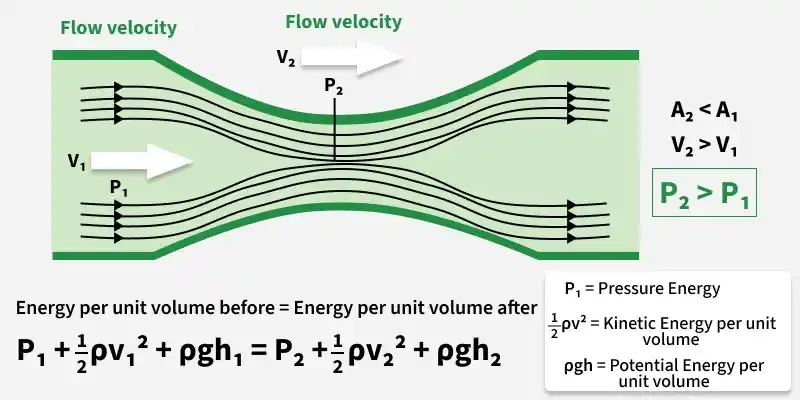
Bernoulli's principle states that in a flowing fluid, where the speed is higher, the pressure is lower, and where the speed is lower, the pressure is higher, assuming the fluid is flowing horizontally. This principle explains how the gravitational potential energy, pressure energy, and kinetic energy of the fluid combine to form the total mechanical energy of the flow, which remains constant.
Real-life examples of Bernoulli's Principle include rivers. The water's speed drops in places where the river's width increases. Conversely, in narrower sections of the river, the speed of the water increases, as the fluid is forced to flow faster through the constricted area.
Bernoulli’s Principle Formula,
Bernoulli's principle is formulated into an equation called Bernoulli's equation. Bernoulli's equation is a relationship between kinetic energy, gravitational potential energy, and the pressure of the fluid inside the container.
P_1 +\frac{1}{2}\rho v_1^2 +\rho g h_1 = P_2 +\frac{1}{2}\rho v_2^2 +\rho g h_2
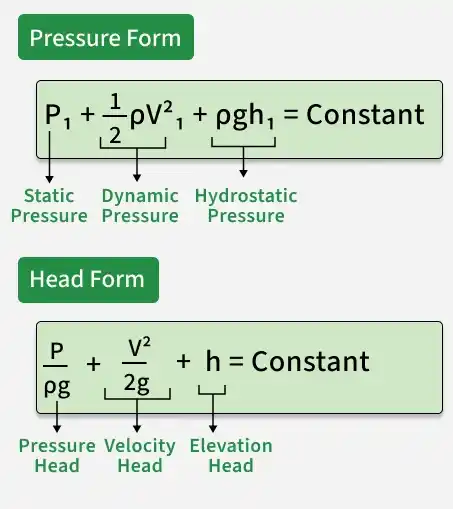
\boxed {P+\frac{1}{2}ρv^2+ ρgh = constant} where,
- P is the Pressure exerted by the fluid,
- ρ is the Density of the fluid,
- v is the Velocity of the fluid,
- g is the Acceleration due to gravity and
- h is the Height of the container.
Derivation of Bernoulli’s Equation
Consider a container in the form of a pipe, with two openings positioned at different heights and having varying diameters. The relationship between the cross-sectional areas A, flow speed v, height from the ground y, and pressure P at two distinct points, 1 and 2
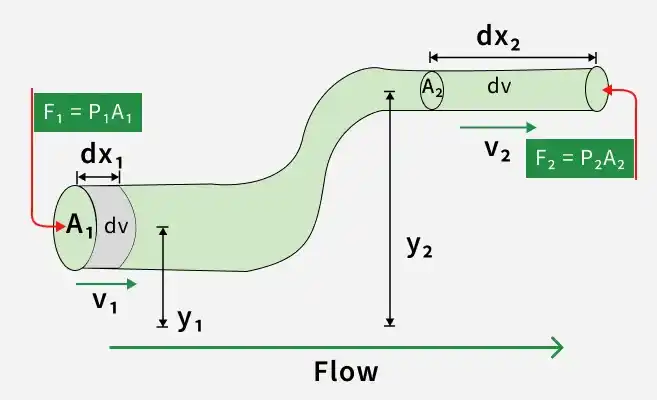
As illustrated in the diagram, the pipe should be at various heights. According to the equation of continuity, its velocity must fluctuate. The fluid surrounding it produces forces to achieve this acceleration, and different places require different pressures.
Assumptions:-
- The fluid flowing is a newtonian fluid, (𝜇 = constant)
- The fluid is incompressible i.e., density is constant (𝜌 = constant)
- Viscous forces are not present ( η =0) i.e., fluid energy is conserved
Prooving:-
The work done at point 1 where the force F1 is exerted to displace the fluid to dx1 is
dW1 = F1 dx1
Here, the force exerted at point 1 is given by, F1 = P1A1
where P1 and A1 are the pressure exerted and cross-sectional area at point 1.
This implies,
dW1 = P1A1 dx1
⇒ dW1 = P1 dv
Similarly, the work done by the fluid at point 2 is:
dW2 = P2A2 dx2
⇒ dW2 = P2 dv
Now, the total work done by the fluid flowing through the container is,
dW = P1 dv - P2 dv
⇒ dW = (P1 - P2) dv . . .(1)
Now, the change in the kinetic energy of the fluid is given by,
\begin{aligned}\text{d}K&=\dfrac{1}{2}m_2v^2_2-\dfrac{1}{2}m_1v^2_1\end{aligned} But, the mass m of the fluid can be written as,
m = ρ dv
Therefore,
\begin{aligned}\text{d}K=\dfrac{1}{2}\rho dv (v^2_2-v^2_1)\end{aligned} . . . (2)Similarly, the change in gravitational potential energy is given by,
\begin{aligned}\text{d}U&=\dfrac{1}{2}m_1gy_2-\dfrac{1}{2}m_2gy_1\\\Rightarrow \text{d}U&=\dfrac{1}{2}\rho dv g(y_2-y_1)\end{aligned} . . . (3)According to the law of conservation of energy:
dW = dK + dU
\begin{aligned}&(P_1 - P_2) dv=\dfrac{1}{2}\rho dv (v^2_2-v^2_1)+\dfrac{1}{2}\rho dv g(y_2-y_1)\\ \Rightarrow & (P_1-P_2)=\dfrac{1}{2}\rho (v^2_2-v^2_1)+\dfrac{1}{2}\rho g(y_2-y_1)\\ &\Rightarrow P_1+\dfrac{1}{2}\rho v_1^2+\rho gy_1=P_2+\dfrac{1}{2}\rho v_2^2+\rho gy_2\end{aligned} This is Bernoulli’s equation and this can be written as a general expression,
\bold{P+\frac{1}{2}\rho v^2+\rho gh=\text{Constant} }
Bernoulli’s Equation at Constant Depth
As the name suggests, let us suppose any fluid is moving at some constant depth, so h1 = h2. Under this condition, Bernoulli's equation
P_1+\frac{1}{2}\rho v_1^2+\rho gh_1 = P_2+\frac{1}{2}\rho v_2^2+\rho gh_2
\Rightarrow P_1+\frac{1}{2}\rho v_1^2= P_2+\frac{1}{2}\rho v_2^2 (As h1 = h2 ⇒ ρgh1 = ρgh2)
Bernoulli’s Equation for Static Fluids
Any fluid is said to be static if there is no motion in it, for example, oil in a container, a calm lake, the air in a room with no air current, etc. For static fluid, there is no velocity gradient throughout the fluid; thus, v1 = v2. So, under this condition, Bernoulli's equation is.
P_1+\frac{1}{2}\rho v_1^2+\rho gh_1 = P_2+\frac{1}{2}\rho v_2^2+\rho gh_2
\Rightarrow P_1+\rho gh_1 = P_2+\rho gh_2 Now, to simplify it much further, h2 = 0 (any height can be chosen for the reference height to be zero)
\Rightarrow P_2 = P_1+\rho gh_1 ,This equation tells us that the static pressure increase from point 1 to 2 by ρgh.
Principle of Continuity
The principle of continuity states that for an incompressible fluid in streamline flow, the mass flow rate is constant across any cross-sectional area. This means the product of velocity and cross-sectional area remains the same along the flow.
Consider a pipe as shown above, with different cross-sectional areas A1 and A2. Let the rate of mass entering and leaving the given system be M1 and M2. Underare, respectively, with a speed of flow v and density ρ of the fluid.
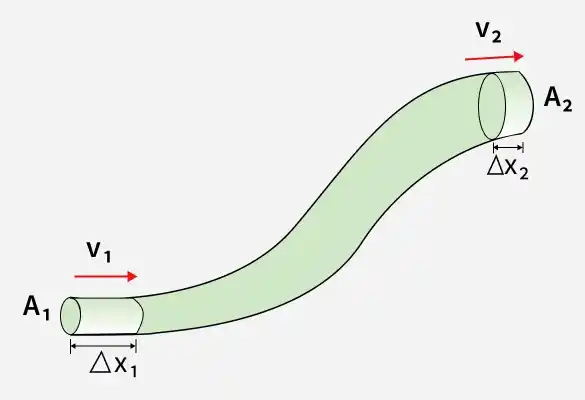
Then, according to the principle of continuity, the rate of mass of fluid entering must be equal to the rate of mass of fluid leaving the system.
Since, the rate of mass entering, M1 = ρA1V1 Δt and
The rate of mass entering, M2 = ρA2V2 Δt
Therefore,
ρA1V1 Δt = ρA2V2 Δt
\bold{\boxed{A_1.v_1=A_2.v_2 }} This is called as Equation of Continuity.
Applications of Bernoulli's Theorem and Equation
1. Venturimeter
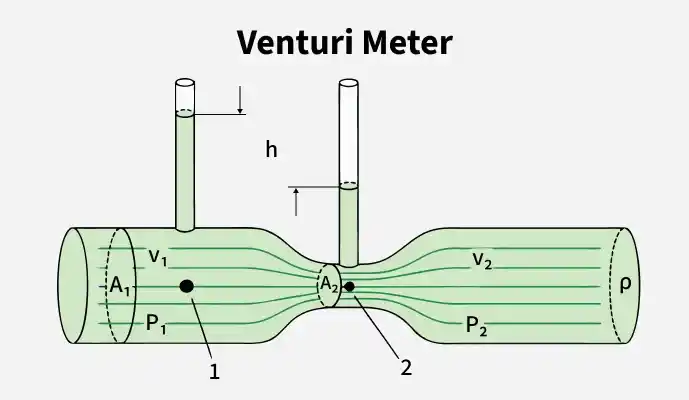
A Venturi meter is a device used to measure the flow rate of a fluid in a pipe with varying cross-sectional areas. It works based on the principle that the fluid's velocity increases and pressure decreases as it passes through a narrower section of the pipe.
To the wide and narrow sections of the pipe, we apply Bernoulli's equation, where h1=h2. The pressure P2 is less than P1 because A1 is bigger than A2, and v2 is greater than v1. The fluid is accelerated as it enters the tube, which is narrow, and slowed as it exits by a net force to the left.
Formula for Venturimeter,
{v_1=\sqrt{\dfrac{2gh}{\left(\dfrac{A_1}{A_2}\right)^2-1}}} where,
- v1 is the rate of fluid flowing,
- g is the acceleration due to gravity,
- h is the difference in liquid level in the two tubes,
- A1 and A2 are the cross-sectional areas of the tube.
2. Principle of Lifting an Aircraft
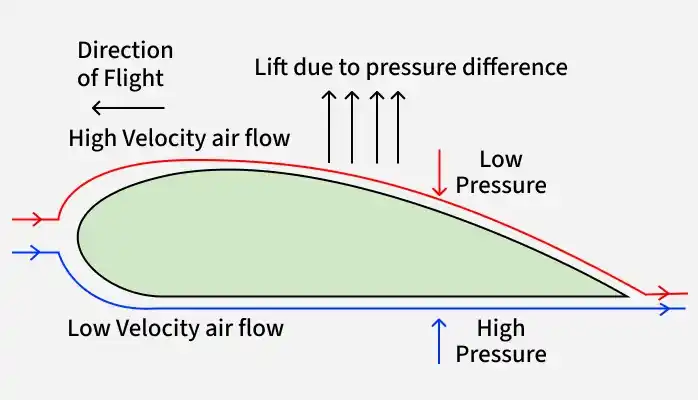
Bernoulli's theorem plays a key role in the operation of airplanes. The wings of an aircraft are designed with a specific shape to take advantage of this principle. As the plane moves, air flows over and under the wings at different speeds. According to Bernoulli's principle, the faster-moving air above the wing creates lower pressure compared to the slower air below the wing. This pressure difference generates an upward force on the wings. When this upward force exceeds the plane's weight, it causes the aircraft to lift.
Conservation of Energy and Bernoulli’s Equation
Bernoulli’s theorem states that in a steady-flowing, incompressible fluid, the sum of kinetic energy, potential energy, and pressure energy remains constant along a streamline. However, several conditions must be met for the equation to hold:
- Steady Flow: The fluid’s velocity, pressure, and density should not change over time. If the flow is unsteady, the equation may not apply.
- Incompressibility: The fluid must be incompressible (typically true for liquids), though for gases, density must remain constant, with minimal variations in pressure, velocity, and temperature.
- Irrotational Flow: The fluid must flow in such a way that there is no rotational motion or angular momentum, ensuring the flow is irrotational.
- Ideal Fluid: The principle assumes no energy loss due to friction. Therefore, the fluid must be ideal, with no internal viscosity or frictional forces that would cause energy dissipation.
Related Article,
Solved Examples
Example 1: Water is flowing at a rate of 2 m/s through a tube with a diameter of 1 m. If the pressure at this point is 80 kPa, what is the pressure of the water after the tube narrows to a diameter of 0.5m? ρwater=1.0 kgl-1
Solution: According to Bernoulli’s expression:
P_{1}+\frac{1}{2}\rho v^2_{1}+\rho gh_{1}=P_{2}+\frac{1}{2}\rho v^2_{2}+\rho gh_{2} The height is same (h1=h2), so the expression can be written as
P_{2}=P_{1}+\frac{1}{2}\rho \left(v^2_{1}-v^2_{2}\right) The expression for the cross-sectional area is
A_{1}=\pi\frac{ d^2}{4}\\ \Rightarrow A_{1}=\pi\frac{ 1^2}{4}\text{ m}^2\\ \Rightarrow A_{1}=\frac{\pi}{4}\text{ m}^2\\ Similarly
A_{2}=\pi\frac{ d^2}{4}\\ \Rightarrow A_{2}=\pi\frac{ 0.5^2}{4}\text{ m}^2\\ \Rightarrow A_{2}=\frac{\pi}{16}\text{ m}^2\\ The expression for the velocity for each diameter is
v_1=\frac{V}{A}\\ \Rightarrow v_1=\frac{2}{\frac{\pi}{4}}\frac{\text{m}}{s}\\ \Rightarrow v_1=\frac{8}{\pi}\frac{\text{m}}{s} Similarly,
v_2=\frac{2}{\frac{\pi}{16}}\frac{\text{m}}{s}\\ \Rightarrow v_2=\frac{32}{\pi}\frac{\text{m}}{s} Substitute the value in Bernoulli’s expression:
P_{2}=80000\text{ Pa}+\frac{1}{2}\times1000\frac{\text{kg}}{\text{m}^3}\times\left(\frac{8}{\pi}-\frac{32}{\pi}\right)\frac{\text{m}}{s}\\ \Rightarrow P_{2}=76.2\text{ kPa}
Example 2: Explain why:
(a) The blood pressure in humans is greater at the feet than at the brain.
(b) Atmospheric pressure at a height of about 6 km decreases to nearly half of its value at sea level, though the height of the atmosphere is more than 100 km.
(c) Hydrostatic pressure is a scalar quantity, even though the force is divided by area.
Solution: (a) The height of the blood column in the foot is greater than that in the brain. As a result, human blood pressure is higher in the feet than in the brain.
(b) The relationship between air density and height is not linear. As a result, pressure does not decrease linearly with height. P = P0e–αh gives the air pressure at a height h, where P0 is the pressure of air at sea level and α is a constant.
(c) When a force is applied to a liquid, the pressure is distributed evenly throughout the liquid. As a result, the pressure due to liquid has no definite direction. As a result, hydrostatic pressure is a scalar value.
Example 3: Derive the expression for Bernoulli’s principle.
Solution: The flow of an ideal fluid in a pipe of varying cross-section. The fluid in a section of length v1∆t moves to the section of length v2∆t in time ∆t
Consider the flow at two regions BC and DE. Take a look at the flow in two different regions: BC and DE. Consider the fluid that present between B and D would travelled in an infinitesimal time interval ∆t. If v1 is the speed at B and v2 is the speed at D, the fluid at B has travelled a distance of v1∆t to C i.e.
dx_{1}=v_{1}\Delta{t} In the same interval ∆t the fluid initially at D moves to E, a distance equal to v2∆t i.e.
dx_{2}=v_{2}\Delta{t} The areas A1 and A2 has the pressures P1 and P2. The work done on the fluid at BC is
W_{1}=P_{1}A_{1}\cdot v_{1}\Delta{t}\\ \Rightarrow W_{1}=P_{1}\Delta{V} where ∆V is the volume passes through region BC.
Since the same volume ∆V passes through both the regions BC and DE. therefore the expression for the work done by the fluid at the another end DE is
W_{2}=P_{2}A_{2}\cdot v_{2}\Delta{t}\\ \Rightarrow W_{2}=P_{2}\Delta{V} So the total work done on the fluid is
W_{1}-W_{2}=P_{1}\Delta{V}-P_{2}\Delta{V}\\ \Rightarrow W_{1}-W_{2}=\left(P_{1}-P_{2}\right)\Delta{V} Let the density of the fluid is ρ therefore the expression ∆m = ρ∆V is the mass passing through the pipe in time ∆t, then change in gravitational potential energy is
\Delta{U} =\rho g\Delta{V}\left(h_{2}-h_{1}\right) The change in its kinetic energy is given by
\Delta{K}=\frac{1}{2}\rho\Delta{V}\left(v^2_{2}-v^2_{1}\right) According to he work – energy theorem'
\left(P_{1}-P_{2}\right)\Delta{V}=\frac{1}{2}\rho \Delta{V}\left(v^2_{2}-v^2_{1}\right)+\rho g\Delta{V}\left(h_{2}-h_{1}\right)\\ \Rightarrow \left(P_{1}-P_{2}\right)=\frac{1}{2}\rho\left(v^2_{2}-v^2_{1}\right)+\rho g\left(h_{2}-h_{1}\right) Rearrange the above expression,
P_{1}+\frac{1}{2}\rho v^2_{1}+\rho gh_{1}=P_{2}+\frac{1}{2}\rho v^2_{2}+\rho gh_{2} This is Bernoulli’s equation and this can written as general expression.
P + 1/2 𝜌v2 + 𝜌gh = constant
Example 4: Suppose that a huge tank 50 m high and filled with water is open to the atmosphere and is hit by a bullet that pierces one side of the tank, allowing water to flow out. The hole is 2 m above the ground. If the hole is very small in comparison with the tank's size, how quickly will the water flow out of it
Solution: According to Bernoulli’s expression:
P_{1}+\frac{1}{2}\rho v^2_{1}+\rho gh_{1}=P_{2}+\frac{1}{2}\rho v^2_{2}+\rho gh_{2} According to question it is assumed that the top of the container as point 1, and the hole where water is flowing out as point 2. Both points are open to the atmosphere. Therefore, the pressure on each side of the above equation is equal to 1 atm, and thus it got cancel. The size of the hole on the side of the tank is so small compared to the rest of the tank, the velocity of the water at point 1 is nearly equal to 0. Hence, we can cancel out the 1/2ρ(v1)2 term on the left side of the equation. The expression can rewrite as,
\rho gh_1=\frac{1}{2}\rho v^2_{2}+\rho gh_{2}\\ \Rightarrow gh_1=\frac{1}{2}v^2_{2}+gh_{2}\\ \Rightarrow v^2_{2}=2\left(gh_1-gh_2\right)\\ \Rightarrow v_{2}=\sqrt{2g\left(h_1-h_2\right)}\\ Substitute the values in the above expression,
v2 = √{2×(9.8)×(50-2)}
v2 = 30.67 ms-1
Unsolved Problems
Problem 1: A fluid is flowing steadily through a pipe. At one point in the pipe, the fluid has a velocity of 10 m/s and a pressure of 200,000 Pa. If the pipe narrows downstream and the velocity of the fluid increases to 15 m/s, what is the pressure at that point?
Problem 2: An airplane is flying at a constant altitude. The air pressure on the upper surface of the wing is 90,000 Pa, while the air pressure on the lower surface of the wing is 100,000 Pa. If the speed of the air over the top of the wing is 250 m/s, what is the speed of the air under the wing?
Problem 3: Water is flowing through a hose with a diameter of 2 cm at a speed of 4 m/s. If the hose narrows to a diameter of 1 cm, what is the speed of the water at that point? Assume incompressible flow.
Problem 4: A hydraulic lift is used to lift a car weighing 12,000 N. The piston on which the car sits has an area of 0.2 square meters. If a smaller piston connected to the same hydraulic system has an area of 0.02 square meters, how much force must be applied to the smaller piston to lift the car?