
A surface with a fixed potential value at all locations on the surface is known as an equipotential surface. For a single charge q, the potential can be expressed as
In the above expression, it is clear that when the distance r remains constant, the potential V also remains constant. Hence, the equipotential surfaces of a single point charge are concentric spherical surfaces with the charge at the center.
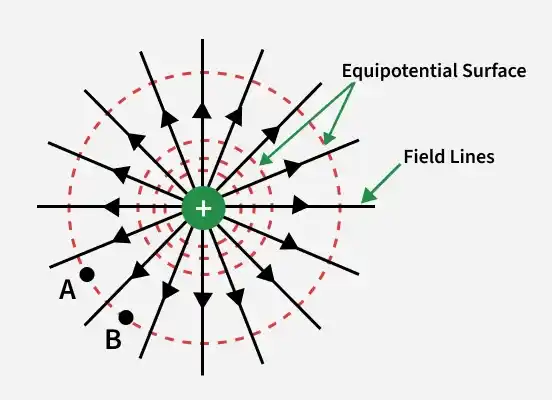
Depending on whether the charge q is positive or negative, the electric field lines either originate from or terminate at the charge and are directed radially. At every point the electric field is normal to the equipotential surface passing through that point. This result is true for any arrangement of charges.
If the electric field were not perpendicular to an equipotential surface, it would have a component along the surface. Work would then be done to move a unit test charge across the surface. This contradicts the definition of an equipotential surface, according to which no work is required to move a test charge between any two points on it. Therefore, the electric field must always be perpendicular to an equipotential surface. Equipotential surfaces thus provide a useful graphical representation complementary to electric field lines.
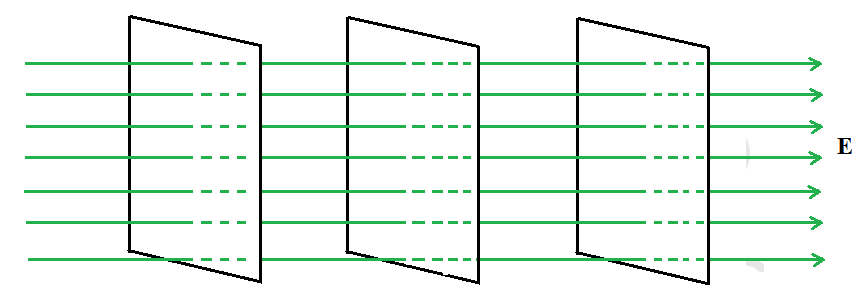
For a uniform electric field E along the x-axis, the equipotential surfaces are planes perpendicular to the x-axis, that is, planes parallel to the y-z plane, as shown in the above figure.
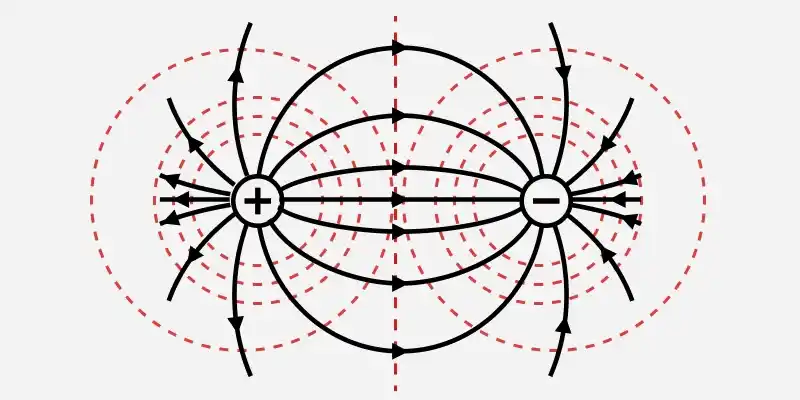
The above figure shows (a) equipotential surfaces for a dipole and (b) equipotential surfaces with two identical positive charges.
Work Done in Equipotential Surface
Moving a charge between two places on an equipotential surface is always zero. In an equipotential surface, if a point charge is transported from point A, having potential energy VA, to point B, having potential energy VB, the work done to move the charge is given by
W = q(VA – VB) = 0
Because VA – VB = 0,
The total work done, W, is 0.
Properties of Equipotential Surface
- The electric field is always perpendicular to an equipotential surface.
- Two equipotential surfaces never intersect each other.
- For a point charge, equipotential surfaces are concentric spherical surfaces.
- In a uniform electric field, equipotential surfaces are planes perpendicular to the field direction.
- The potential inside a hollow charged spherical conductor is constant; therefore, no work is done in moving a charge inside it.
- The spacing between equipotential surfaces indicates the strength of the electric field: closer surfaces → stronger field, wider spacing → weaker field.
Electric Potential
Electric potential is defined as the work done per unit positive charge in bringing it from a reference point, usually infinity, to a given point against the electric field.
When a charge moves against an electric field, it gains energy, known as electric potential energy. The electric potential at a point is equal to the electric potential energy per unit charge. Electric potential is a scalar quantity that does not depend on whether a test charge is actually placed at that point.
For a point charge +q, all points at the same distance r from the charge have the same electric potential.
The electric potential at a point depends on:
- The magnitude of the source charge(s)
- The position of the point relative to other charged objects is important.
Electric Potential Due to a Point Charge
Consider the origin of a point charge Q. Take Q to be positive. With position vector r from the origin, we want to find the potential at any point P. To do so, we must compute the amount of work required to transport a unit positive test charge from infinity to point P. When Q > 0, the work done on the test charge against the repulsive force is positive. We choose a handy path—along the radial direction from infinity to point P—since the work done is independent of the path.
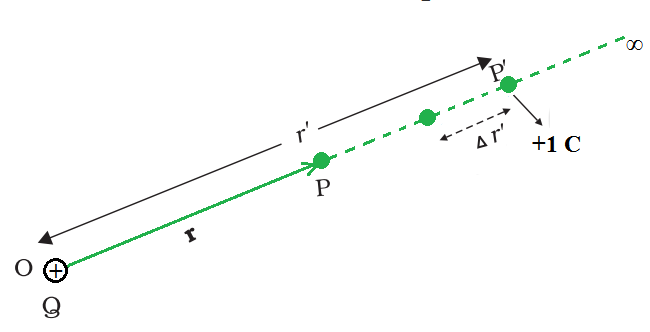
The electrostatic force on a unit positive charge at some intermediate point P′ on the path equals
where '
The negative sign represents ∆r′ < 0, and ∆W is positive. Total work done (W) by the external force is determined by integrating the above equation both side, from r′ = ∞ to r′ = r,
The potential at P due to the charge Q can be expressed as
Sample Problems
Problem 1: Calculate the potential at a point P due to a charge of 4 × 10⁻⁷ C located 9 cm away.
Solution: The potential at P due to the charge Q can be expressed as
V=\frac{Q}{4\pi\epsilon_0r} Substituting the cave in the above expression,
V=9\times10^{-7}\text{ Nm}^2\text{C}^{-2}\times\frac{4\times10^{-7}\text{ C}}{0.09\text{ m}}\\ V=4\times10^{4}\text{ V}
Problem 2: Obtain the work done in bringing a charge of 2 × 10⁻⁹ C from infinity to point P. Does the answer depend on the path along which the charge is brought? (V = 4 × 10⁴ V)
Solution: Given,
q= 2 × 10⁻⁹ C
V= 4 × 10⁴ V
The expression for work don is
W = qV
Substitute the value in the above expression,
W = 2 × 10–9 C × 4 × 104 V
W = 8 × 10⁻⁵ J
No, the work done will be path independent. Any infinitesimal path can be broken down into two perpendicular displacements: one along to r and one perpendicular to r. The work done relation to the latter will be zero.
Problem 3: Determine the electrostatic potential energy of a system consisting of two charges, 7 µC and –2 µC (and with no external field), placed at (–9 cm, 0, 0) and (9 cm, 0, 0), respectively.
Solution: Given,
Two charges 7 µC and –2 µC.
Distance between two points is 0.18 m.
The expression for the electrostatic potential energy is,
U=\frac{1}{4\pi\epsilon_o}\frac{q_1q_2}{r} Substitute the value in the above expression,
U=9\times10^9\times\frac{7\times(-2)\times10^{-12}}{0.18}\\ U= -0.7\text{ J}
Problem 4: 6 A molecule of a substance has a permanent electric dipole moment of magnitude 10–29 C m. A mole of this substance is polarized (at low temperature) by applying a strong electrostatic field of magnitude 106 V m⁻¹. The direction of the field is suddenly changed by an angle of 60 º. Estimate the heat released by the substance in aligning its dipoles along the new direction of the field. For simplicity, assume 100% polarization of the sample.
Solution: Here, dipole moment of each molecule = 10–29 Cm.
As 1 mole of the substance contains 6 × 10²³ molecules.
Electrostatic field of magnitude 106 V m–1.
Total dipole moment of all the molecules can be written as
p = 6 × 1023 × 10–29 Cm
p = 6 × 10⁻⁶ Cm
Initial potential energy, Ui given by
Ui = –pE cos θ
Ui = –6×10–6×106 cos 0°
Ui = –6 J
Final potential energy (when θ = 60°), Uf
Uf = –6 × 10–6 × 106 cos 60°
Uf = –3 J
Change in potential energy = –3 J – (–6 J) = 3 J
So, there is loss in potential energy. This must be the energy released by the substance in the form of heat in aligning its dipoles.
Question 5: Three point charges are placed along a line: q1 = +3 μC, q2 = −2 μC, and q3 = +4 μC. Distances between charges: r12=0.5 m, r23=0.3 m, r13=0.8. Find the total electrostatic potential energy of the system.
Solution: Electrostatic potential energy of two charges
U = \frac{1}{4 \pi \epsilon_0} \frac{q_i q_j}{r_{ij}} Compute each pair
1. q1 and q2
U_{12} = 9 \times 10^9 \frac{(3 \times 10^{-6})(-2 \times 10^{-6})}{0.5} = -0.108\ \text{J} 2. q2 and q3
U_{23} = 9 \times 10^9 \frac{(-2 \times 10^{-6})(4 \times 10^{-6})}{0.3} = -0.24\ \text{J} 3. q1 and q3
U_{13} = 9 \times 10^9 \frac{(3 \times 10^{-6})(4 \times 10^{-6})}{0.8} = 0.135\ \text{J} Total potential energy
U_\text{total} = U_{12} + U_{23} + U_{13} = -0.108 - 0.24 + 0.135 = -0.213\ \text{J}
U_{\text{total}} = -0.213\ \text{J}
Unsolved Problems
Question 1: Three point charges, q1 = 5 μC, q2 = −3 μC, and q3 = 2 μC, are placed at the vertices of a triangle with sides 0.4 m, 0.6 m, and 0.5 m. Calculate the total electrostatic potential energy of the system.
Question 2: A particle with charge q = 10⁻⁶ C is moved from a point where the electric potential is VA = 2000 V to another point where the potential is VB = 500 V. Calculate the work done by the external force in moving the particle.
Question 3: A point charge of q = 3 × 10⁻⁶ C is located at the origin. Calculate the electric potential at a point 0.2 m away from the charge.
Question 4: Two point charges, q1 = 6 μC and q2 = −4 μC, are 0.3 m apart. Calculate the electrostatic potential energy of the system.
Question 5: Two identical point charges, q = 4 μC, are initially 1 m apart in a vacuum. A third charge, Q = −2 μC, is placed midway between them. Calculate the net electric potential at the position of the third charge and the work required to bring it from infinity to that point.