
Friction is the force that opposes the relative motion or the tendency of motion between two surfaces in contact. It acts parallel to the surfaces and opposite to the direction of motion. For example, a rolling football eventually stops due to friction between the ball and the ground.
Friction is a contact force and a non-conservative force. It is essential for activities like walking, writing, gripping objects, and braking vehicles. At the same time, it causes energy loss, heat generation, and wear and tear of machine parts, so it is often called a necessary evil.
- The unit of force Newton (N) or ms-2.
- Its dimensional formula is [MLT-2].
Cause and Factors of Friction
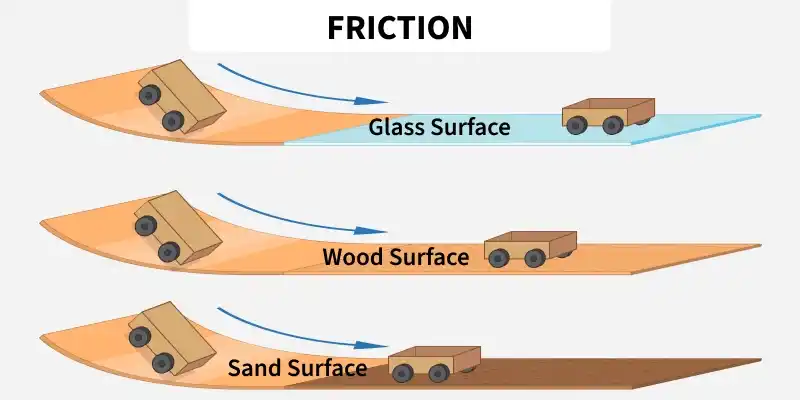
Friction arises due to microscopic irregularities on the surfaces in contact. These irregularities interlock when one surface moves over another, resisting motion.
Friction depends on:
- Nature of surfaces (rough → more friction, smooth → less friction)
- Normal force between the surfaces
Frictional Force and Coefficient of Friction
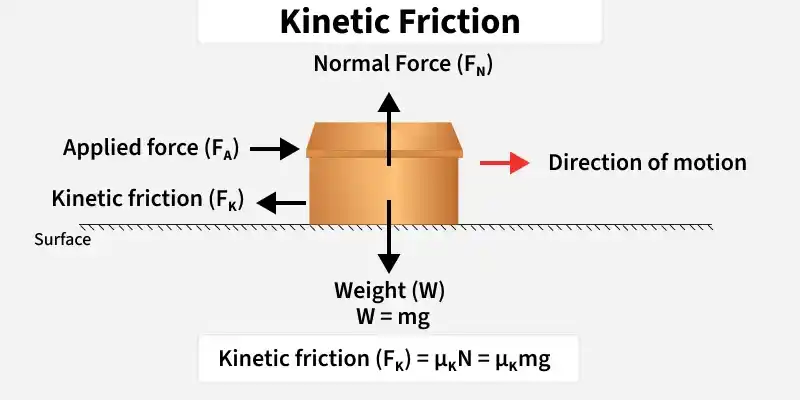
The frictional force is given by:
where μ is the coefficient of friction and (N) is the normal force.
The coefficient of friction is a dimensionless quantity and depends only on the nature of the surfaces.
Types of Friction
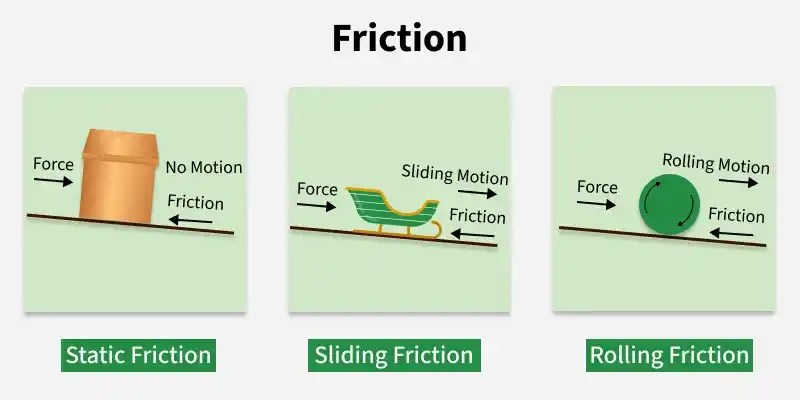
1. Static Friction
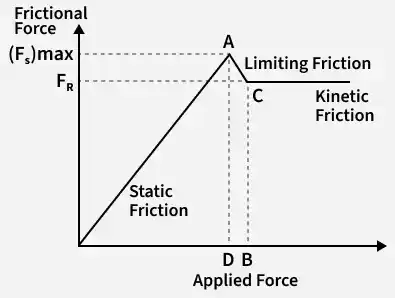
- It acts when the object is at rest and prevents motion up to a maximum value (limiting friction).
- Adjusts itself according to applied force
- Its Value is : 0 ≤ Fs ≤ μsN
- Sliding Friction prevents motion
2. Sliding (Kinetic) Friction
- It acts when surfaces slide over each other and it is less than static friction.
- It is constant in magnitude
- Sliding friction is independent of speed (approx.)
3. Rolling Friction
- Acts when an object rolls and it is the least value among all the solid frictions.
- It is much smaller than sliding friction
- Used in wheels, bearings and other rolling objects.
Laws of Friction
a. Laws of static friction
- The friction force always acts in a direction, opposite to that in which the body tends to move.
- The magnitude of friction force is equal to the external force. F=P
- The ratio of limiting friction (F) and normal reaction (N) is constant. F/N=μ
- The friction force does not depends upon the area of contact between the two surfaces.
- The friction force depends upon the roughness of the surfaces.
b. Laws of dynamic friction
- The friction force always acts in a direction, opposite that in which the body is moving.
- The ratio of limiting friction (F) and normal reaction (N) is constant & it is known as coefficient of friction (μ).
- For moderate speeds, the friction force remains constant. But it decreases slightly with the increase of speed
Effects of Friction
Friction plays an essential role in daily life by enabling activities such as walking, running, and writing. It provides the necessary grip between surfaces. At the same time, friction produces heat and sound and leads to wear and tear of machine parts, which reduces the efficiency and lifespan of mechanical systems.
Applications of Friction
Friction is widely used in practical applications. The working of brakes and clutches in vehicles depends on friction to control motion. Writing with a pen or chalk, lighting a matchstick, holding objects, fixing nails, and power transmission through belts and pulleys are all possible due to frictional force.
Disadvantages of Friction
Despite its usefulness, friction has several disadvantages. It causes loss of energy in the form of heat, leading to reduced efficiency of machines. Continuous friction results in wear and tear of moving parts and may cause overheating of engines, increasing maintenance costs.
Methods to Reduce Friction
Friction can be reduced by using lubricants such as oil and grease, which form a thin layer between surfaces. Polishing surfaces reduces surface irregularities, while ball bearings convert sliding friction into rolling friction. Streamlining objects helps reduce fluid friction when moving through air or liquids.
Fundamental Formulas
1. Coefficient of Friction (𝛍) :-
The ratio of limiting Friction (F) and normal reaction (N) is called coefficient of friction.
2. Normal Reaction (Horizontal Surface) :- N = mg
3. Limiting (Maximum Static) Friction:- F_{\text{max}} = \mu_s.N
The Maximum frictional force that can be developed at the contact surface, when body is just on the point of moving is called limiting force of friction
4. Kinetic (Sliding) Friction:- F_k = \mu_k N
Important:
5. Angle of Friction
The angle of friction is that minimum angle of inclination of the inclined plane at which a body placed at rest on the inclined plane is about to slide down.
- When θ ≤ φ (or tan-1 µs ) the body is in equilibrium.
- When the angle of inclination is more than the angle of friction (θ > φ) the block starts sliding down with acceleration. And, if we wish to keep it in equilibrium an external force has to be applied.
Read More,
Solved Questions
Question 1: A block of mass 5 kg rests on a rough horizontal surface. The coefficient of friction between the block and the surface is μ=0.4 .Find the maximum frictional force that can act on the block. (Take g=10 m/s2)
Solution: Normal reaction, N= mg = 5 × 10=50 N
Limiting friction, fmax= μN = 0.4 × 50=20 N
Question 2: A block of mass 10 kg is placed on a rough horizontal surface. Coefficient of static friction is μs=0.3. Find the minimum force required to just start motion.(Take:- g=10 m/s2)
Solution: Normal reaction, N = mg =10 × 10=100 N
Maximum static friction, fs= μsN = 0.3 × 100=30 N
The applied force must be equal to this to start motion.
Question 3:A block is placed on a rough horizontal surface. An external force of 15 N is applied, but the block does not move. If the maximum static friction is 20 N, find the actual friction acting on the block.
Solution: Static friction adjusts itself to balance the applied force (up to its maximum value).
Since, 15 N < 20 N
Therefore Actual friction, f=15 N
Unsolved Problems
Question 1: Two blocks A and B of masses 3 kg and 2 kg respectively are placed one over the other.The coefficient of friction between the two blocks is 0.4The ground is smooth. Find the maximum horizontal force that can be applied on block A so that block B does not slip.
Question 2: A block of mass 2 kg is placed on a rough inclined plane at an angle of 37° .The coefficient of friction is 0.4 . Find whether the block will move up, move down, or remain at rest.
(sin37° = 0.6 , cos37° = 0.8)