
Viscosity is a fundamental property of fluids that describes their internal resistance to flow. It occurs because of the internal friction between the layers of a fluid as they move past one another.
For example, if three bowls contain water, oil, and honey and are tilted, water flows out fastest while honey flows the slowest. This happens because honey and oil have higher viscosity, meaning they resist flow more, while water has lower viscosity and flows easily.

Viscosity is defined as the measure of the resistance offered by a liquid to its flow. Liquids with low viscosity (like water) flow easily, whereas liquids with high viscosity (like honey) flow slowly and with greater difficulty.
Units and Dimension
- SI unit: pascal–second (Pa·s) or N·s ·m⁻²
- Other unit: Poise (P), centipoise (cP)
- Dimensional formula: ML⁻¹T⁻¹
Viscosity Formula
Viscosity is defined as the ratio of shear stress to the velocity gradient in a fluid, representing the force required to move one layer of fluid over another.
η = \frac{2ga^2(∆ρ)}{9v} where,
- g is Acceleration due to Gravity
- a is Radius of Sphere
- ∆ρ is Density difference between fluid and sphere tested
- v is Velocity of Sphere
Types of Viscosity
Viscosity is classified into two types based on definition:
- Dynamic Viscosity (Absolute Viscosity)
- Kinematic Viscosity
One way is to measure the fluid’s resistance to flow when an external force is applied. This is known as dynamic viscosity. And the other way is to measure the resistance to flow of a fluid under the weight of gravity. We call this measure of fluid viscosity kinematic viscosity.
The Formula for Dynamic Viscosity is given as,
\boxed {Dynamic \ Viscosity = \frac{Shearing \ Stress} {Shearing \ Rate \ Change}}
The Kinematic Viscosity Formula is given as,
\boxed {Kinematic \ Viscosity = \frac{Absolute \ Viscosity}{Density \ of \ the \ Liquid}}
Read More: Dynamic Viscosity and Kinematic Viscosity
Coefficient of Viscosity
According to Newton’s law of viscosity, the viscous drag, between these layers is,
- Directly proportional to area (A) of the layer F ∝ A
- Directly proportional to velocity gradient
\frac{dv}{dx} between the layers F ∝ \frac{dv}{dx}
Therefore, it can be written as
F ∝ A \frac{dv}{dx}
Let's remove the proportionality sign by introducing a proportionality constant. η.
\boxed {F = η A \frac{dv}{dx}}
Here, η is called the coefficient of viscosity.
If A = 1 m2 and dv/dx = 1 s⁻¹, then the above expression becomes:
F = η
Thus, the coefficient of viscosity of a liquid is defined as the viscous drag or force acting per unit area of the layer with a unit velocity gradient that is perpendicular to the direction of the liquid's flow.
Variation of Viscosity
The coefficient of viscosity depends on the following factors:
- Effect of Temperature on Viscosity: The viscosity of liquids decreases with an increase in temperature. The viscosity of gases increases with an increase in temperature, as η ∝ √T.
- Effect of Pressure on Viscosity: The coefficient of viscosity of liquids rises as pressure increases, although there is no relationship to explain the phenomenon thus far.
The table given below lists some fluids and their coefficient of viscosity at different temperatures:
Fluid | Temperature (in °C) | η (deca-poise) |
|---|---|---|
Air | 20 | 0.018 × 10⁻³ |
Water | 0 | 1.8 × 10⁻³ |
20 | 1.0 × 10⁻³ | |
Engine Oil | 30 | 250 × 10⁻³ |
Glycerine | 0 | 10 |
20 | 1.5 |
Newtonian and Non-Newtonian Fluids
Viscosity mainly depends on temperature. Pressure has only a small effect on liquids. So on this basis we have two types of liquid that are,
- Newtonian Fluids
- Non-Newtonian Fluids
1. Newtonian Fluids
Any fluid whose viscosity remains constant when the amount of shear is applied at a constant temperature is called a Newtonian fluid. There is a linear relationship between shear stress and velocity gradient in the case of Newtonian fluid. Examples: Water, alcohol, petroleum, and others.
2. Non-Newtonian Fluids
Non-Newtonian fluids are the opposite of Newtonian fluids, i.e., when applying shear, the viscosity of non-Newtonian fluids changes, depending on the fluid. Examples: Ketchup, Quicksand, Silly Putty, etc.
Measurement of Viscosity
The viscosity of a liquid is often determined by observing the fall of a metal ball through the substance and recording the time it takes for the ball to reach the bottom. A slower fall indicates a higher viscosity. This method doesn't provide an accurate idea of the viscosity, but a more precise measurement is given by the viscometer.
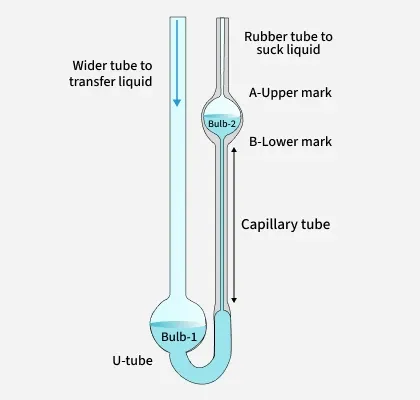
U-Tube Viscometer
A U-tube viscometer, also called an Ostwald or glass capillary viscometer, is used to measure the viscosity of liquids.
It consists of a U-shaped glass tube with two bulbs (reservoirs) connected by a narrow capillary tube. The upper bulb is located above the capillary, and the lower bulb is at the other arm of the tube. Two marked reference points are present above and below the upper bulb to indicate a fixed volume of liquid.
In operation, the liquid is drawn into the upper bulb by suction. It then flows through the capillary tube under gravity. The time taken by the liquid to flow between the two marked points is measured.
The measured flow time is proportional to the kinematic viscosity of the liquid. By multiplying this time with a viscometer constant, the viscosity of the liquid can be determined accurately.
Bernoulli's Theorem
Bernoulli's theorem states that for an incompressible, non-viscous fluid (ideal fluid) flowing through a streamline, the total mechanical energy along the streamlines remains constant. This total energy is the sum of the pressure energy, kinetic energy, and potential energy of the fluid.
For Unit Volume:
P+\frac{1}{2}ρv^2+ρgh=Constant
- P is the pressure at a point in the fluid
- ρ is the density of the fluid
- v is the velocity of the fluid
- g is the gravitational acceleration
- h is the height of the fluid above a reference point
For Unit Mass:
\frac{P}{\rho}+\frac{1}{2}v^2+gh=Constant where,
- P/ρ represents the pressure head, the potential energy per unit mass of the fluid
- v2represents the kinetic energy per unit mass
- gh represents the potential energy per unit mass due to gravity
Read More: Bernoulli’s Principle