
The Doppler shift in sound is the change in observed pitch or frequency caused by the relative motion between the source and the listener. The frequency increases when they move toward each other and decreases when they move apart. By convention, velocities toward each other are taken as positive, which results in a higher perceived frequency.
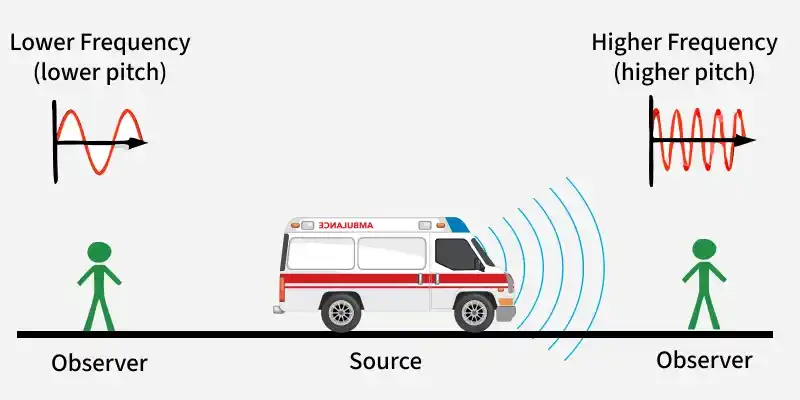
There are two types of Doppler shift observed mainly in electromagnetic waves: red shift and blue shift. Red shift refers to a decrease in observed frequency (increase in wavelength), indicating that the source is moving away from the observer, while blue shift refers to an increase in observed frequency (decrease in wavelength), indicating that the source is moving toward the observer.
Formula
f = f_s\left(\dfrac{v + v_l}{v – v_s}\right) where,
- fs denotes the frequency of the source of the sound
- v denotes the velocity of sound
- vs denotes the velocity of the source
- vL denotes the velocity of listener
Sample Problems
Question 1: An object at 70 m/s is producing a frequency at 100 Hz. Find the frequency of the sound heard by a person in front of the object.
Solution:
Given that,
v = 343 m/s
vs = 70 m/s
fs = 100 Hz
vL = 0 m/s
Therefore, by the formula of Doppler shift:
\begin{aligned}f &= f_s\left(\dfrac{v + v_l}{v – v_s}\right)\\&=100\times \frac{343 + 0}{343 – 70}\\&= 125.64 \text{ Hz}\end{aligned}
Question 2: An object at 90 m/s is producing a frequency at 120 Hz. Find the frequency of the sound heard by a person in front of the object.
Solution:
Given that,
v = 343 m/s
vs = 90 m/s
fs = 120 Hz
vL = 0 m/s
Therefore, by the formula of Doppler shift:
t
\begin{aligned}f &= f_s\left(\dfrac{v + v_l}{v – v_s}\right)\\&=120\times \dfrac{343 + 0}{343 – 90}\\&= 135.57 \text{ Hz}\end{aligned}
Question 3: A sound source emits a frequency of 600 Hz and moves toward a stationary listener at a speed of 20 m/s. Find the frequency heard by the listener. (Velocity of sound = 340 m/s)
Solution:
Given
fs = 600 Hz
vs = 20 m/s
vl = 0
v = 340 m/s
Formula
f = f_s \left( \frac{v + v_l}{v - v_s} \right)
f = \frac{600 \times 340}{340 - 20}
f = \frac{600 \times 340}{320}
f = 637.5 \,\text{Hz}
Question 4: A stationary sound source produces sound of frequency 750 Hz. A listener moves toward the source with a speed of 15 m/s. Calculate the frequency perceived by the listener. (Velocity of sound = 343 m/s)
Solution:
Given
fs = 750Hz
vl = 15m/s
vs = 0
v = 343m/s
f = f_s \left( \frac{v + v_l}{v} \right)
f = \frac{750 \times (343 + 15)}{343}
f = \frac{750 \times 358}{343}
f \approx 782.7 \,\text{Hz}
Unsolved Problems
Question 1: A stationary source emits sound of frequency 700 Hz. An observer moves away from the source with a speed of 10 m/s. Find the frequency heard by the observer. (Velocity of sound = 340 m/s)
Question 2: A sound source of frequency 550 Hz moves away from a stationary observer with a speed of 22 m/s. Calculate the apparent frequency heard. (Velocity of sound = 343 m/s)
Question 3: A source emitting sound of frequency 900 Hz moves in the same direction as the observer with a speed of 25 m/s, while the observer moves at 15 m/s. Find the frequency heard by the observer. (Velocity of sound = 340 m/s)
Question 4: An observer moves toward a source at 12 m/s, while the source moves away from the observer at 18 m/s. If the frequency of the source is 800 Hz, find the observed frequency. (Velocity of sound = 343 m/s)