
Electric potential energy is the energy stored in a system due to the position of charges in an electric field. It is defined as the work done in bringing a charge from infinity to a point in the electric field against the electrostatic force. This energy is stored in the system of charges and can be converted into other forms such as kinetic energy.
| Representation | UE or U |
| Dimensions | ML2T-2 |
| General Formula | UE = kq1q2/r |
| SI Unit | Joules |
Formula
Electric potential energy is the energy stored in a system of two charges due to their separation. It equals the work done in bringing them from infinity to a distance (r) and depends on the magnitude of the charges and their separation.
U = \frac{1}{4\pi \varepsilon_0} \cdot \frac{q_1 q_2}{r} Where:
- U = Electric potential energy of the system
- q1, q2 = Magnitudes of the two point charges
- r = Distance between the two charges
- ε0 = Permittivity of free space
\frac{1}{4\pi \varepsilon_0} = k = Coulomb’s constant
Work and Potential Energy Relationship
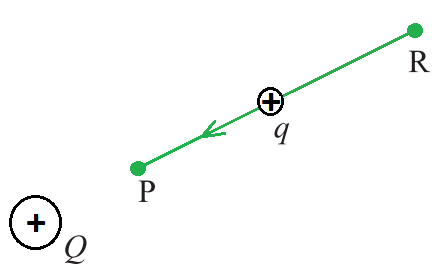
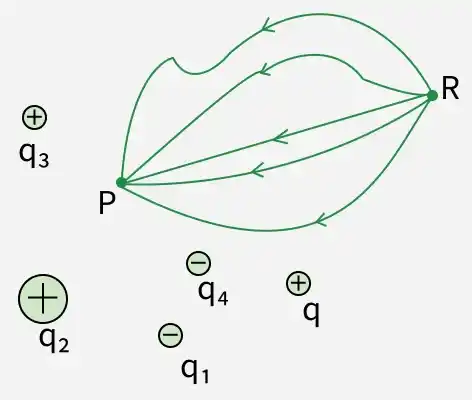
When a charge is moved from point R to point P in an electric field, work is done by an external force against the electrostatic force acting on the charge. If the charge is moved slowly (without acceleration), the external force at every point is equal in magnitude and opposite in direction to the electric force. The small amount of work done in moving the charge through a displacement dr is given by:
Since the external force is opposite to the electric force:
So, the work done becomes:
This work done against the electric field gets stored in the system as electric potential energy. The change in electric potential energy between points R and P is:
Potential Energy of a Point Charge
Consider a point charge (Q) at the origin (Q>0). Electric potential energy at a point (P) is the work done in bringing a unit positive test charge from infinity to (P).
Since Q is positive, it repels the test charge, so external work is required against this force. This work gets stored as electric potential energy. As electrostatic force is conservative, the result is path independent, so we consider radial motion for calculation.
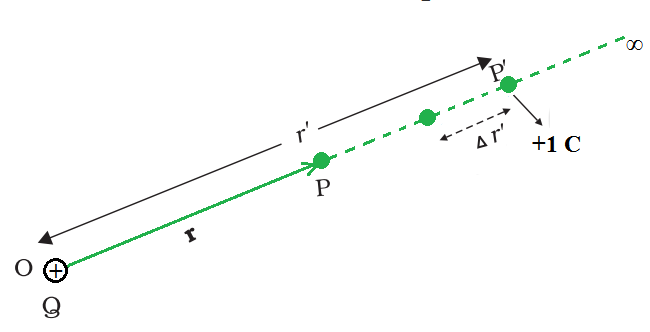
The electrostatic force on a unit positive charge at a distance r′ from Q is:
The small work done in moving the charge through a displacement dr′ is:
The negative sign indicates that the displacement is opposite to the direction of the electrostatic force, but the work done by the external force is positive.
Integrating from infinity to r:
Hence, the electric potential at point P due to charge Q is:
Potential Energy of a System of Charges
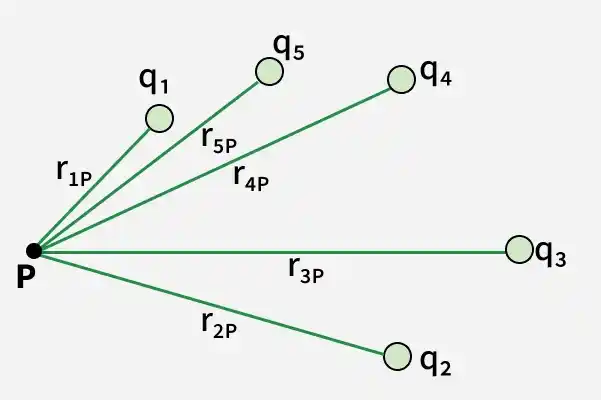
The electric potential at a point due to a system of charges is defined as the work done in bringing a unit positive test charge from infinity to that point in the presence of all charges. Since potential is a scalar quantity, it follows the principle of superposition.
For a system of point charges q1,q2,…,qn each charge contributes its own potential at a point P independently. The total potential is the algebraic sum of these individual potentials.
If r1P, r2P,...., rnP are the distances of point P from the respective charges, then the potential at P is:
For a continuous charge distribution, the system is divided into infinitesimally small charge elements dq. Each element contributes a small potential at point P, and the total potential is obtained by integrating over the entire distribution:
Thus, the potential due to a system of charges depends only on the positions and magnitudes of charges and is independent of the path taken, since electric potential is a scalar quantity.
Electric Potential
Electric potential V is the work done per unit positive charge in bringing it from infinity to a point without acceleration.
Potential difference between two points is:
Electric potential is a scalar quantity and depends only on position in the electric field, not on the test charge used. It is independent of the test charge because electrostatic force is proportional to charge (F = qE), so work done also scales with q.
Its SI unit is volt (V), and dimensional formula is [ML2T-3A-1]
Check: Magnitude of Vector
Electric Potential Difference
Electric potential difference, or voltage, is the work done per unit charge to move a charge from one point to another in an electric field.
It is similar to gravitational potential energy: a ball moves from a higher height to a lower height, creating a difference in energy. Likewise, electric charges move from higher to lower potential, and the energy they possess is called electric potential energy.
A charge at higher potential has more energy, while one at lower potential has less. Electric current naturally flows from higher to lower potential.
The formula for electric potential difference is:
V_{xy} = V_x - V_y = \frac{W_x - W_y}{q}
Electric Potential Derivation
Electric potential at a point is defined as the work done per unit positive charge in bringing a test charge from infinity to that point in an electric field without acceleration.
Using Coulomb’s law:
Substituting and integrating:
Thus, electric potential energy of two point charges is:
Electric Potential of a Point Charge
Electric potential energy of a charge q in the field of a point charge Q at distance r is the work done in bringing q from infinity.
where
System of Charges
For multiple charges Q1,Q2,…,Qn total potential energy is
U = k_e \, q \sum_{i=1}^{n} \frac{Q_i}{r_i} where
- U = total electric potential energy
k_e = \frac{1}{4\pi \varepsilon_0} - q = test charge
- Qi = source charges
- ri = distance between q and each charge Qi
Related Articles:
Solved Questions
Question 1: Suppose you have a 12.0 V motorcycle battery that can move 5000 C of charge and a 12.0 V car battery that can move 60,000 C of charge. How much energy does each deliver?
Solution: Given,
The voltage of the battery is V =12.0 V.
The charge that the motorcycle battery move is Q = 5000 C.
The 12.0 V car battery can move 60,000 C of charge.
When such a battery moves charge, it puts the charge through a potential difference of 12.0 V, and the charge is given a change in potential energy equal to Δ(PE) = qΔV.
For the motorcycle battery, q = 5000 C and ΔV = 12.0 V. The total energy delivered by the motorcycle battery is
ΔPEmotorcycle = (5000 C) × (12.0 V)
ΔPEmotorcycle = 6.00 × 10⁴ J
Now, for the car battery,
ΔPEcar = (60,000 C) × (12.0 V)
ΔPEcar =7.20 × 10⁵ J
Question 2: A particle of mass 40 mg carrying a charge 5 × 10⁻⁹ C is moving directly towards a fixed positive point charge of magnitude 10-8 C. When it is at a distance of 10 cm from the fixed point charge, it has a velocity of 50 cm/s. At what distance from the fixed point charge will the particle come momentarily to rest? Is the acceleration constant during motion?
Solution: Given,
The mass of the particle m = 40 mg.
The charge of the particle Q = 5×10⁻⁹ C.
The fixed positive point charge of magnitude q =10-8 C.
Velocity of the charged particle is v = 50 cm/s = 0.5 m/s
The particle comes to rest momentarily at a distance r from the fixed charge, from conservation of energy we have,
According to the law of conservation of energy, the total energy of the system = Constant
i.e., (K.E. + P.E.) = constant.
The expression for the kinetic energy can be expressed as,
K.E= \frac{1}{2}mu^2 The expression for the potential energy can be expressed as,
Now,
(1/2)mu2 + (1/4πεo) × [Qq/a] = (1/4πεo) × [Qq/r]
(1/2)mu2 = (1/4πεo) [Qq/r - Qq/a]
(1/2)mu2 = (1/4πεo) Qq[1/r - 1/a]
Substituting the values in the above equation,
1/2 × 40 × 10-6 × (0.5)2= 9 × 109 × 10-8 × 5 × 10-9 × [ 1/r – 1/(10 × 10-2)]
or, [1/r – 10] = (5×10⁻⁵)/(9×5×10-8) = 100/9
or, 1/r = (100/9) + 10
or, 1/r = 190/9 m
or r = 4.7 × 10⁻² m
Since, F = [1/4πεo] × [Qq/r2]
Therefore, acceleration = F/m ∝ 1/r2 , i.e., acceleration is not constant during motion.
Question 3: A ball of mass 5 g and charge 10-7 C moves from point A, whose potential is 500 V, to point B, whose potential is zero. What is the velocity of the ball at point A if at point B, it is 25 cm per second?
Solution: Given,
The mass ball is 5 g.
The charge of the particle is 10-7 C.
The potential of ball at point A is 500 V and potential at point B is zero.
Suppose u be the velocity of the ball at point A.
The work done on the charge by the field given by,
W = q × (VA – VB)
Substitute the value in the above expression,
W = 10-7 C× (500 V – 0 V)
W = 5 × 10⁻⁵ J
Therefore,
W = (1/2) mv2 – (1/2) mu2
5 × 10⁻⁵ J= (1/2) × (5/1000 )×[(1/4)2 – u2]
2 × 10-2 = 1/16 – u2
u2 = (1/16) – 0.02
u2 = (1- 0.32)/16
u2 = 0.0425
Therefore, u =0.206 m/s
u = 20.6 cm/s.
Question 4: When a 12.0 V car battery runs a single 30.0 W headlight, how many electrons pass through it each second?
Solution: The expression for the potential energy can be written as,
Δ(PE) = qΔV
Rearrange the above expression,
q = Δ(PE)/ΔV
Substitute the values in the above equation,
q = −30.0 J/ 12.0 V
q = −30.0 J/ 12.0 J/C
q = −2.50 C
The number of electrons n can be calculated as,
n = q/e
n = −2.50 C/(−1.60 × 10−19 C/e)
n = 1.56 × 10¹⁹ electrons
Question 5: How much work is required to be done in order to bring two charges of magnitude 3 C and 5 C from a separation of infinite distance to a separation of 0.5 m?
Solution: Given,
Two charges of magnitude 3 C and 5 C.
The separation between two charges are 0.5 m.
The potential at P due to the charge Q can be expressed as
U_{r} =\frac{Qq}{4\pi\epsilon_0r} ∆U = U0 – Ur
∆U = 0 J – [-(9 × 10⁹ Nm2/C2× 5 C × 3 C)/0.5 m] J = 2.7 × 10¹¹J.
Therefore, ∆U = 2.7 × 10¹¹ J.
Unsolved Problems
Question 1: An electron is moved between two points in an electric field with a potential difference of 120 V.
Find the change in kinetic energy of the electron.
Question 2: A point charge +10 μC is brought from infinity to a point at a distance 0.25 m from another fixed charge +5 μC.
Calculate the work done by the electric field.
Question 3: A particle of charge 2 × 10⁻⁸ C enters a region of uniform electric potential such that its potential decreases linearly from 400 V to 100 V over a distance of 0.60 m. Find the electric force acting on the charge.
Question 4: Two identical charges +q are fixed at a distance 2a apart. A third charge −q is placed at the midpoint and released.
Determine the initial acceleration of the middle charge.
Question 5: A charged particle is projected with speed v₀ towards a fixed positive charge Q. The particle comes to rest at a distance r from Q. Express v₀ in terms of Q, q, r, m, and fundamental constants using energy conservation.