
Electrostatics is a field of physics that studies the phenomena and behaviours of stationary or slow-moving electric charges. Coulomb's law describes electrostatic processes, which result from the forces that electric charges apply to one another, even if the forces generated by electrostatics appear to be rather small.
Electrostatic forces are non-contact forces that can push or pull on items without coming into contact with them. A storm cloud's internal accumulation of static electricity produces lightning.
Examples of Electrostatic Phenomena are:
- A balloon rubbing hair
- The shock of touching a doorknob after crossing a carpet
- An electric balloon adhering to a wall
- A charged comb that gathers tiny bits of paper
- rubbing nylon clothing against flesh or other materials
Electric Charge
Electric charge is a fundamental property of matter that determines how it interacts with electromagnetic fields. When charges are stationary, they produce an electric field around them, and when in motion, they produce a magnetic field as well. Electric charge comes in two types: positive and negative. Like charges repel, whereas unlike charges attract.

Basic Properties of Electric Charge
Electric charge possesses three fundamental properties:
- Quantization: Electric charge is quantized, meaning charges are always found in integer multiples of the elementary charge(e), i.e., q=ne where n I. Elementary charge is the charge of an electron, approximately -1.602 x 10⁻¹⁹coulombs (C).
- Conservation: The total electric charge in an isolated system remains constant over time. Charge cannot be created or destroyed, only transferred from one object to another. This principle is known as the conservation of electric charge.
- Additivity: The total charge of a system is the algebraic sum(considering the correct sign) of the individual charges within it.
Types of Charged Particles
There are primarily two types of charged particles which are discussed below:
1. Positively Charged Particles
Protons are the positively charged particles that are found in the nucleus of an atom. Protons have a mass of about 1 u. A particle gain positive charge when it lose electrons.
2. Negatively Charged Particles
Electrons are Negatively charged subatomic particles that surround the nucleus of an atom. Electrons have a much smaller mass of about 0.0005u. Electrons are located outside the nucleus in the outermost regions of the atom, called electron shells. A particle gain negative charge when its gains electron from other particle
After from positive and negatively charged particles, there are neutral particles which are discussed below:
3. Neutral Particles
Neutrons are Neutral subatomic particles that are also found in the nucleus of an atom. Neutrons have a mass of about 1 u.
Coulomb’s law
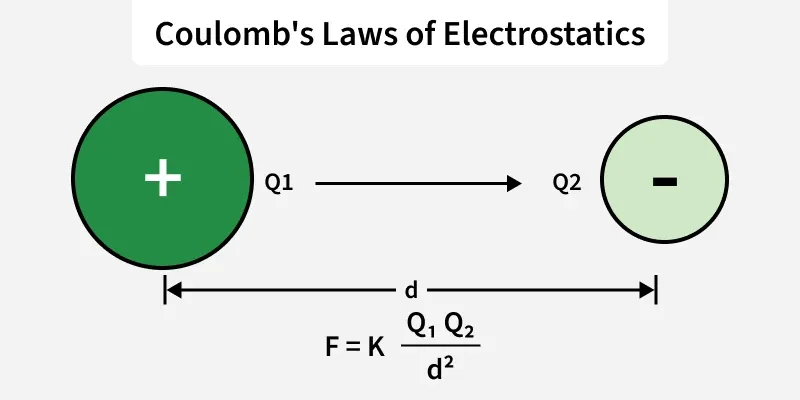
Coulomb's law states that the magnitude of the electrostatic force F between two point charges q1 and q2 is directly proportional to the product of the magnitudes of the charges and inversely proportional to the square of the distance between their centers. Mathematically, Coulomb's law is expressed as:
\boxed{F= \frac{1}{4 \pi \epsilon_{o}}.\frac{q_{1}q_{2}}{r^2 }}
F= \frac{k.q_{1}.q_{2}}{r^2 } where
- k= Coulombs Constant =
\frac{1}{4 \pi \epsilon_{o}} = =9 x 10⁹ N.m2/C2- r is the distance between two charges
Superposition Principle
Total force exerted on a charged particle by multiple charged particles is the vector sum of the forces exerted by each individual particle. This principle holds true because the electrostatic force obeys Coulomb's law, which is a linear relationship.
Electric Field
The electric field at a given point is defined as the force per unit charge experienced by a small positive test charge q0 placed at that point. Mathematically, the electric field E due to a point charge q is given by:
\boxed{E=\frac{F}{q}= \frac{1}{4 \pi \epsilon_{o}}.\frac{q}{r^2 }}\hspace{1.5mm} \hat r
F= \frac{k.q}{r^2}\hspace{1.5mm} \hat r
The electric field emanates radially outward when q is positive, and conversely, it converges radially inward when q is negative.
Electric Field Lines
These are imaginary lines drawn in a way that the tangent at any given point on the line represents the direction of the electric field at that point. Some key characteristics of field lines include:
- They form continuous unbroken curves.
- They never intersect.
- They extend from positive to negative charges, there can be no closed loops.
Electric Flux
Electric flux quantifies the number of electric field lines passing through a surface. Mathematically, electric flux through a surface S is defined as the surface integral of the electric field E over the surface:
ΦE = ∫S E.dA
The dot product indicates the projection of the electric field vector onto the area vector.
The SI unit of electric flux is Nm2 C-1.
Electric Dipole
An electric dipole consists of two equal and opposite electric charges separated by a distance. These charges create an electric field around the dipole. The magnitude of the electric dipole moment, denoted by p, is the product of the magnitude of either charge q and the separation distance 2a between them:
\overrightarrow{\rm p}=q \times 2a = 2qa where
- q= Electric Charge
- 2a= Distance between the Charges
1. Electric Field Along Equator of Dipole
The derivation of electric field along equator of dipole is shown below:
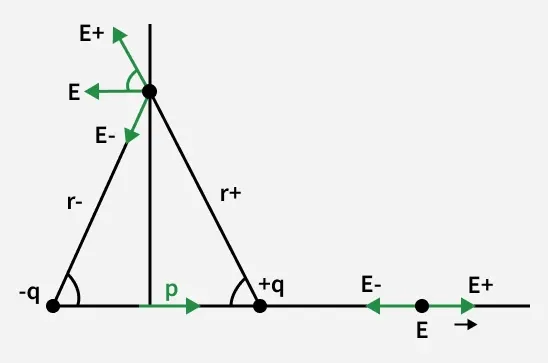
Resolving E into horizontal and vertical components. The vertical components (E sin θ) strike off each other. Therefore the electric field at A is 2 E cos θ.
Where E = q/4πε0( a2+r2)
EA = 2q/4πε0( a2+r2) cos θ
From figure ,
cos θ = a/√(a2+r2)
EA = 2qa / 4πε0( a2+r2)3/2
We know Dipole moment p = 2qa
EA = (-p/4πε0) (1/(a2+r2)3/2
For r >> a
E = -p/4πε0r3
2. Electric Field Along Axis of Dipole
The derivation of electric field along axis of dipole is discussed below:
AB is electric dipole of two point charges -q, +q separated by a distance 2d.
Electric field at P due to +q at B,
E1 = q / 4πε0 (r - d)2
Electric field at P due to -q at A,
E2 = q / 4πε0 (r + d)2
Resultant electric field, E = E1 - E2
E = q / 4πε0 [ 1/(r - d)2 - 1/(r + d)2]
E = q / 4πε0 [4rd/ (r2 - d2)2]
Since point P is far away from the dipole, then r>>d
E = 4qrd / 4πε0 r4
E = 4qd / 4πε0 r3
We know Dipole moment p = 2qd
E= 2p/4πε0r3
Point to be noted : Electric field for dipole varies as 1/r3 not 1/r2.
Gauss’ law
Gauss’ law for electrostatics states that the total electric flux through a closed surface is proportional to the enclosed electric charge. This includes the bound charge due to polarization. The coefficient of proportionality is the reciprocal of the permittivity of free space(ε0). Mathematically, this can be expressed as
∮E.ds = Q/ε0
Where E is the electric field, ds is the infinitesimal area element and the closed integral of E over ds gives the electric flux. Important points to be noted: the area must be of a closed surface, the charge considered must be the charge enclosed by this surface.
Conductors, Insulators, and Semiconductors
● Conductors: Conductors are materials with low electrical resistivity, strong electrical conductivity, and ease of electricity conductivity. Charge can flow across conductors when a voltage is supplied to them.
● Semiconductors: Semiconductors are materials with a conductivity value in between that of an insulator and a conductor. When required, semiconductors can function as both a conductor and an insulator.
● Insulators : Insulators are materials that don't conduct electricity. Current cannot flow through insulators. Insulators are used to shield ourselves from the potentially harmful effects of electricity passing via conductors.
Dielectric Strength
Dielectric strength refers to an insulating material's electrical strength. It is the highest electric field that a substance is capable of withstanding before degrading and turning electrically conductive.
Electric Potential (V) and Electric Potential Energy (U)
Electric potential at a point is the work done in bringing a unit positive charge from infinity to that point against the electric field. It is a scalar quantity, denoted by V , and given by:
\boxed{U = \frac{1}{4 \pi \epsilon_{o}}.\frac{q}{r }}
The Electric Potential energy U of a system of two point charges is defined as the work required to assemble the configuration and is:
\boxed{U = \frac{1}{4 \pi \epsilon_{o}}.\frac{q_{1}.q_{2}}{r }}
Equipotential Surface
An equipotential surface is a region in space where all points have the same potential. Although it is typically used in reference to scalar potentials, vector potentials can also be considered.
Combined Field Due to Two Point Charges
If there are many source charges, each contributes to the electric field at every site in their area. The electric field at a point in space close to the source charges is the vector sum of the electric fields caused by each source charge. Assume that the set of source charges consists of two charged particles. The electric field vector resulting from the first charged particle plus the electric field vector resulting from the second charged particle equals the electric field at point P.
Determining the overall electric field at place P is a vector addition since the two electric field vectors that contribute to it are vectors.
Therefore, the electric field intensity at each point resulting from a system or group of charges is equal to the vector sum of the electric field intensities attributable to individual charges at the same site. The vector sum of electric field intensities is given by E=E1+E2+E3+..+En.
Electric Lines of Force
Electric lines of force are imaginary lines or curves formed across an electric field. The direction that a tiny free positive charge will go along a line of force is known as its direction. Since two tangents can be traced to the two lines of force at the intersection, electric lines of force never cross. This indicates that there will be two electric field directions at the intersection, which is not feasible.
Formulae Table
The important formulas required in Electrostatics are as follows:
Name of formulas | Formula |
|---|---|
Coulombs force between two-point charges | F = {1/4πε0} (q1q2/r2) where, k= 1/4πε0 = 9 x 10⁹ Nm2/C2 q1 and q2 are the charges separated by a distance r |
Electric field | E = {1/4πε0}(q/r2) The electric field separated from the charge q by a distance r |
Electric field Intensity | E= F/q where F is the force that the electric field E exerts on the charge q. |
Electrostatic Energy | U = {1/4πε0}(q1q2/r) where q1 and q2 are the charges separated by a distance r |
Electric Potential | V = 1/4πε0(q/r) |
Electric Dipole Moment | p = 2qa It is calculated by multiplying a charge (q) by the separation distance (2a) |
Electric Field Along Equator of Dipole | E= -p/4πε0r3 where p is electric dipole moment, r denotes the distance |
Electric Field Along Axis of Dipole | E= 2p/4πε0r3 where p is electric dipole moment, r denotes the distance |
Some Misconceptions in Electrostatics
- Confusing electric field with electric potential
- Applying formulas for point charges to extended charge distributions
- Mixing concepts of static and current electricity
- Neglecting the direction or sign of vectors
Related Articles:
Solved Examples on Electrostatics
Example 1: Consider a sphere of radius R with a total charge Q uniformly distributed throughout its volume. Find the electric field inside the sphere.
Solution: We'll use Gauss's law to find the electric field.
Consider a Gaussian surface in the form of a sphere with radius r, where r < R .
According to Gauss's law, the electric flux through this surface is:
Φ = E.4πr2
The total charge enclosed by this Gaussian surface is density of charge times the volume inside sphere with radius r
q = Q/(4/3πR3) × 4/3 πr3=Qr3/R3
Therefore, Gauss's law gives us:
E.4πr2 = q/ε0 = Qr3/ε0R3
The electric field becomes
E = Q r/4πε0R3
Example 2: Two point charges, q1 = +3C and q2 = -6C, are placed 10 cm apart in air. Calculate the magnitude of the electric force between them.
Solution: Given:
q1 = +3C and q2 = -6C
r = 10 cm = 0.1 m
Using Coulomb’s law
F = k |q1q2|/r2
Substituting the given values:
F = 9 × 109 × 18 × 10-12/ (0.1)2 = 16200 N
Therefore, the magnitude of the electric force between the two charges is 16200 N.
Example 3: An electric dipole consists of q=4 C, separated by a distance of 10 cm. Calculate the electric dipole moment and the electric field at a point 2 m away from the centre of the dipole along its axis.
Solution: Given:
q = +4C and -q = -4C
2a = 10 cm = 0.1 m
The electric dipole moment is
p = 4 × 10⁻⁷ C.m
For the electric field at a point along the axis of the dipole, we can use the case r>>a
E=2p/4πε0r3= 9 × 109 × 8 × 10-7 /8 = 900 N/C
Example 4: For the above problem, calculate the electric field at a point 2 m away from the centre of the dipole along its equator.
Solution: For this we use the formula :
E= -p/ 4π0r3= -450 N/C
Therefore, the magnitude of the electric field is 450 N/C.
Unsolved Questions
Question 1. A point charge Q = +4μC is located at the centre of a spherical Gaussian surface of radius r=0.1m. Calculate the electric flux through the Gaussian surface.
Question 2: Consider a uniform electric field E = 2×10³ N/C directed along the positive x-axis. Determine the total charge enclosed by a cylindrical Gaussian surface of radius r=0.05m and height h = 0.2m centred at the origin.
Question 3. Two point charges, q1 = +4C and q2 = -3C, are placed 5cm apart in air. Calculate the magnitude of the electric force between them.
Question 4. The charges, q1 = +5C, q2 = -3C, q3 = +7C are placed at the vertices of an equilateral triangle of side length 15 cm. Calculate the magnitude and direction of the net electric force on each.
Question 5. An electric dipole consists of q=2C, separated by a distance of 10 cm. Calculate the electric dipole moment and the electric field at a point 20 cm away from the centre of the dipole along its axis.