
Wave motion is the propagation of a disturbance that transfers energy and momentum from one point to another through a material medium or even through a vacuum, without causing any permanent displacement of the particles of the medium. In wave motion, the particles of the medium only oscillate about their mean positions, while the disturbance moves forward.
Depending on the nature of the wave, it may propagate through solids, liquids, gases, or even a vacuum. Examples of wave motion include sound waves, light waves, ocean waves, seismic waves, electromagnetic waves, and matter waves.
Classification of Wave Motion
Waves can be classified into various types based on different parameters. The main classification parameters are described below:
- Classification Based on Medium of Propagation
- Classification based on the Motion of Wave in a Space
- Classification Based on Transfer of Energy
A. Classification Based on Motion of Wave in Space
The waves are classified into three types based on the motion of the wave in a space. They are as follows:
- One-Dimensional waves
- Two-Dimensional waves
- Three-Dimensional waves
Wave Type | Definition | Example |
|---|---|---|
One-Dimensional waves | A wave that moves in only one dimension is called a "one-dimensional wave." | These waves are produced in a string. |
Two-Dimensional waves | The wave that moves in a plane is called a two-dimensional wave. | Ripple in water. |
Three-Dimensional waves | The wave that moves in a three-dimensional space is called a three-dimensional wave. | Propagation of light and sound waves. |
B. Classification Based on Medium of Propagation
Waves are classified into three types based on the requirement of a medium. They are as follows:
- Mechanical waves
- Electromagnetic waves
- Matter waves.
1. Mechanical Waves
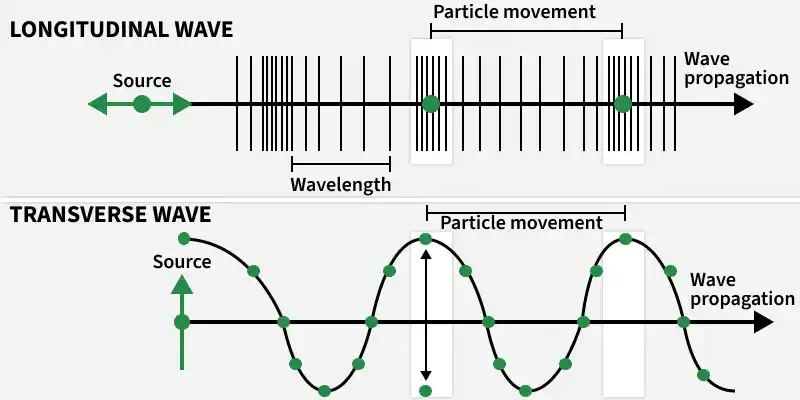
A mechanical wave is a disturbance in matter that transfers energy through the material medium (solid, liquid, or gas). Mechanical waves cannot propagate in a vacuum. Mechanical waves can travel in air, water, and solid Earth. Mechanical waves are classified into three types, which are:
- Longitudinal waves
- Transverse waves and
- Surface waves.
Mechanical waves carry or transport energy like all other waves. The directions of energy propagation and mechanical wave propagation are the same.
2. Electromagnetic/ Non-mechanical waves
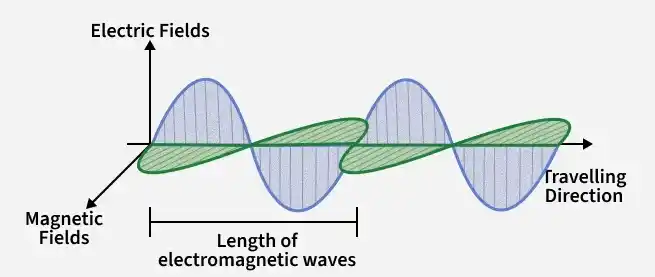
They are waves that do not require a material medium for their propagation and can travel through a vacuum. They are produced by accelerating electric charges. In an electromagnetic wave, the electric field and magnetic field oscillate perpendicular to each other, and both are perpendicular to the direction of wave propagation.
These waves are further classified into the following:
- Radio Waves
- Microwaves
- Infrared Waves
- Visible Light
- Ultraviolet Waves
- X-rays
- Gamma Rays
C. Classification Based on Transfer of Energy
Depending upon the transfer of energy, waves are classified into two types. These are -
- Progressive waves
- Stationary waves
1. Progressive Wave
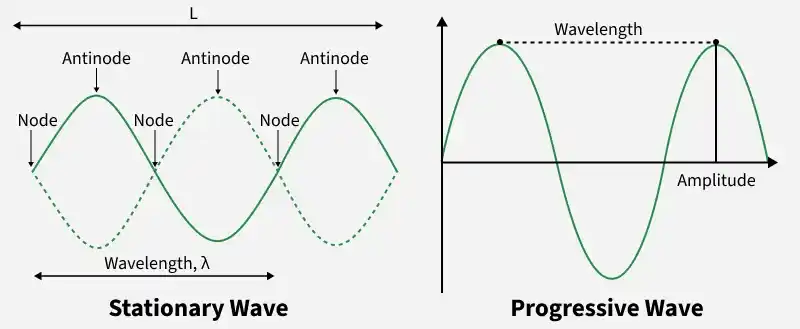
A progressive wave travels continuously in a certain direction in a medium. A progressive wave is also known as a traveling wave. In an infinite or unbounded medium, the progressive wave travels in a particular direction, transferring energy and momentum between the particles of that medium.
2. Stationary Waves or Standing Waves
Stationary waves are produced when two similar waves with the same amplitudes and wavelengths travel in the same straight line but in opposite directions and collide with each other. They appear stationary, with nodes (points of zero amplitude) and antinodes (points of maximum amplitude).
Types of Waves
Apart from the other discussed classifications of waves, some other types of waves are illustrated in the table below:
Wave Type | Definition | Example |
|---|---|---|
Periodic Wave | Periodic Wave waves repeat their pattern of oscillation regularly over time. | Sine waves and Square waves. |
Non-periodic Wave | Non-periodic Wave does not repeat their pattern of oscillation regularly over time. | Transient signals and Noise. |
Transverse Wave | In transverse waves, the particles of the medium oscillate perpendicular to the direction of wave propagation | Light waves and waves on a string. |
In longitudinal waves, the particles of the medium oscillate parallel to the direction of wave propagation. | Sound waves and Seismic waves. | |
Surface Wave | Surface Waves travel along the boundary between two different media. | Surface of a water wave. |
Linear Wave | Linear waves follow the principle of superposition, where the combined effect of multiple waves is the algebraic sum of their individual effects | Light Waves in a Homogeneous Medium. |
Non-linear Wave | Non-linear waves that do not obey the principle of superposition and can exhibit complex behaviors. | Shock Waves. |
Also Check, Types of Wave
Wave Motion Characteristics
- In a medium the particles vibrate their mean positions. The particles of the medium do not move.
- It travels at the same speed in all directions in a medium.
- The speed of a wave motion depends upon the nature of the medium through which it moves.
- Energy, pressure, momentum, etc., are transferred from one point of the medium to another point. During this transfer, there has been no movement in the matter.
A few other characteristics of wave motion are explained below:
- Amplitude
- Period
- Wavelength
- Frequency
- Wave velocity
1. Amplitude (A)
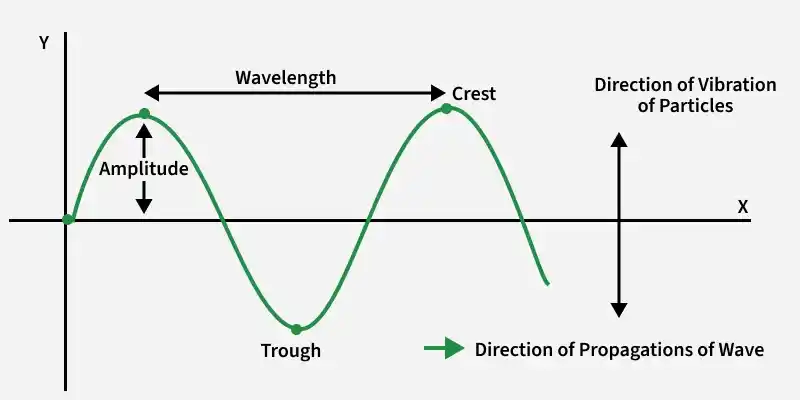
The amplitude of a wave is the maximum displacement of any particle of the medium from its original or mean position. For describing the size of a wave, amplitude is used. It is denoted by the letter A, and its SI unit is meter (m).
2. Period (T)
The period of a wave is the time taken by two consecutive rarefactions or compressions to reach a fixed point, or in other words, any particle of the medium to complete one vibration or oscillation during a period (T). Time period is denoted by the letter T, and its SI unit is the second (S). Time period is inversely proportional to frequency.
\text{Time Period} = \frac{1}{\text{Frequency}}
3. Wavelength (λ)
Wavelength is the length between two consecutive compressions or rarefactions. Wavelength is denoted by lambda, and its SI unit is meter (m).
4. Frequency (f)
Frequency is the number of vibrations made per second by any particles of the medium (f = 1/T). The frequency of a wave does not change with a change in medium. Its SI unit is hertz (Hz).
6. Wave Velocity (v)
Distance travelled by a wave in 1 second is called wave velocity. It defines the speed of the wave. It is denoted by the letter v. Its SI unit is meter per second (m/s or ms-1).
Important Terms Related to Wave Motion
The following important terms are related to wave motion. These terms are
- Reflection
- Refraction
- Intensity
- Angular Frequency
- Time Difference
1. Reflection
Reflection is an important property of wave motion that is displayed by visible light. Reflection arises when the light, which is travelling through a specific medium, is incident onto a boundary between two media, and the light ‘bounces’ off the boundary or changes direction upon striking this boundary and moves on in the initial medium.
2. Refraction
Refraction is another important property of wave motion that is exhibited by visible light. It comes when light rays move from one medium to another medium, and for this, it changes direction and speed. Refraction can happen in sound waves, water waves, and other waves along with light waves.
It is possible for us to have lenses, magnifying glasses, prisms, and rainbows because of the bending property of refraction. Even our eyes depend upon the bending property of light refraction. We wouldn't be able to focus light onto our retina without refraction of light.
3. Intensity
The intensity of a wave is the energy carried by a wave per unit time across a unit area surface. The SI unit of intensity is watts per square meter (W/m²). The intensity of a wave is the property that is proportional to the square of its amplitude.
For example, the intensity of an electromagnetic wave is proportional to the square of the wave's electric field amplitude.
4. Interference
Interference is a phenomenon that occurs when two or more waves meet at the same point in space and time. It results from the superposition of wave patterns, where the waves combine to form a resultant wave. Interference is of two types - constructive and destructive interference.
5. Angular Frequency
Angular frequency is the rate at which the change in rotation takes place or the rate at which change in the sinusoidal waves occurs. In other words, we can define angular frequency as the angular displacement of an element of a wave per unit time.
The SI unit of angular frequency is radian per second and the equation of angular frequency can be written as,
\boxed{\omega = 2\pi f} where,
- ω = angular Frequency and
- f = frequency
6. Time Difference (ΔT)
Time difference means the time taken to travel from one point to another by the wave through the medium.
Related Articles:
Solved Problems
Question 1: A wave travels a distance of 450 m in 0.75 s. Find the frequency of the wave if its wavelength is 3 m.
Solution:
v=\frac{450}{0.75}
= 600 m/s
f=\frac{v}{λ}
=\frac{600}{3}
= 200 Hz
Question 2: The frequency of a wave is 80 Hz. How much distance will the wave travel in 5 s if its wavelength is 2.5 m?
Solution:
v=fλ
=80×2.5
=200 m/s
Distance=vt
=200×5
=1000 m
Question 3: A wave has a time period of 0.004 s and travels a distance of 170 m in 0.5 s. Find its wavelength.
Solution:
f=\frac{1}{T}
= \frac{1}{0.004}
=250 Hz
v=\frac{170}{0.5}
= 340m/s
λ=\frac{v}{f}
=\frac{340}{250}
=1.36m
Question 4: A wave covers 600 m in 2 s. If the frequency is doubled, find the new wavelength.
Solution:
v =\frac{600}{2}
=300m/s
Original frequency = 𝑓 Original Wavelength:
λ=\frac{v}{f} new Frequency = 2f
λ′=\frac{v}{2f}=\frac{λ}{2} New wavelength becomes half of the original wavelength.
Question 5: A wave travels with a speed of 480 m/s. If the time period is decreased from 0.02 s to 0.01 s, find the change in wavelength.
Solution: Initial frequency:
f_1=\frac{1}{0.02} = 50Hz Initial wavelength:
λ_1 = \frac{480}{50} = 9.6 m Final Frequency:
f_2 = \frac{1}{0.01} Final Wavelength:
λ_2 = \frac{480}{100} = 4.8m Change in wavelength = 9.6 − 4.8 = 4.8 m
Unsolved Problems
Question 1: A wave has a frequency of 120 Hz and a wavelength of 2.5 m. Find the speed of the wave.
Question 2: The time period of a wave is 0.04 s. Calculate its frequency and the number of oscillations completed in 10 s.
Question 3: A sound wave travels a distance of 680 m in 2 s. Find its wavelength if the frequency of the wave is 170 Hz.
Question 4: A wave travels with a speed of 360 m/s. Its time period is reduced from 0.02 s to 0.01 s. Find the change in wavelength.
Question 5: A wave travels 900 m in 3 s. If its frequency is increased by 50% without changing the speed, find the new wavelength.