
The potential due to an electric dipole at a point in space is the electric potential energy per unit charge that a test charge would experience at that point due to the dipole. Electric potential is defined as the amount of work required to move a positive unit charge from a reference point to a given point in an electric field without producing any acceleration.
Electric Potential
Electric potential describes the amount of electric potential energy per unit charge at a point in space. It is measured in volts. It represents the work needed to move a positive electric charge from a reference point to a specific point in the field, without producing any acceleration. It indicates how much potential energy a unit charge would gain or lose moving toward that point in the field.
Electric Dipole and Dipole Moment
An electric dipole is a pair of charges of equal magnitude but opposite signs, separated by a small distance. Theoretically, an electric dipole is defined by the first-order term of the multiple expansion. It consists of two equal and opposite charges that are infinitesimally close together, although real dipoles have separate charges.
The dipole moment is a measure of the polarity of a molecule. It is the product of the partial charge (q) magnitude and the distance (d) between them. The SI unit for an electric dipole moment is a coulomb meter (C⋅m). Another unit is debye (D), where 1D = 3.33 × 10⁻³⁰ cm.
Potential due to an Electric Dipole
The electric potential is the work required to move a unit of positive charge from a reference point to a particular point within an electric field having no acceleration. A dipole is referred to as a pair of opposite charges having equal magnitudes that are separated by a distance (d).
Electric potential (V) at a point due to an electric dipole is given by the following expression:
V = \frac{k\,p\cos\theta}{r^2}
where
k = \frac{1}{4\pi\epsilon_\omicron}=9 \times 10^9 \frac {N m^2}{C^2 } , k is Coulomb's constant- p is the magnitude of electric dipole, given by p = q.d
- θ is the angle between the dipole moment vector p and the position vector r.
This formula tells us that the electric potential due to an electric dipole decreases with the square of the distance r and depends on the angle between the dipole moment and the position vector.
Proof of Potential due to an Electric Dipole
Let us consider an electric dipole consisting of two equal and opposite point charges -q at A and +q at B, separated by a small distance AB = 2a, with center at O.
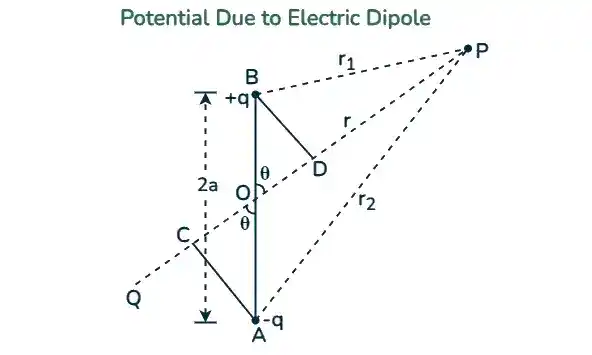
Dipole moment, p = q×2a
We will calculate potential at any point P, where
OP = r and ∠BOP = θ
Let BP = r1 and AP = r2
Draw AC perpendicular PQ and BD perpendicular PO
In ΔAOC, cos θ = OC/OA = OC/a
OC = acosθ
Similarly, OD = acosθ
Potential at P due to +q = 1/4πϵ0.qr2
Potential at P due to -q = 1/4πϵ0.qr1
The net potential at point P is due to the dipole.
V = 1/4πϵ0(q/r2 − q/r1)
V = q/4πϵ0(1/r2 − 1/r1)
Now, r1 = AP = CP
r1 = OP + OC
r1 = r + acosθ
And r2 = BP = DP
r2 = OP – OD
r2 = r - acosθ
where,
- k is Coulomb Constant and is given as
k = 1/4\pi\epsilon_\omicron - p is dipole moment given as p = 2aq
Special Cases
Case 1: When the point P lies on the axial line of the dipole, θ=0∘ , cos θ = 1
V = \frac{p}{r^2 - a^2}
\text{If } a \ll r \Rightarrow V = \frac{k p}{r^2}
Thus, due to an electric dipole, potential, V∝ 1/r2
Case 2: When the point P lies on the equatorial line of the dipole, θ = 90∘, cosθ = 0
This means electric potential due to an electric dipole is zero at every point on the equatorial line of the dipole.
This expression provides a mathematical description of how the electric potential varies around an electric dipole. It is fundamental in understanding the behavior of electric fields and potentials in dipole systems.
Solved Examples
Question 1: An electric dipole has a dipole moment p = 4 × 10-30 Cm. Find the electric potential at a point on its axial line at a distance r = 0.2 m from the centre of the dipole. (Note: k = 9 × 10⁹ N m2/C2).
Solution: Axial line,
V = \frac{k p}{r^2}
V = \frac{(9 \times 10^{9})(4 \times 10^{-30})}{(0.2)^2}
V = \frac{36 \times 10^{-21}}{0.04}
V = \frac{36 \times 10^{-21}}{0.04}
V = 9 \times 10^{-20}\,\text{V}
Question 2: Find the electric potential at a point on the equatorial line of an electric dipole.
Solution: Equatorial line
\theta = 90^\circ \Rightarrow \cos\theta = 0
V = \frac{k p \cos\theta}{r^2}
V = \frac{k p (0)}{r^2} = 0
V = 0
Question 3: Two charges +2nC and −2 nC, are separated by 4 cm. Find the potential at a point on the axial line at a distance of 20 cm from the centre.
Solution: Dipole moment
p = q \cdot d
p = (2 \times 10^{-9}) \cdot 0.04
p = 8 \times 10^{-11}\,\text{C m}
V = \frac{k p}{r^2}
V = \frac{(9 \times 10^{9})(8 \times 10^{-11})}{(0.2)^2}
V = \frac{72 \times 10^{-2}}{0.04}
V = 18\,\text{V}
Question 4: The dipole moment of an electric dipole is 6×10-30 Cm. Find the potential at a point 0.3 m away, making an angle 60o with the dipole axis.
Solution:
V = \frac{k p \cos \theta}{r^2}
\cos 60^\circ = \frac{1}{2}
V = \frac{(9 \times 10^9)(6 \times 10^{-30})(1/2)}{(0.3)^2}
V = \frac{27 \times 10^{-21}}{0.09}
V = 3 \times 10^{-20}\, \text{V}
Unsolved Problems
Question 1: An electric dipole has a dipole moment p=5×10⁻³⁰ C m. Find the potential at a point on its axial line at a distance r=0.25 m from the centre.
Question 2: A dipole has charges of ±2 nC separated by 5 cm. Find the potential at a point on the axial line r=1 m from the center, assuming a≪r.
Question 3: Two charges +1.5 nC and −1.5 nC are separated by 3 cm. Find the potential at a point on the axial line at a distance of 0.1 m from the centre.
Question 4: Two charges +3 nC and −3 nC are separated by 2 cm. Find the potential at a point on the axial line at r=0.05 m from the centre using the exact formula (not the approximation a≪r).
Question 5: A dipole has p = 6×10-30 C m. Calculate the potential at a point on the axial line r = 0.25 m, A point on the equatorial line r = 0.25 m, and A point at angle θ = 60o at distance r = 0.25 m.