
Buoyant force can be defined as an upward force exerted on an object that is completely or partially submerged in liquid. The unit of the buoyant force is Newton. Buoyancy force depends upon two factors:
- Amount (Volume) of liquid displaced by the object
- The density of the object.
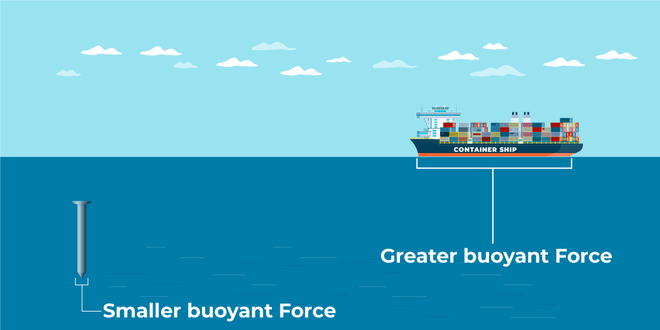
In this example, the iron nail has a smaller volume and displaces a very small amount of water, resulting in a lower buoyant force (upward force), which causes it to sink. Whereas ships have more volume, displace more water, and therefore experience a greater buoyant force (upward force) from the water, they float. When talking in terms of relative density, if it is less than 1, the object floats in water, and if it is more than 1, the object sinks.
Origin of Buoyant Force
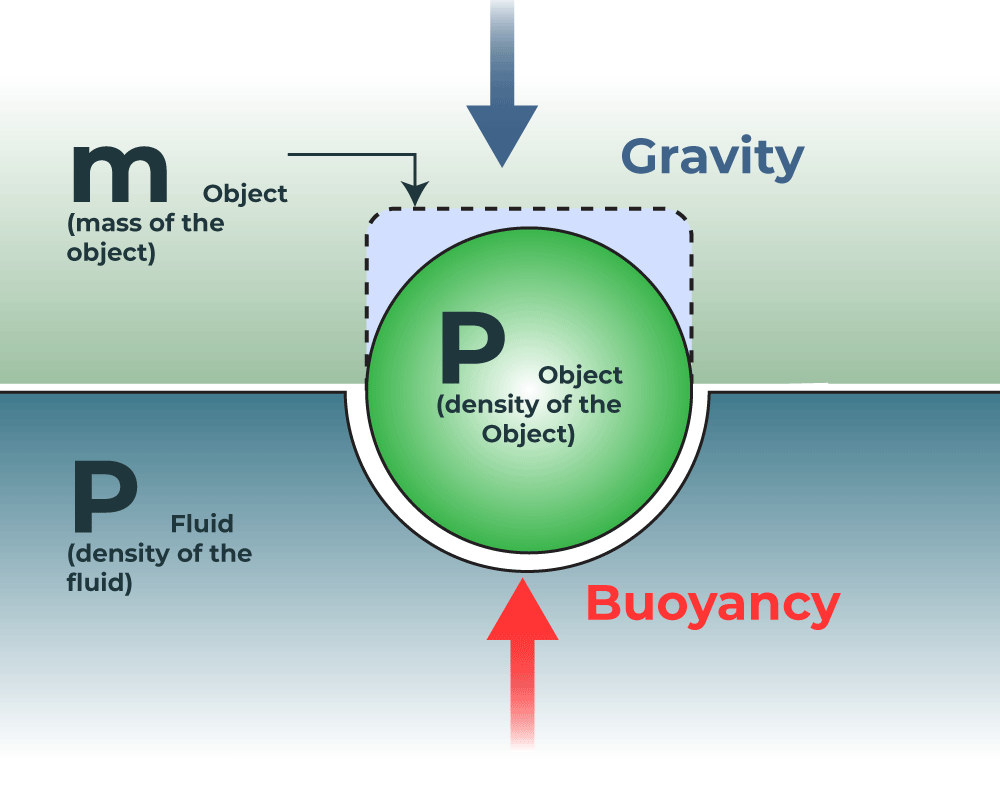
An object when immersed in a liquid experiences buoyant force. This force is upward in the direction opposite to the gravitational force; this is responsible for the reduced weight of the object inside the fluid. It's known that the pressure increases with the depth of the fluid. The pressure at the bottom of the object is greater than the pressure experienced at the top; this difference creates the net force experienced by the object inside the liquid, which is called buoyant force.
Archimedes' Principle
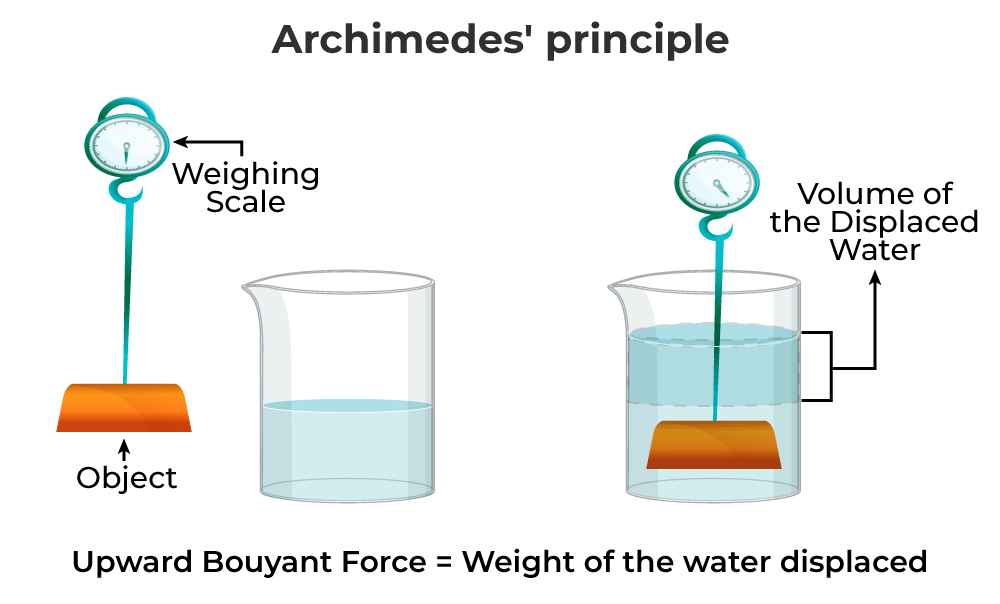
The physical law of buoyancy was given by the Greek mathematician and inventor Archimedes. Archimedes' principle states that the upward buoyant force that is exerted on a body immersed in a fluid, whether fully or partially, is equal to the weight of the fluid that the body displaces. In the image given below, fluid pressure opposes gravity, and actual gravitational forces decrease; therefore, they are given by
Apparent weight = Weight of object (in the air) - Thrust force (buoyancy)
Formula
Archimedes' law is mathematically written as:
Where,
- FB = buoyant force.
- ρ = density of the fluid.
- V = submerged volume.
- g = acceleration due to gravity.
Derivation
After rearranging the formula, ρV is the density of the displaced fluid multiplied by the volume of the displaced fluid, and we know the mass, density, and volume relation.
m = ρV
That means the term ρV corresponds to the mass of the displaced fluid.
Fb = mg, i.e., the mass of the displaced fluid times the magnitude of the acceleration due to gravity is just the weight of the displaced fluid.
Fb = W
The above equation, when stated in words, is called Archimedes' principle. Assuming Archimedes' principle to be reformulated
Apparent immersed weight = weight – Weight of displaced fluid
Then inserted into the quotient of weights, which has been explained by the mutual volume.
The density of the immersed object relative to the density of the fluid can be calculated:
Fb = PA = g ρ V = ρ g h A ⇢ (i)
- P = pressure
- Fb = force of buoyancy in Newton,
- A = Area in meters,
- g = acceleration due to gravity,
- h = Height at which force acts, taken from the surface
- p = density of the fluid,
- V = volume of the object inserted into the fluid.
Fb = Wa – Wf ⇢ (ii)
- Fb = force of buoyancy
- Wa = Weight of the object in the air
- Wf = Weight of the object when it is immersed in the fluid
Using (l) and (ll),
g ρ V = Wa – Wf ⇢ (iii)
If the object is not sinking, then Fg - Fb
Mg = ρ g V
Demonstration of Buoyant Force
An object that is partly or completely submerged experiences a higher pressure on the bottom surface than on its top surface. This force is called upthrust. When we put something on the water body's surface, it displaces some of the fluid. The upthrust force is equal to the weight of the fluid displaced by the object.
A floating object is stable if it returns to its original position after a small displacement. When pushed down slightly, it displaces more fluid, increasing the buoyant force. This greater upward force pushes the object back to equilibrium. If tilted slightly, it may return (stable), move further away (unstable), or stay in the new position (neutral).
The stability of a floating body depends on the positions of its center of gravity and center of buoyancy. The buoyant force acts through the center of buoyancy, while the weight acts through the center of gravity. A restoring or righting moment is produced when these forces act in such a way that the body returns to its original position.
Upthrust
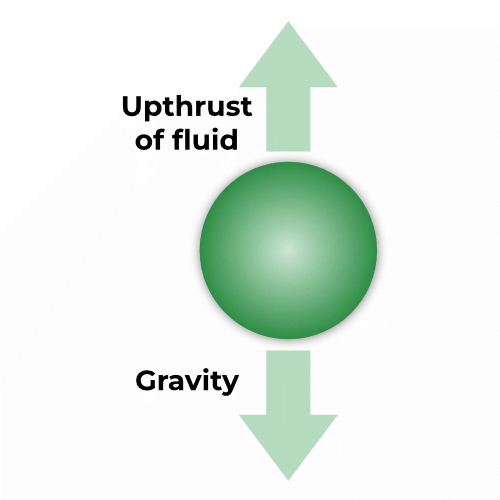
When an object is placed in a fluid, it experiences an upward force called "upthrust" or "buoyant force," which is exerted by the fluid and acts in the vertically upward direction. At the same time, the object experiences gravitational force due to its mass, which acts vertically downward. These two forces act in opposite directions, and their balance determines whether the object floats or sinks. The SI unit of upthrust is the newton (N).
Floating and Sinking of Objects
A liquid can be thought of as made up of many layers, each exerting pressure. Since pressure increases with depth, an object experiences greater pressure at its bottom than at its top. This difference creates an upward force called buoyant force.
The floating or sinking of an object depends on the balance between its weight and the buoyant force:
- If the buoyant force is equal to or greater than the object's weight, the object floats.
- If the buoyant force is less than the object's weight, the object sinks.
Types of Buoyancy
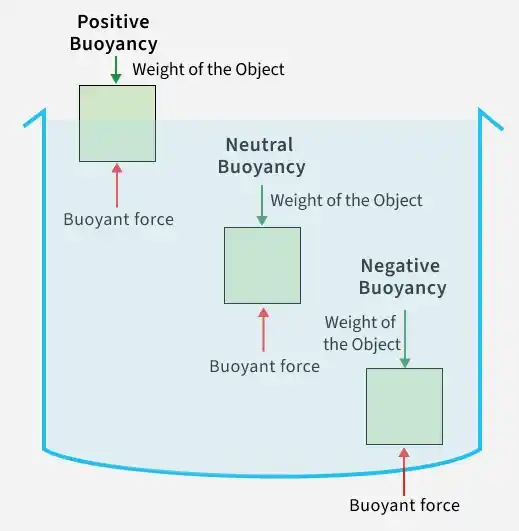
Buoyancy can be classified based on the relationship between an object's weight and the weight of the fluid it displaces.
1. Positive buoyancy: When the weight of an object is lighter than the fluid it displaces, it is called positive buoyancy. For example, a boat that weighs 3000 kg but displaces 4500 kg of water will easily float
2. Negative buoyancy: When the weight of an object is greater than the fluid it displaces, it is called negative buoyancy. For example, an iron nail may weigh 27 grams, but if it only displaces 17 grams of water, it will sink.
3. Natural buoyancy: When the weight of an object is equal to the fluid it displaces. For example, a submarine can adjust its weight by adding or expelling water in special tanks called ballast tanks, which is an example of natural buoyancy.
Applications of Buoyancy
- Hot Air Balloons: Rise when the buoyant force of air becomes greater than the weight of the balloon.
- Ships and boats float because they displace water equal to their weight, reducing overall density.
- Submarines: Control floating and sinking by adjusting water in ballast tanks.
- Fish: Use a swim bladder to adjust buoyancy and move up or down in water.
- Life Jackets: Help swimmers float by increasing the buoyant force acting on the body.
Related Articles:
Solved Problems
Example 1: Find the volume of the immersed object if M is 10000 kg.
Solution: Given:
Mass (M) = 10000 kgDensity (ρ) = 997 kg/m³
Mg=ρgV g got cancelled
10000 = 997 V
V = \frac{10000}{997}
\boxed {V = 10.03 m^3}
Example 2: A block of wood with length = 3.2 m, width = 0.8 m, and height = 0.6 m. The density of water is 1000 kg/m3. If the block is placed in the water, what is the buoyant force? Acceleration due to gravity is 10 N/kg.
Solution: Given:
Density = 1000 kg/m3
Gravity = 10 N/Kg
Volume(V) = 1.536 m3
F=ρgV F = 1000 × 10 × 1.536
F = 15360 N
Example 3: The weight of an object in the air is 108 N. The object is placed in a liquid. The increase in the volume of liquid is 1.8 m3. If the specific weight of the liquid is 10 N/m3, what is the weight of the object in the liquid?
Solution: Given:
Weight in air = 108 N
Volume displaced = 1.8 m3
Specific Weight (γ) = 10 N/m³
Buoyant Force
F= \gamma V
F = 10 \times 1.8
F = 18\,N Weight in Liquid = Weight in air - Buoyant Force
= 108 - 18
= 90 N
Example 4: An object weighs 12 N in air. When immersed fully in water, it weighs only 9 N. What would be the weight of the liquid displaced by the object?
Solution: According to Archimedes’s law:
Apparent weight = Weight of object (in the air) – Thrust force (buoyant force)
Apparent weight = 9N
Weight of object (in the air) = 12N
Thrust force (buoyant force) = ?
Apparent weight = 12N - Fb
Fb = 12N - 9N = 3N
Example 5: A piece of marble tile weighs 285 g in air. If its density is 3.5 g/cc, what will be its weight in water?
Solution: Given:
Mass = 285 g
Density of marble = 3.5 g/cc
Density of water = 1 g/cc
weight in water = weight in air − weight of displaced water
Volume of marble
V = \frac{285}{3.5} = 81.4 cc Weight of displaced water = 81.4 g
Weight in water = 285 − 81.4
= 203.6 g
Unsolved Problems
Question 1: An object weighs 150 N in air and 120 N when fully immersed in water. Find the buoyant force acting on it and the weight of water displaced.
Question 2: A cube of side 0.5 m is completely submerged in water. If the density of water is 1000 kg/m³ and g = 10 m/s2. Calculate the buoyant force acting on the cube.
Question 3: A body of volume 2 m³ is fully immersed in a liquid of density 800 kg/m³. Find the buoyant force acting on it. (Take g=10 m/s2).
Question 4: A metal block weighs 400 N in air and 250 N when completely immersed in a liquid. Calculate the buoyant force, the density of the liquid, and the relative density of the block.
Question 5: A wooden block of density 600 kg/m³ and volume 5 m³ is placed in water of density 1000 kg/m³. Determine the volume of the block submerged in water and the buoyant force acting on it.