
A conservative force is a type of force with the special property that the total work done on a moving object is not dependent upon the path travelled. Conservative force is dependent upon the initial and final points of the path covered.
When an object is moving in a closed loop, the total work done by the conservative force is zero. Because in a closed loop or circular path, if a particle completes a complete move, it means it came to the initial point. So the initial point and final point are the same in this case. Thus, the work done is zero by the conservative force. This force is not dependent on the path that is covered by an object. The conservative force follows the theories of the law of conservation of energy and the conservation of kinetic energy.
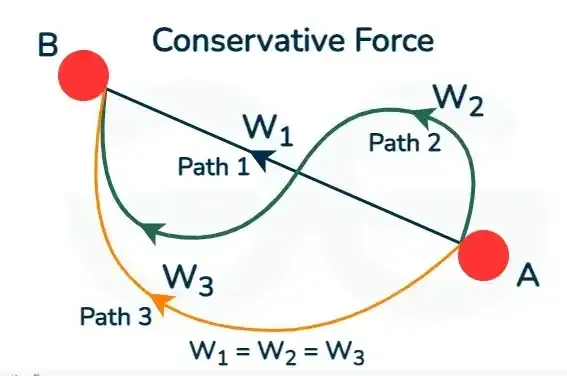
Examples of Conservative Forces
Electrostatic force, gravitational force, magnetic force etc., are examples of the conservative forces. Forces due to a spring and electrostatic force are also examples of conservation force.
Properties of Conservative Force
The properties of Conservative force is mentioned below:
- It is Independent of the path covered by a particle
- It is fully dependent upon the final and initial position of the particle.
- Work done will remain zero in the closed loop or circular path.
- This force is reversible.
Work Done by a Conservative Force
The total work done by a conservative force is referred as the work done by an object when a conservative force acting upon the object. To calculate the work done by a conservative force, we have to find out the magnitude of the force and the displacement of the body. Once we find out the magnitude of the force and the displacement of object, then multiply the magnitude of the force by the travelled distance of the object. The final value after multiplication is the total work done by the force.
The equation to calculate the total work done by a conservation force is ,
W = F × d
where
- W = work done,
- F = Force acting on the object,
- d = the distance between the force and the object.
Note:
- Work done by conservative force on a system is given by the change in the potential energy of the system
- Work done by conservative force is equal to the negative change in the potential energy.
- Work done by conservative force is positive when potential energy of the body decreases and kinetic energy of the body increases
Gravitational Force is a Conservative Force
The work done against gravity is always conserved, so it is an example of Conservative force. Let us discuss the gravitational force as an example of Conservative force.
Let us suppose, an object or a particle at height “h” from the ground, is thrown vertically, then the work done against gravity on this object is,
W1 = -mgh
When the same object falls down from the same height "h", the work done on that object is,
W2 = mgh
Thus the total work done on that object is,
W = W1 + W2
W = -mgh + mgh = 0.
Hence, the total work done for an object moves from the ground to a height 'h' and falling back to the ground from that height 'h' is equal to zero. It means that the work done is zero and it is conserved. This example shows that gravitational force is a type of conservative force.
Conservative Force Formula
The formula of a conservative force is given as
Fc = - dU/ds
where,
- Fc = conservative force
- U = Potential energy
- s = position
Conservative Force and Potential Energy
A conservative force is a force that only depends on the initial and final position of the moving path and not dependent on the total path travelled.
Potential energy is a type energy that depends a system's position, shape, or configuration. It is a stored type energy which is completely recoverable.
Potential energy is denoted as PE and it is defined for any conservative forces. During the work done by a conservative force, the object reach the final configuration. Conservative force depends on the final configuration and that configuration adds potential energy.
For a conservative force, the mechanical energy is the sum of kinetic energy and potential energy. When a conservative force acts on a body, the total mechanical energy remains constant. It defined that the conservative force obeys the law of mechanical energy.
KEi + PEi = KEf + PEf = Constant
Conservative and Non-Conservative Forces
In contrast to conservative forces, non-conservative force are the force that depends on the path covered by a body. Non conservative force is also depends on the final and initial position of the body.
Examples of non-conservative forces include Air Resistance, Tension in the cord, Hands Rubbing and Friction are the examples of Non-conservative force.
By rubbing hands together, a significant quantity of heat energy is generated. This is because of friction, which opposes the force used to rub the hands together. The frictional force opposes the motion and removes the energy generated by the applied force into heat energy. The transformation of physical energy to thermal energy involves the presence of an opposing force.
Properties of the Non-Conservative Force
The followings are the important properties of the Non-conservative force -
- It is Dependent of the path covered by a body.
- It is Dependent upon the path travelled by the body.
- Work done will always remain a positive.
- This force is irreversible.
Conservative Force vs Non-conservative Force
The detailed difference between conservative and non-conservative force is tabulated below:
Conservative Force | Non-conservative Force |
|---|---|
Independent on path travelled. | Dependent on path travelled. |
It follows the law. | It does not follow the law. |
In closed path, work done is zero in case of Conservative force. | Work done is not zero in case of Non-conservative force. |
It is recoverable. | It is not recoverable. |
Mechanical energy is conserved in case of Conservative force. | It may or may not be conserved in case of Non-conservative force. |
magnetic force and gravitational force | Friction. |
Related Articles:
Solved Problems
Question 1: A 2 kg object is lifted vertically from the ground to a height of 5 m. Calculate the work done by gravity when. The object is lifted and the object falls back to the ground.
Solution:
Mass of the object, m = 2 kg
Height, h = 5 m
Gravitational acceleration, g = 10 m/s2.
Work done against gravity while lifting:
W1 = − mgh
− (2) (10) (5) = − 100 J
Work done by gravity while falling:
W2 = mgh
(2) (10) (5) = 100 J
Total work done ( up and down)
W= W1 + W2
−100 + 100 = 0
Answer = 0 J
Question 2: A spring with spring constant k = 200 N/m is compressed by 0.1 m. Calculate the work done by the spring.
Solution:
Work done by a spring (conservative force) is:
W = \frac{1}{2} k x^2 Given :
x = 0.1 m
K = 200 N/m
W = \frac{1}{2} \cdot 200 \cdot (0.1)^2
100 \cdot 0.01 Answer = 1 J
Question 3: A block of 5 kg slides on a horizontal surface with friction coefficient μ=0.2. It moves 10 m before stopping. Calculate the work done by friction.
Solution:
Friction Force
f = μmg
(0.2) (5) (10)
F = 10 N
Work done by friction (opposes motion):
W = f × d
10 × 10
W = 100 J
friction opposes motion so the work done is negative
W = - 100 J
Question 4: A spring with spring constant k=500 N/m is compressed by 0.2 m. A block of 2 kg is attached and released from rest. Find the speed of the block just after release.
Solution:
Potential energy stored in spring
PE = \frac{1}{2} k x^2
\frac{1}{2} \cdot 500 \cdot (0.2)^2 = 10 J
Kinetic energy just after release = PE of spring
KE = \frac{1}{2} m v^2
\frac{1}{2} \cdot 2 \cdot v^2 = 10
v^2 = 10
v = \sqrt{10}
v \approx 3.16 \, \text{m/s}
Question 5: A particle moves along the x-axis under a potential energy U (x) = 4x2 − 2x J. Find the conservative force acting on the particle at x = 1 m.
Solution:
A conservative force is related to potential energy by
F_{\rm c} = -\frac{du}{dx} At x = 1 m
F_{\rm c} = -(8 \cdot 1 - 2) Fc = -6 N
Unsolved Problem
Question 1: A spring with spring constant k=400 N/m is stretched by 0.15 m. Calculate the work done by the spring and the speed of a 3 kg block attached to the spring if it is released from rest.
Question 2: A particle moves along the x-axis under a potential energy U(x)=6x2 − 3x J. Find the conservative force acting on the particle at x = 2 m.
Question 3: A block of 2 kg slides down a friction less incline of height 5 m. Find the velocity of the block at the bottom.
Question 4: A 2 kg block slides down a 4 m long friction less inclined plane of height 3 m. At the bottom, it hits a horizontal rough surface with coefficient of friction μ = 0.2. Calculate the velocity of the block at the bottom of the incline and the distance the block slides on the rough surface before stopping.
Question 5: A particle moves along the x-axis with potential energy U(x) = 5x2 − 4x + 1J. Find the conservative force acting on the particle at x = 1 m and the position where the force is zero.
Question 6: A 3 kg block is pulled on a horizontal surface by a force of 20 N over a distance of 5 m. The friction coefficient between the block and surface is μ = 0.1. Find the net work done on the block.