
Thermodynamics is a branch of physics that deals with energy, heat, work, and temperature and explains how thermal energy is transformed into other forms of energy. It studies the relationships between these quantities and their effects on the physical properties of matter.
Thermodynamics focuses on the principles that govern energy transfer and transformation within a system and examines a system’s ability to perform useful work on its surroundings. The behaviour of heat, work, temperature, and entropy is described by the four laws of thermodynamics, which provide a fundamental framework for understanding energy interactions.
System & Surrounding
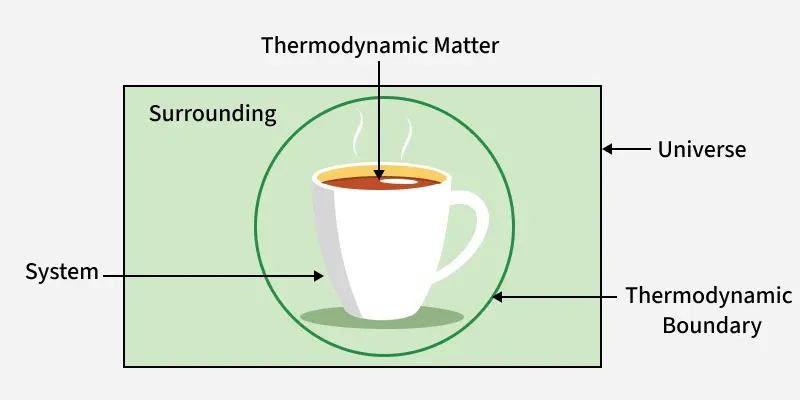
Creating a clear boundary makes thermodynamics much simpler. The "system" refers to everything contained within the boundary, and the "surroundings" refers to everything outside of it. Once the boundary diagram has been created, the flow across system boundaries can be used to describe the movement and transfer of energy. The word "universe" refers to both the surroundings and the system.
Different Branches of Thermodynamics
The study of Thermodynamics is classified into several branches listed below:
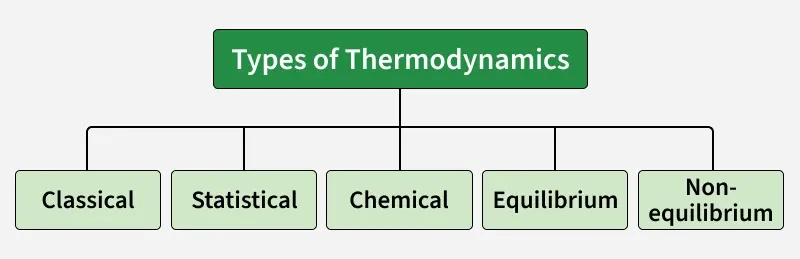
A. Classical Thermodynamics (Macroscopic view)
- Classical thermodynamics examines the behaviour of matter from a macroscopic perspective.
- The focus is on understanding and predicting the characteristics of matter undergoing various processes.
- Key units considered include temperature and pressure.
- These units help determine the characteristics and predict the behaviour of matter.
B. Statistical Thermodynamics (Molecular view)
- Statistical mechanics interprets microscopic interactions between individual particles or quantum-mechanical states.
- The field explains classical thermodynamics as a natural consequence of statistics, classical mechanics, and quantum theory at the microscopic level.
- It connects microscopic, bulk properties observable on the human scale to macroscopic, individual atom, and molecule properties.
C. Chemical Thermodynamics
- Chemical thermodynamics studies how energy interacts with chemical processes or state changes.
- This field operates in accordance with the laws of thermodynamics.
- The main goal is to determine the spontaneity of a given transition.
D. Equilibrium Thermodynamics
- Equilibrium thermodynamics studies matter and energy transfers in systems or substances moved from one state of thermodynamic equilibrium to another by environmental agents.
- "Thermodynamic equilibrium" refers to a condition where all macroscopic flows are zero.
- For basic systems or bodies, this means uniform intensive properties and perpendicular pressures at boundaries.
- In an equilibrium state, there are no unbalanced potentials or driving forces between the system's diverse macroscopic components.
E. Non-equilibrium Thermodynamics
- Non-equilibrium thermodynamics focuses on systems that are not in thermodynamic equilibrium.
- Most natural systems are not in thermodynamic equilibrium due to continuous and irregular fluxes of matter and energy.
- These systems are not in stationary states.
Basic Concepts of Thermodynamics
There are various concepts in thermodynamics, some of these concepts are explained as follows:
1. Thermodynamic Systems
A collection of an extremely large number of atoms or molecules confined within certain boundaries such that it has certain values of pressure (P), volume (V) and temperature (T) is called a thermodynamic system.
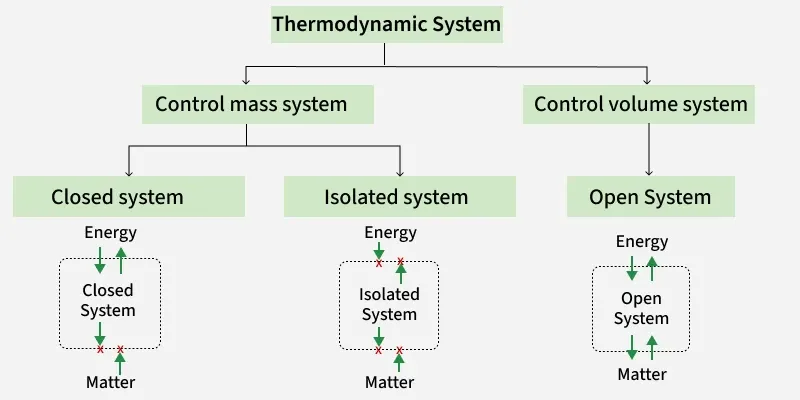
Anything outside the thermodynamic system to which energy or matter is exchanged is called its surroundings. Taking into consideration the interaction between a system and its surroundings, a system said to be an open system if it can exchange both energy and matter with its surroundings may be divided into three classes-
- Open system: A system is said to be an open system if it can exchange energy and matter with its surroundings.
- Closed system: A system is said to be a closed system if it can exchange only energy (not matter) with its surroundings.
- Isolated system: A system is said to be isolated if it can neither exchange energy nor matter with its surroundings.
2. Heat
- Heat is energy that is transmitted between objects or systems as a result of a temperature difference.
- Heat is conserved energy, which means it cannot be created or destroyed. However, it can be moved from one location to another.
- Additionally, heat can be transformed into and out of various types of energy.
3. Work
- The work done by a system or on a system during a process depends not only on the system's starting and final states but also on the path chosen for the process.
- When a force acting on a system moves the body in its own direction, work has been done.
- Force and displacement combine to create the work (W) that is done to or by a system.
4. Internal Energy
- The kinetic and potential energies of the molecules are added up to form internal energy. The system's internal energy is represented by the letter U.
- Kinetic energy is the energy that molecules or atoms possess due to their motion. Two molecules have some potential energy because they are attracted to one another.
- The total kinetic and potential energy of the atoms or molecules that make up a system is what is known as the system's internal energy.
Thermodynamic Properties or Variables
A thermodynamic system can be described by specifying its pressure, volume, temperature, internal energy, enthalpy, and the number of moles. These parameters or variables are called thermodynamic variables.
Thermodynamic variables are the measurable properties used to describe the state of a thermodynamic system.
Some Thermodynamic Variables
1. Pressure (P):Pressure is the force exerted per unit area by the molecules of a system on its boundaries.
2. Temperature (T): Temperature indicates the degree of hotness or coldness of a system and determines the direction of heat flow.
3. Volume (V):Volume is the space occupied by a thermodynamic system.
4. Internal Energy (U): Internal energy is the total microscopic energy of a system due to the motion and interaction of its molecules.
5. Entropy (S): Entropy is a measure of the degree of disorder in a system and indicates the unavailability of energy for useful work.
6. Enthalpy (H): Enthalpy is the sum of internal energy and pressure–volume energy of a system. (H = U + P.V)
7. Gibbs Free Energy (G): Gibbs free energy represents the maximum useful work obtainable from a system at constant temperature and pressure.
8. Helmholtz Free Energy (A): Helmholtz free energy is the energy available to do work at constant temperature and volume.
9. Number of Moles (n): Mass or number of moles represents the amount of substance present in the thermodynamic system.
Intensive and Extensive Thermodynamic Properties
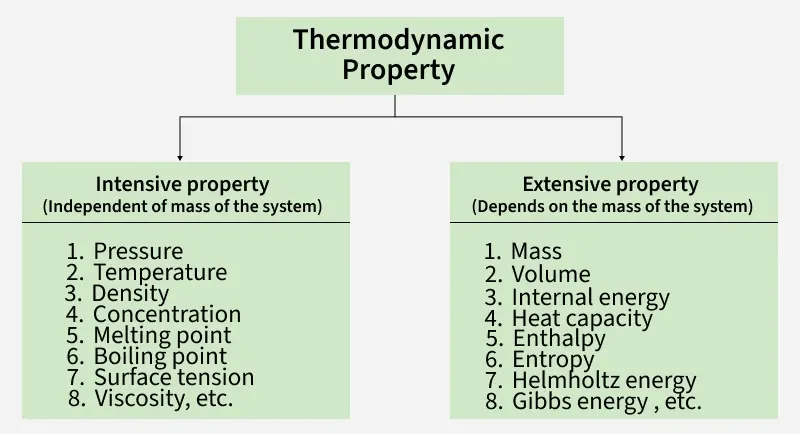
- Intensive Property: An intensive property is one that does not depend on the mass of the substance or system. E.g. Temperature, pressure, and specific heat capacity.
- Extensive Property: An extensive property of a system depends on the system size or the amount of matter in the system. E.g. Volume, energy, entropy, heat capacity, and enthalpy.
Thermodynamic Equilibrium
Thermodynamic equilibrium is a state of a system in which there is no net change occurs within the system over time i.e., the state of a thermodynamic system in which macroscopic properties such as temperature, pressure, and chemical composition, remain constant. There are different types of thermodynamic equilibrium:
- Thermal Equilibrium: In the state of thermal equilibrium, the temperature of the system remains constant i.e., there is no net heat transfer occurring within the system.
- Mechanical Equilibrium: When in a system either there is no net force acting or there is no pressure difference, then this state of the system is called mechanical equilibrium. This state is also sometimes referred to as a state of mechanical balance.
- Chemical Equilibrium: A thermodynamic system is said to be in chemical equilibrium when the rates of forward and reverse reactions become equal. When the system reaches chemical equilibrium, the concentrations of reactants and products remain constant over time.
Thermodynamic Processes
Any process in which the thermodynamic variables of a thermodynamic system change is known as the thermodynamic process.
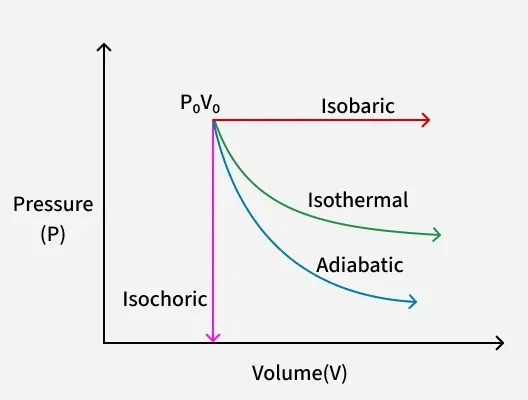
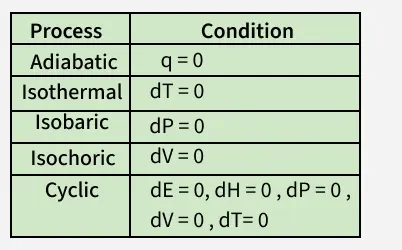
- Isothermal Process: A process in which the pressure and volume of the system change at constant temperature are called the isothermal process. In this case, P and V change but T is constant. i.e. dT (change in temperature) = 0.
- Adiabatic Process:A process in which pressure, volume, and temperature of the system change, but there is no exchange of heat between the and its surroundings is called the adiabatic process. In this case, P. V and T change but Q = 0. The system should be compressed or allowed to expand suddenly so that there is no time for the exchange of heat between the system and its surroundings. Since these two conditions are not fully realized in practice, so no process is perfectly adiabatic.
- Isochoric Process: A thermodynamic process that takes place at constant volume is called the isochoric process. It is also known as the isovolumic process. In this case, dV = 0.
- Isobaric Process: A thermodynamic process that takes place at constant pressure is called the isobaric process. In this case, dP = 0.
- Cyclic Process: A cyclic process consists of a series of changes that return the system to its initial state.
Thermodynamic Potentials
The stored energy in a system is measured by its thermodynamic potentials. Potentials measure how a system's energy transforms from its initial state to its final one. Depending on the constraints of the system, such as temperature and pressure, different potentials are used.
Different forms of thermodynamic potentials are mentioned below:
- Internal Energy (U): It is equal to the sum of the ability to do work and the ability to release heat.
- Gibbs Energy (G): It is the ability to do non-mechanical work.
- Enthalpy (H): It is the ability to do non-mechanical work and the ability to emit heat.
- Helmholtz Energy (F): It is the ability to do both mechanical and non-mechanical work.
Enthalpy
In a thermodynamic system, energy is measured by enthalpy. Enthalpy is a measure of a system's total heat content and is equal to the system's internal energy plus the sum of its volume and pressure.
Enthalpy is a property or state function that resembles energy; it has the same dimensions as energy and is therefore measured in joules or ergs. The value of enthalpy is entirely dependent on the temperature, pr13essure, and composition of the system, not on its history.
Entropy
Entropy is the measurement of the amount of thermal energy per unit of temperature in a system that cannot be used for useful work.
Entropy is a measure of a system's molecular disorder or randomness since work is produced by ordered molecular motion. Entropy theory offers a deep understanding of the direction of spontaneous change for many common events.
Laws of Thermodynamics
The laws of thermodynamics are fundamental principles that govern energy, heat, temperature, and entropy in a system. They explain energy transfer, transformation, and the conditions required for thermodynamic equilibrium, and apply universally to all physical and chemical processes.
There are four laws of thermodynamics, namely:
- Zeroth Law of Thermodynamics
- First Law of Thermodynamics
- Second Law of Thermodynamics
- Third Law of Thermodynamics
Zeroth Law of Thermodynamics
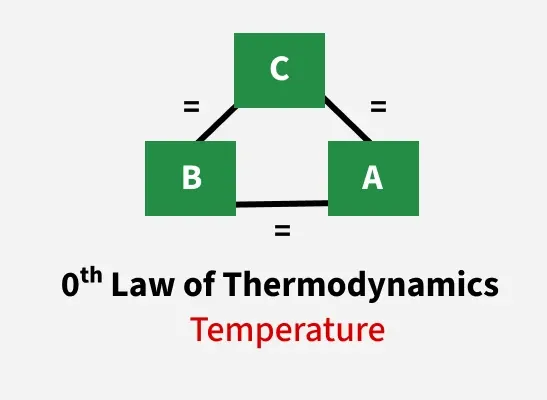
According to the Zeroth Law of Thermodynamics, if two bodies are separately in thermal equilibrium with a third body, then the first two bodies are likewise in thermal equilibrium with each other.
This indicates that if system A is in thermal equilibrium with system B, and system C is likewise in thermal equilibrium with system B, then both systems A and C are in thermal equilibrium.
First Law of Thermodynamics
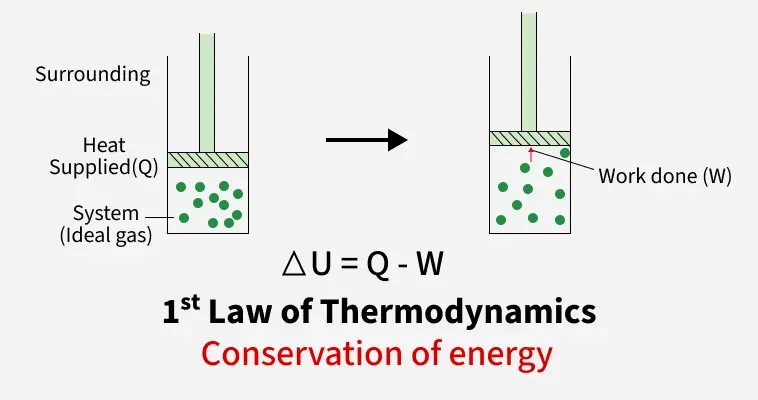
Energy cannot be generated or destroyed, according to the first law of thermodynamics, but it can be converted from one form to another. According to this law, some of the heat provided to the system is utilized to change the internal energy, while the remaining is used to perform work.
First law of thermodynamics is also known as the law of conservation of energy.
Mathematical Form of First Law of Thermodynamics:
Mathematically, it may be expressed as
\boxed{ \Delta Q =\Delta U +W} Where,
- ΔQ =The heat given or lost
- ΔH = The change in internal energy
- W =stands for work done.
Second Law of Thermodynamics
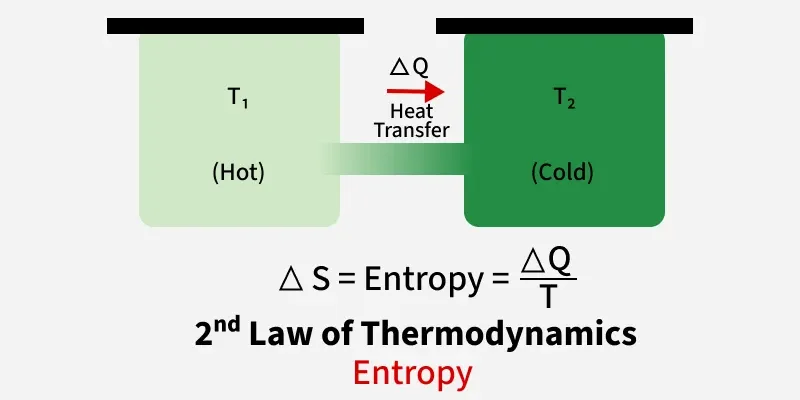
The Second Law of Thermodynamics states that the state of entropy of the entire universe, as an isolated system (no energy or matter transfer with its surrounding), will always increase in any natural and spontaneous process.
Third Law of Thermodynamics
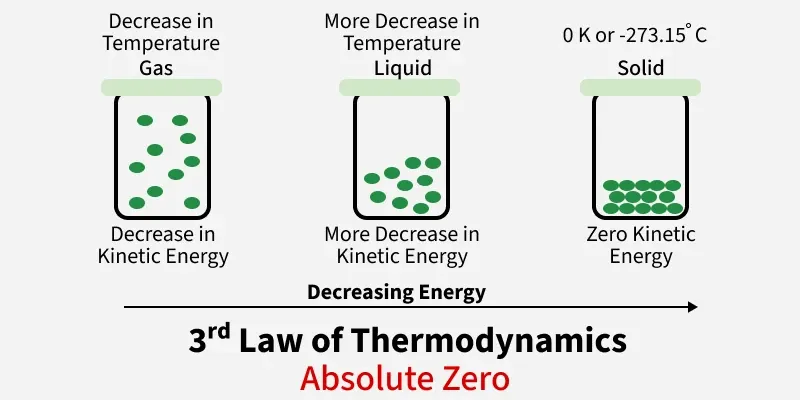
The third law of thermodynamics states that when the temperature approaches absolute zero (0 Kelvin) temperature, the entropy of a system approaches a constant value. At absolute zero temperature, the entropy of a pure crystalline solid is zero.
Thermodynamics Examples in Daily Life
We came across various examples in our daily life which can be explained using thermodynamic properties. Some of them are,
- Melting of Ice Cubes: Drinks with ice cubes become cooler as the heat from the drink is absorbed. If we neglect to drink it, it will eventually warm back up to room temperature by absorbing heat from the environment. The first and second laws of thermodynamics govern how all of this works.
- Sweating in a Crowded Room: In a crowded room, everyone begins to sweat. By transmitting body heat to the sweating, the body begins to cool down. Sweat evaporates, heating the space. Again, this occurs as a result of the application of the first and second laws of thermodynamics. Keep in mind that heat is not lost but rather moved until equilibrium is reached with the least amount of entropy.
- Flipping a Light Switch: Different kinds of power plants, including thermal and nuclear ones, are studied using thermodynamics.
Thermodynamics Examples
Example 1: Calculate ΔG at 280 K for the reaction, 2NO + O2 → 2NO2
when ΔH and ΔS of the reaction are -100 J and -0.25 J/K respectively
Given,
ΔH = -100 J
ΔS = -0.25 J/K
T = 280 KWe know that,
ΔG = ΔH - TΔS
⇒ ΔG = (-100) -280(-0.25)
⇒ ΔG = -100 + 70
⇒ ΔG = -30 J
Example 2: Calculate the temperature at which ΔG of the given reaction is 200 J when ΔH and ΔS of the reaction are -150 J and -0.5 J/K respectively: H2 + I2 → 2HI
Given,
ΔG = 200 J
ΔH = -150 J
ΔS = -0.5 J/KT =?
We know that,
ΔG = ΔH - TΔS
Thus,
⇒ 200 = (-150) - T(-0.5)
⇒ 200 = -150 + T/2
⇒ 200 + 150 = T/2
⇒ T = 700 K
Example 3: If an ideal heat engine operates in a Carnot cycle between 600 K and 400 K and if it absorbs 6000 J of heat at a higher temperature then find the heat supplied from the source.
Given,
T1 = 600 K
T2 = 400 K
Heat Absorbed at High Temperature = 6000 J
Heat Supplied from Source =?
Efficiency of Heat Engine (E) = 1 - (T2 / T1)
⇒ Efficiency of Heat Engine (E) = 1 - 400/600 = 1- 2/3
⇒ Efficiency of Heat Engine (E) = 1/3We know that,
E = Heat Supplied from Source/Heat Absorbed at High Temperature
⇒1/3 = Heat Supplied from Source/6000
Heat Supplied from Source = 2000 J
Example 4: Find the Efficiency of the Heat Engine if it operates between 700 K and 350 K.
T1 = 700 K
T2 = 350 K
Efficiency of Heat Engine (E) = 1 - (T2 / T1)
⇒ Efficiency of Heat Engine (E) = 1 - 350/700 = 1- 1/2
⇒ Efficiency of Heat Engine (E) = 1/2
⇒ E = 1/2 × 100 % = 50%
Unsolved Questions
Q1. 28.0 L of CO2 is produced on complete combustion of 16.8 L gaseous mixture of Ethene and methane at 25 ℃ and 1 atm. Heat evolved during combustion process is ___ kJ. Given: ΔHc(CH4) = -900 kjmol-1, ΔHc(CH4) = -1400 kjmol-1
Q2. When 2 litre of Ideal gas expands isothermally into vacuum to total of 6 litre, the change in internal energy is ___J. (Nearest Integers).
Q3. 1 mole of Ideal gas is allowed to expands reversibly and adiabatically from a temperature of 27 ℃. the workdone is 3 kJmol-1. The final temperature of the gas is ___ K (Nearest Integer). Given Cv = 20 J mol-1K-1.
Q4. Enthalpies of formation of CCl4(g), H2O(g), CO2(g) and HCl(g) are -105, -242, -394, and -92 kJmol-1 respectively. The magnitude of enthalpy of the reaction given below is kJmol-1. (Nearest Integer)
CCl4(g) + 2H2O(g) --> CO2(g) + 4HCl(g)
Q5. The value of log K for the reaction A ⇋ B at 298 K is -----(Nearest Integers). Given: ΔH° = -54.07 kJmol-1, ΔS° = 10 JK-1mol-1.