
When objects travel along curved paths, such as the swinging motion of a pendulum, we refer to this motion as angular motion. This type of motion involves rotation around a fixed point or axis, contrasting with linear motion, where objects move along a straight path. Angular motion refers to the motion of an object about a fixed point or axis, where its position changes with respect to angles rather than linear distance. It involves the rotation of an object around an axis, resulting in changes in angular displacement, velocity, and acceleration. Some examples of angular motion are:
- Rotation of Earth: The Earth rotates about its axis, causing day and night.
- Spinning Top: A spinning top rotates around its central axis.
- Rotating Fan: The blades of a ceiling or cooler fan rotate about a fixed axis.

Concepts Related to Angular Motion
Angular motion, a fundamental aspect of physics and engineering, delves into the dynamic study of rotational movement, exploring concepts such as angular displacement, velocity, acceleration, and momentum within rotating systems.
1. Angular Displacement
Angular displacement is the angle through which a body rotates around an axis or centre. Each point on the rotating object follows a circular path. It is measured in radians.
The angular displacement Δθ\Delta \thetaΔθ can be calculated as:
\Delta \theta = \frac{\text{arc length(l)}}{r} , Where r is the radius of the circular path
2. Angular Velocity
Angular velocity is a measure of how fast an object rotates or spins. The Angular velocity is represented by omega 'ω'. Formula of velocity is given as:
ω = \frac{Δθ}{Δt}
where Δθ is the angular displacement, and Δt is the time taken.
It can be of two types:
- Spin Angular Velocity: The rate at which an object rotates around its own axis, e.g., spinning tops, planets, or subatomic particles.
- Orbital Angular Velocity: The rate at which an object revolves around another object in an orbit, e.g., planets, moons, or satellites.
3. Torque
Torque is the force that causes rotation. It is the product of the applied force and the perpendicular distance from the axis of rotation. Torque produces angular acceleration or deceleration. The formula for torque is.
\tau = r \times F = r F \sin \theta where θ is the angle between the position vector r and the force vector F.
4. Angular Acceleration
Angular acceleration is the rate at which an object's angular velocity changes with time, showing how quickly it speeds up or slows down during rotational motion around a fixed axis, and it determines how fast the rotation of the object changes.
\alpha = \frac{d\omega}{dt} where,
α is the angular acceleration
ω is the angular velocity
It is the time taken by the object
5. Angular Kinetic Energy
Angular kinetic energy is the rotational equivalent of linear kinetic energy. Objects in rotational motion have energy due to their angular velocity. This energy depends on the object’s moment of inertia (I) and the square of its angular velocity (ω).
K.E. = \frac{1}{2} I \omega^2
where:
- I = moment of inertia, a measure of how mass is distributed relative to the axis of rotation
- ω = angular velocity
6. Angular Momentum
Angular momentum (L) of a rotating body is the quantity of rotational motion it possesses. It is defined as the product of the moment of inertia (I) and the angular velocity (ω). It depends on both how mass is distributed about the axis and how fast the object is rotating.
L = I \omega
where:
- L = angular momentum
- I = moment of inertia
- ω = angular velocity
7. Angular Equations of Motion
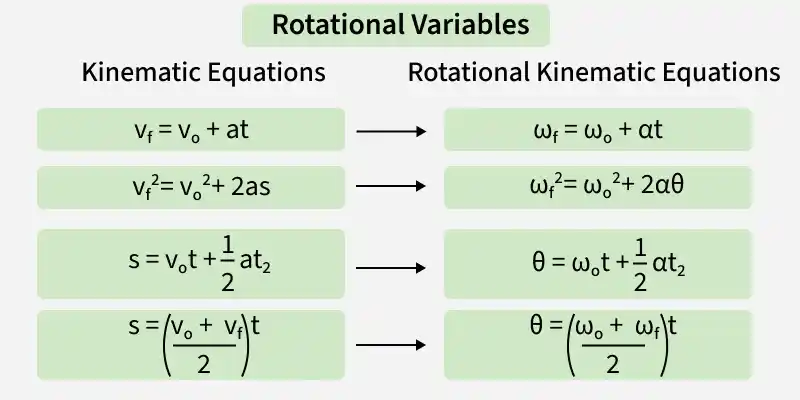
As we had three basic equations in linear motion describing motion using velocity, acceleration, and displacement, we have angular equations of motion. They are very similar to linear motion equations but include rotational motion. The equations are :
\theta=\theta_0 + \omega_0t+ \frac{1}{2} \alpha t^2
\omega = \omega_0 + \alpha t
\omega^2 = \omega_0^2+2\alpha \theta
where
- θ = angular displacement
- θ0 = initial angular displacement
- ω = final angular velocity
- ω0 = initial angular velocity
- α = angular acceleration
- t = time
Relationship Between Linear and Angular Motion
The table below clearly shows the relationship between linear and angular variables commonly used.
Relationship | Angular Motion | Linear Motion |
|---|---|---|
θ = x/r | Angular Displacement(θ) | |
ω = v/r | Angular Velocity(ω) | |
α = a/r | Angular Acceleration(α) |
Here, r is the radius of the circle along which the angular motion is taking place.
Difference between Linear and Angular Motion
The difference between linear and angular motion is illustrated in the table below:
Aspect | Linear Motion | Angular Motion |
|---|---|---|
Definition | Motion along a straight path | Rotation around a fixed point or axis |
Displacement | Δx | Δθ |
Velocity | ||
Acceleration | ||
Example | Car moving along a road | Pendulum swinging back and forth |
Related Articles:
Solved Problems
Question 1: A wheel rotates through an angular displacement of 10 rad in 5 seconds. Find its angular velocity.
Solution: Given
Δθ = 10 rad
Δt = 5 s
Formula
\omega = \frac{\Delta \theta}{\Delta t}
\omega = \frac{10}{5}
\omega = 2 \,\text{rad/s}
Question 2: A disc has an initial angular velocity of 4 rad/s. After 3 seconds, its angular velocity becomes 10 rad/s. Find the angular acceleration.
Solution: Given
ω0 = 4 rad/s
ω = 10 rad/s
t = 3 s
\omega = \omega_0 + \alpha t
10 = 4 + 3\alpha
6 = 3\alpha
\alpha = 2 \,\text{rad/s}^2
Question 3: A rotating body has a moment of inertia of 5 kg·m² and an angular velocity of 4 rad/s. Find its angular kinetic energy.
Solution: Given
I = 5 kg.m2
ω = 4 rad/s
K.E. = \frac{1}{2} I \omega^2
K.E. = \frac{1}{2} (5)(4)^2
K.E. = \frac{1}{2} (5)(16)
K.E. = 40 \,\text{J}
Question 4: A rotating object has a moment of inertia of 3 kg·m² and rotates with an angular velocity of 6 rad/s. Find its angular momentum.
Solution: Given
I = 3 kg.p m2
ω = 6 rad/s
L = I \omega
L = 3 \times 6 L = 18 kg.m2 s
Unsolved Problems
Question 1: A wheel starts from rest and rotates with a constant angular acceleration of 3 rad/s2. Find its angular velocity and angular displacement after 4 s.
Question 2: A force of 25 N is applied perpendicular to a wrench at a distance of 0.4 m from the pivot. Calculate the torque produced.
Question 3: A disc with initial angular velocity 8 rad/s slows uniformly at 2 rad/s2. Find the time taken to stop and the total angular displacement before stopping.
Question 4: A body with a moment of inertia of 12 kg · m2 rotates at 5 rad/s. Calculate its angular momentum, rotational kinetic energy, and the factor by which kinetic energy changes if the angular velocity doubles.
Question 5: A wheel of radius 0.5 m rotates at 20 rad/s. Determine the linear velocity and centripetal acceleration of a point on its rim.