
The Second Law of Thermodynamics states that in every spontaneous natural process, the total entropy of an isolated system always increases and never decreases. It also implies that heat cannot spontaneously flow from a colder body to a hotter body, and no heat engine can convert all absorbed heat completely into useful work.
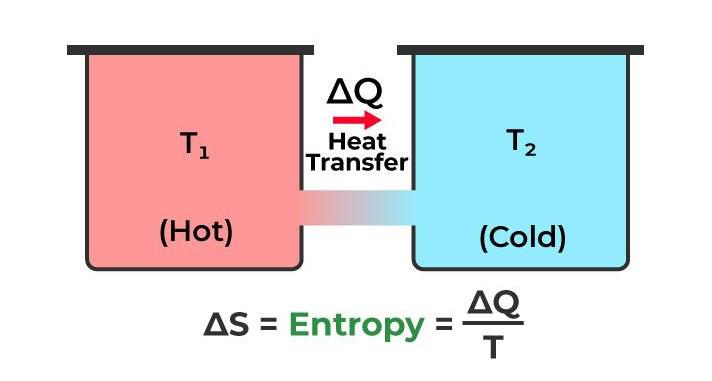
The overall entropy of a system and its surroundings remains constant in some instances where the system is in thermodynamic equilibrium or going through a reversible process. Law of Increased Entropy is another name for the second law.
Different Statements of Second Law of Thermodynamics
Second law of thermodynamics may be expressed in many specific ways, by different scientists at different times. Here are the Second Law of Thermodynamics statements:
Kelvin-Planck Statement
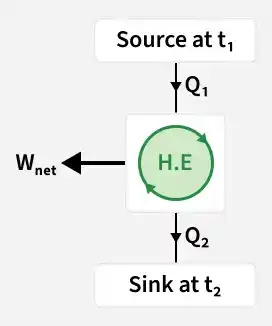
It is impossible to construct a heat engine that operates in a complete cycle and converts all the heat absorbed from a hot reservoir entirely into work without rejecting some heat to a cold reservoir.
- A heat engine absorbs heat from a hot reservoir.
- It converts part of that heat into work.
- The remaining heat must be rejected to a cold reservoir.
- No heat engine can be 100% efficient.
- A sink (cold reservoir) is always necessary.
Clausius Statement
It is impossible to construct a device that operates in a cycle and transfers heat from a colder body to a hotter body without the input of external work.
- Heat cannot naturally flow from a cold body to a hot body.
- External energy (work) is required to transfer heat from cold to hot.
- A refrigerator cannot function unless its compressor is powered by an external source.
- This principle applies to refrigerators, air conditioners, and heat pumps.
Equivalence of Two Statements
If a refrigerator could transfer heat from a cold body to a hot body without any external work, it would violate the Clausius statement. Now, if this imaginary refrigerator is combined with a heat engine operating between the same reservoirs, the system would convert all the heat taken from the hot reservoir completely into work without rejecting any heat. This would violate the Kelvin–Planck statement. Therefore, violation of one statement leads to violation of the other, proving that both statements of the Second Law of Thermodynamics are equivalent.
Second Law of Thermodynamics Equation
Second law of thermodynamics is expressed mathematically as;
\Delta S_{\text{universe}} > 0
Where:
ΔS₍universe₎ = Change in entropy of the universe
Meaning Of the Equation
For a spontaneous (natural) process
For a reversible process
For an impossible process
The universe includes both System and Surroundings so,
Entropy (S)
Entropy is a measure of disorder or randomness of a system. It is generally expressed as change in entropy,
If entropy at a specific state is to be measured, a reference state is chosen and assigned zero entropy.
Isentropic Process
An isentropic process is a thermodynamic process in which the entropy of the system remains constant throughout the process, meaning there is no change in entropy and the process is ideally reversible and adiabatic.
Perpetual Motion Machine of Second Kind
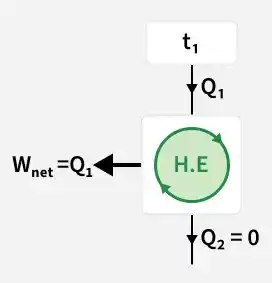
A Perpetual Motion Machine of the Second Kind is a hypothetical device that would absorb heat from a single heat reservoir and convert it completely into work without rejecting any heat to a colder reservoir. Such a machine would operate continuously with 100% efficiency and without any additional energy input. However, this violates the Second Law of Thermodynamics, which states that some heat must always be rejected to a sink during energy conversion. Therefore, such a machine is impossible in reality and exists only in theory.
Real-Life Applications
Here are the Applications and Uses of Second Law of Thermodynamics:
- Explains the working principle of heat engines where heat energy is partially converted into mechanical work.
- Governs engine cycles such as the Otto cycle and Diesel cycle, which are used in automobiles and power plants.
- Forms the fundamental principle behind refrigeration and air-conditioning systems operating on the Carnot cycle.
- Establishes the natural direction of heat flow from higher temperature to lower temperature.
- Determines the maximum possible efficiency of heat engines and proves that complete conversion of heat into work is impossible.
Limitations
- Describes the direction of natural processes but does not explain the exact rate at which a process occurs.
- Allows many processes according to energy conservation, yet restricts them based on entropy increase. Example: water at room temperature never spontaneously freezes by absorbing heat from its surroundings, even though energy conservation would allow it.
- Does not provide detailed information about the microscopic behaviour of individual atoms and molecules.
- Predicts the concept of heat death of the universe, where all systems reach the same temperature and no useful work can be performed.
- Deals with the quality of energy (entropy) but does not specify exact mechanisms for energy degradation in every practical situation.
Article Related to Second Law of Thermodynamics:
Solved Problems
Question 1: If a heat pump works for 600 J and removes 800 J of heat from the low-temperature reservoir. What is the amount of heat delivered to a higher-temperature reservoir?
Solution: Given,
W = 600 J
QC = 800 J
Now, according to the laws of thermodynamics.
QH = W + QC
QH = 600 J + 800 J
QH = 1400 J
Thus, heat delivered to the higher temperature reservoir is 1400 J.
Question 2: Find the work done by the heat pump if the heat pump removes 1000 J of heat from high-temperature and delivers 400 J to the low-temperature reservoir.
Solution: Given,
QC = 400 J
QH = 1000 J
Now, according to the laws of thermodynamics.
QH = W + QC
1000 J = W + 400 J
W = 1000 - 400
W = 600 J
Thus, work done by the heat pump is 600 J
Question 3: For a reversible heat engine the heat received is 1400 kJ at a temperature of 500K. If the surrounding temperature is 200K then the available amount of heat energy for doing work is?
Solution: Q1 = 1400 KJ
T1 = 500K
T2 = 200 K
For a reversible heat engine, the maximum work is given by,
W_{\text{max}} = Q_1 \left(1 - \frac{T_2}{T_1}\right) Substituting the given values
W_{\text{max}} = 1400 \left(1 - \frac{200}{500}\right)
= 1400 \left(1 - 0.4\right)
= 1400 \times 0.6
= 840 \text{ kJ}
Question 4: For a reversible heat engine the heat received is 1200 KJ at a temperature of 400K and ΔS = 2 KJ/K, then find the temperature of the surrounding.
Solution: Q1 = 1200 KJ
T1 = 400K
T2 =?
ΔS = 2 KJ/K
We know that,
ΔS = Q1 / (T1 + T2)
2 = 1200 / (400 + T2)
400 + T2 = 600
T2 = 600 - 400 = 200 K
Thus, temperature of the surrounding is 200 K.
Unsolved Problems
Question 1: A reversible heat engine receives 2000 kJ of heat from a source at 600 K and rejects heat to a sink at 300 K. Calculate the maximum work obtainable.
Question 2: A heat engine operates between 800 K and 400 K. If it absorbs 1500 kJ of heat from the hot reservoir, determine the maximum possible efficiency and work output.
Question 3: A refrigerator removes 900 J of heat from the cold reservoir and operates between temperatures 250 K and 300 K. Calculate the minimum work required if it works reversibly.
Question 4: A heat pump supplies 1800 J of heat to a warm room maintained at 310 K. If the outside temperature is 280 K, determine the minimum work required for reversible operation.
Question 5: A reversible heat engine working between 500 K and 200 K produces 600 kJ of work. Calculate the heat absorbed from the hot reservoir.