
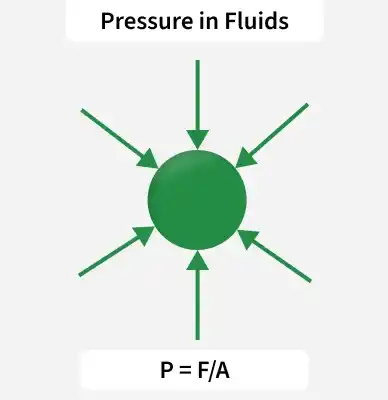
Pascal's Law states that when an external pressure is applied to a confined liquid, the pressure is transmitted equally in all directions throughout the liquid.
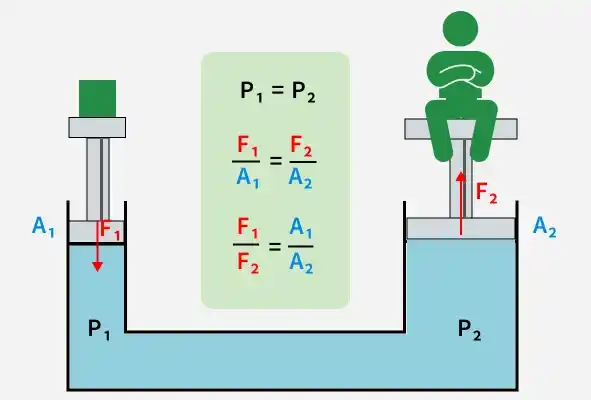
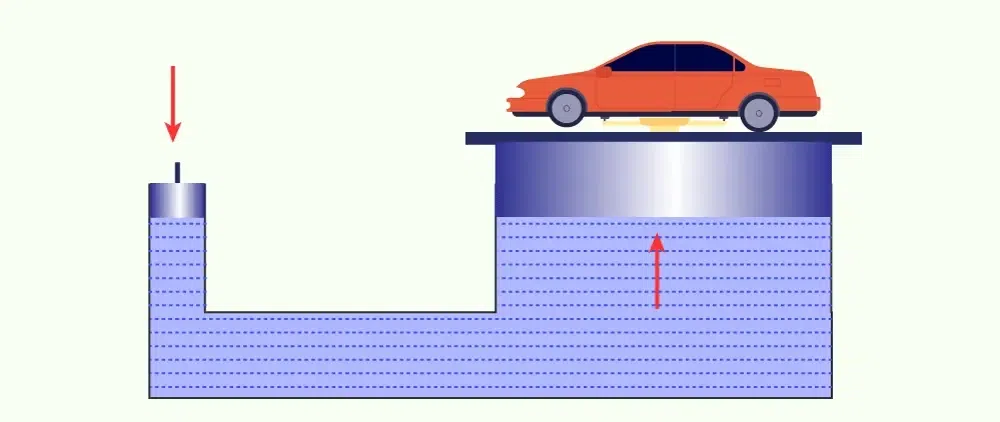
Example: Consider a hydraulic lift system with two piston areas connected by fluid-filled cylinders as given in the figure below. Small force F1 on smaller piston area A1 creates pressure
This produces a greater force
Formula
Pressure is defined as the ratio of the Force and the cross-sectional area on which that force is applied, mathematically we can represent the same as follows:
P = \frac{F}{A}
- P is pressure
- F is the applied force
- and A is the cross sectional area.
Difference of Pressure in Column
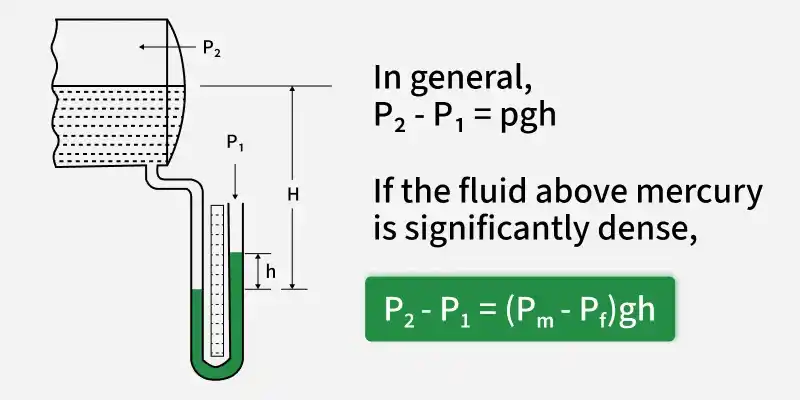
The figure shows a cylindrical element submerged in the fluid of density ρ, of area A, and height h. Let the pressure at the top of the element be P1 and P2 at the bottom. Let us assume that the weight of the liquid is "mg" in this element. Then the difference in pressures between the two points is given by,
P1 - P2 = mg/A
Now, as the density of the liquid is "ρ", then the mass of the liquid in the element will be,
m = ρ(A.h)
or
m = ρ.A.h
Plugging this value of m in the above equation for the pressure difference,
P1 - P2 = ρgh
This extra pressure with the height “h” is called gauge pressure.
Derivation
Let us consider a right-angled triangle(with sides p, q, and r) prism (height s) submerged in the liquid of density ρ, also assume the size of the submersed element is negligible with compare to the volume of the liquid, and all the points on the element experience the same gravitational force.
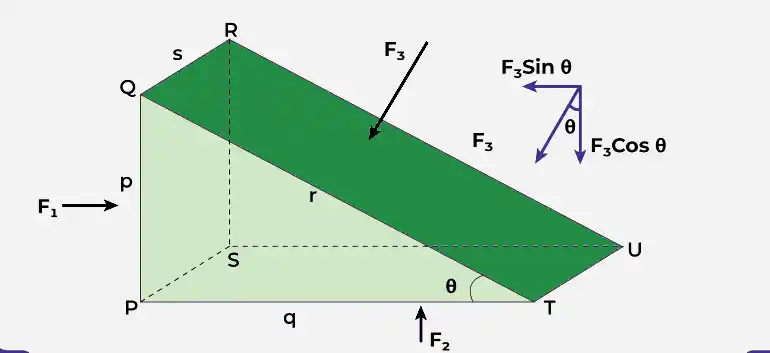
Now, the area of the faces PQRS, PSUT, and QRUT of the prism is ps, qs, and rs, respectively. Also, assume the pressure applied by the liquid on these faces is P1, P2, and P3, respectively.
The exerted force by this pressure on the faces in the perpendicular inward direction is F1, F2, and F3.
Thus, F1 = P1 × Area of PQRS = P1 × ps
F2 = P2 × Area of PSUT = P2 × qs
F3 = P3 × Area of QRUT = P3 × rs
Now, in triangle PQT,
sin θ = p/r and cos θ = q/r
The net force on the prism will be zero since the prism is in equilibrium.
F3 sin θ = F1 and F3 cos θ = F2 (putting values of F1, F2, and F3 from the above values)
⇒ P3 × rs × p/r = P1 × ps and P3 × rs × q/r = P2 × qs
⇒ P3 = P1 and P3 = P2
Thus, P1 = P2 = P3
Therefore, pressure throughout the liquid remains the same.
Applications of Pascal's Law
The application of Pascal's Law can be seen throughout industries. Some of the applications are as follows:
1. Hydraulic Lift
By applying Pascal's Law of transmission in real life, we can use it to lift heavy equipment such as cars, trucks, cargo containers, etc. As the ratio of force and the cross-sectional area remains constant throughout the liquid, applying a small force to the small cross-sectional area can exert a higher force at a high cross-sectional area, so that ratio remains the same. The image added below shows a hydraulic lift lifting a vehicle.
2. Hydraulic Jack
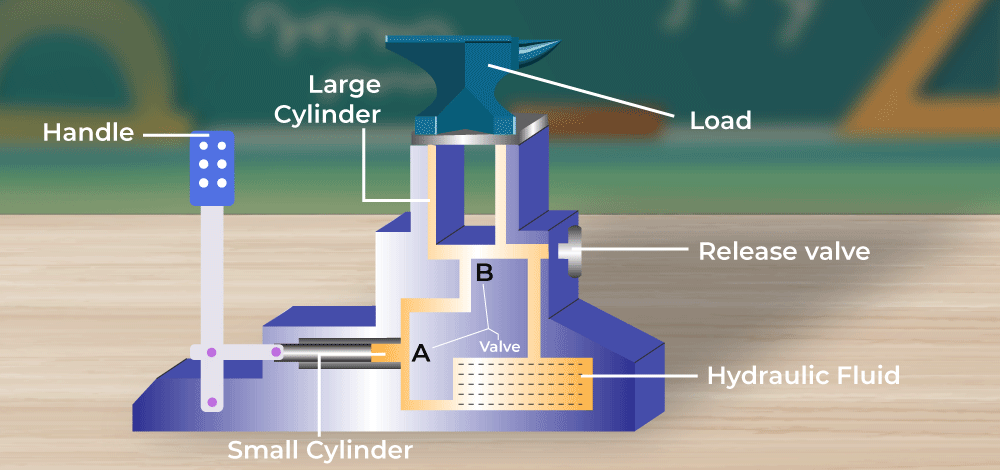
Hydraulic Jacki is the less powerful version of the Hydraulic lift, which can help us lift our cars or heavy motor vehicles partially for maintenance and other purposes. It uses the same principle but on a small scale. The hydraulic jack is shown in the image below.
Other than the above-mentioned use cases, Hydraulic Braking Systems and Hydraulic Pumps also leverage the same principles to stop cars/heavy motor vehicles and pump water, respectively.
Solved Problems
Question 1: Find the pressure difference that comes when someone goes 8m deep inside the water. Given, the density of water = 900Kg/m3.
Solution: The difference between the pressures is given by,
P1 - P2 = dgh
Given: d = 900, g = 10 and h = 8
P1 - P2 = dgh
⇒P1 - P2 = (900)(10)(8)
⇒P1 - P2 = 72 × 103 Kg/m2
Question 2: Find the pressure difference that comes when someone goes 5 m deep inside a liquid. Given the density of liquid = 100Kg/m3.
Solution: The difference between the pressures is given by,
P1 - P2 = dgh
Given: d = 100, g = 10 and h = 5
P1 - P2 = dgh
⇒ P1 - P2 = (100)(10)(5)
⇒ P1 - P2 = 5 x 10³ Kg/m2
Question 3: A hydraulic system has pistons at its two ends. The area of the pistons is given by A1 = 1m2 and A2 = 0.2m2. A Force of 80N is applied on the piston with a smaller area. Find the force on the other end.
Solution: In a hydraulic system, the force on the other end is given by,
F_2 = \frac{F_1A_2}{A_1} Given: A1 = 1m2 and A2 = 0.2m2. F1 = 80N
Plugging the values in the equation,
F_2 = \frac{F_1A_2}{A_1} ⇒
F_2 = \frac{(80)(0.2)}{(1)} ⇒ F2 = 16N
Question 4: A hydraulic system has circular pistons at the two ends. The radius of these pistons is 30cm and 60cm. A 50 kg box is kept on the piston with a 40cm radius. Find the force that should be applied at the other end.
Solution: In a hydraulic system, the force on the other end is given by,
F_2 = \frac{F_1A_2}{A_1} Given: A1 =
\pi(0.3)^2 m2 and A2 =\pi(0.6)^2 m2. F2 = 500NPlugging the values into the equation,
F_2 = \frac{F_1A_2}{A_1} ⇒
500 = \frac{F_1(\pi (0.6)^2)}{(\pi (0.3)^2)} ⇒
\frac{500}{4} = F_1 ⇒ F1 = 125N
Question 5: In a car wash, the hydraulic system has pistons at its two ends. The area of the pistons is given by A1 = 0.5m2 and A2 = 4m2. A Force of 80N is applied to the piston with a smaller area. Find the force on the other end.
Solution: In a hydraulic system, the force on the other end is given by,
F_2 = \frac{F_1A_2}{A_1} Given: A1 = 0.5m2 and A2 = 4m2. F1 = 80N
Plugging the values into the equation,
F_2 = \frac{F_1A_2}{A_1} ⇒
F_2 = \frac{(80)(4)}{(0.5)} ⇒ F2 = 640 N
Unsolved Problems
Question 1: A hydraulic lift has a small piston of area 0.02 m² and a large piston of area 0.5 m². If a force of 100 N is applied on the small piston, find the force exerted on the large piston.
Question 2: A piston of area 0.1 m² is pressing a fluid, creating a pressure of 2000 Pa. Find the force applied on the piston.
Question 3: A cylinder filled with liquid has two pistons at its ends. The smaller piston has an area of 0.05 m² and the larger piston 0.2 m². A force of 50 N is applied to the small piston. Find the force on the large piston.
Question 4: A hydraulic jack is used to lift a car of mass 800 kg. The jack has a small piston of area 0.01 m² and a large piston of area 0.5 m². Find the force required on the small piston. (Take g = 10 m/s²)
Question 5: A hydraulic lift has two circular pistons of radius 0.15 m and 0.6 m. A car of weight 12,000 N is on the large piston. Find the force required on the smaller piston to lift the car.