Relative motion explains how the position or velocity of an object changes with respect to another object or observer. In physics, motion is always measured using a frame of reference, which may itself be moving.
Motion is not absolute. An object can be moving relative to one observer and at rest relative to another. Therefore, motion is a combined effect of both the object being observed and the observer’s frame of reference.
Relative motion is especially useful when analyzing situations involving multiple moving objects, such as cars on a road, boats in a river, or airplanes in the air.
A person walking inside a moving train appears at rest to another passenger in the train, but the same person appears to be moving to someone standing on the ground. This shows that motion depends on the observer.
Position-Time Graphs Depicting Relative Velocity
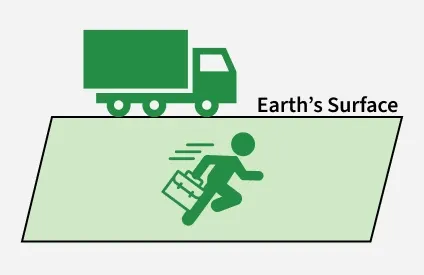
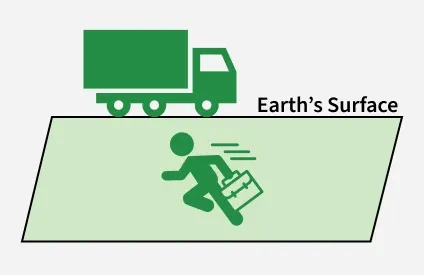
In the above carousel these are the three cases shown
Case 1: Two objects moving in the same direction with equal velocities.
Case 2: Two objects moving with different velocities in the same direction.
Case 3: Two objects moving with different velocities but in opposite directions.
Reference of Frame
A reference frame is a set of axes used to observe the motion of an object.
Motion is always described with respect to a reference frame.
A reference frame can be stationary or moving.
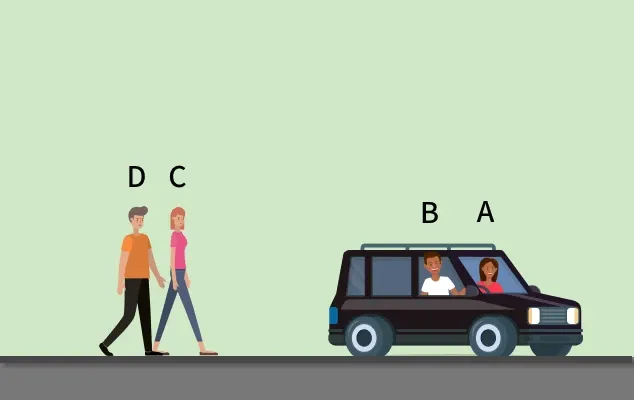
In the Above Image Consider a car moving with constant speed carrying two passengers, A and B. At the same time, two other people, C and D, are standing still on the ground and observing the car.
From the viewpoint of C and D, both A and B are moving along with the car. However, for A, B appears to be at rest since they share the same motion. In a similar way, C appears stationary to D, but to A and B inside the moving car, C and D seem to be moving backward.
Relative Velocity
Let us assume the initial position of two objects A and B are both at origin, at points xA (0) and xB (0) respectively. The corresponding positions of these objects at time instance t will be equivalent to,
xA (t) = xA(0) + vAt
xB (t) = xB(0) + vBt
Displacement from object A to B is given by,
xB(t) - xA(t) = [xB (0) - xA (0)] + (vB -vA)t
The velocity of B relative to A is given by,
vBA = vB – vA
The velocity of A relative to B is given by,
vAB = vA – vB
Relative Motion in One Dimension
In the case of relative motion in one dimension, the two objects must be in motion along the same axis but the motion and the velocity of the two objects can be either in the same or opposite direction. Hence, the following two cases arise:
Case 1: Objects may be moving in the same direction with reference to each other.
If the two are moving in the same direction, for instance, a train and a person with ground as the reference frame. The velocity of the train with respect to the person can be written as:
\boxed{\vec{v}_{TP}= \vec{v}_{TG}-\vec{v}_{Pg}}\space \space m/s
⁛ This speed can be considered to be positive as the speed of the train is greater than the person's.
Case 2: Objects may be moving in opposite directions with reference to each other.
If the two are moving in the opposite direction, for instance, a train and a person with ground as the reference frame. The velocity of the person with respect to the train can be written as:
\boxed{\vec{v}_{PT}= \vec{v}_{PG}+\vec{v}_{GT}}\space \space m/s
Equations of Motion for Relative motion
v_{rel} =u_{rel}+a_{rel}t
s_{rel}=u_{rel}t+\frac{1}{2}a_{rel}t^2
v_{rel}^2 = u_{rel}^2+ 2a_{rel}s
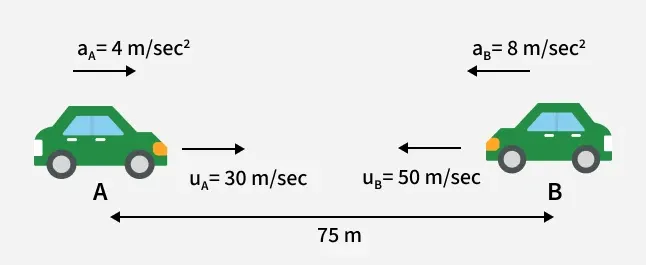
Example:- Two cars A & B initially separated by 150 meters, start moving towards each other at t=0 along a straight line aA=4m/sec2 , uA=30m/sec, and aB=8m/sec2, uB=50m/sec. calculate the time when would they meet?
Solution:
Lets sit on the car A and the car B would acts as the origin and as well as at rest, therefore the relative components of cars would be :-
Problem 1: The elevator is moving in an upward direction with a uniform acceleration 'a' m/s2. The man throws a rubber ball in the upward direction with a velocity 'v' relative to the lift. The man catches the ball after a time instance of t seconds. Show that a + g = 2v/t.
Solution:
The lift frame can be assumed to be the point of reference. Therefore, the aspects of motion, acceleration, displacement, and velocity will be considered from the point of reference. When the ball returns to the man, therefore, the displacement from the lift frame becomes zero. Let us assume the velocity of the object with respect to the lift frame is v.
g - (-a) = a + g (↓) downwards
Now, s = ut + \frac{1}{2}at^2
⇒ 0 = vt - \frac{1}{2} (a+g)t^2
a + g = 2(v/t) .
Problem 2: The two trains move with different velocities, t1 with 10 m/s and t2 with 15 m/s on parallel tracks in reference to each other. Compute the relative velocity of train t1 with respect to t2.
Solution:
Given,
v1 = 10 ms-1
v2 = 15 ms-1
Relative velocity of slow train w.r.t. the fast train = v1 - v2 = 10 – 15 = - 5 ms-1
Negative sign shows that slow train appears to move westward w.r.t. fast train with a velocity of 5 ms-1.
Problem 3: Cart A is moving with a velocity of 40 ms-1 from North to South along one track, while cart B is moving in an opposite direction to the previous card with a speed of 30 ms-1 from South to North. Calculate the relative velocities of both the carts with each other.
Solution:
Let us consider the direction from North to South to be positive.
Therefore,
vA = +40 ms-1
vB = -30 ms-1
(i) Relative velocity of B w.r.t. A = vB - vA = -30 - 40 = - 70 ms-1
Therefore, cart B appears to move from South to North with a speed of 70 ms-1 for any person sitting in cart A.
(ii) Velocity of the ground, vB = 0, since it is a stationary object.
Relative velocity of ground w.rt. A = vB - vA = 0 - 40 = - 40 ms-1
Therefore, the ground appears to move from the south to north direction with a speed of 40 ms-1 w.r.t. cart A.
Unsolved Questions
Q1. A boat takes two hours to travel 8 km down and 8 km up the river when the water is still. How much time will the boat take to make the same trip when the river starts flowing at 4 kmph?
Q2. A taxi leaves the station X for station Y every 10 minutes. Simultaneously, a taxi leaves the station Y also for station X every 10 minutes. The taxis move at the same constant speed and go from X to Y or vice-versa in 2 hours. How many taxis coming from the other side will each taxi meet enroute from Y to X ?
Q3. A ball is dropped from the top of a building of height 80 m. At same instant another ball is thrown upwards with speed 50 m/s from the bottom of the building. The time at which balls will meet is
Q4. Two cars A and B are moving in same direction with velocities 30 m/s and 20 m/s. When car A is at a distance d behind the car B, the driver of the car A applies brakes producing uniform retardation of 2m /sec2 There will be no collision when