
Elasticity is the property of a material that enables it to regain its original shape and size after the removal of an external force that caused deformation. Although materials like rubber appear highly stretchable, elasticity is defined by how effectively a material returns to its original form. They are more elastic because they return to their original shape more completely after the deforming force is removed.
Stress and Strain
When a force is applied to an elastic body, it undergoes a temporary deformation that depends on the material. This deformation creates a restoring force that tries to return the body to its original shape. Stress is defined as restoring force per unit area. If F is the applied force and A is the area, then the relationship can be expressed as follows:
Stress =
Strain is defined as the ratio of the change in dimension to the original dimension of a body. It measures the amount of deformation produced due to applied stress. Example: when tensile or compressive stress is applied to a cylinder, its length changes, resulting in longitudinal strain.
Let
\Delta L be the change in length of the cylinder, and L be the original length. This is called longitudinal strain. It is given by,
\text{Longitudinal Strain }= \frac{\Delta L}{L} In the case of shearing stress,
\text{Shearing Strain }= \frac{x}{L} = tan(\theta) Here,
\theta is the angular displacement of the cylinder from its mean position.When hydraulic stress is applied, the body changes its volume. In this case, volumetric strain is used.
\text{Volumetric Strain }= \frac{\Delta V}{V}
Hooke's Law
Hooke’s Law is based on experimental observations and is valid for most materials within the elastic limit. It describes the relationship between stress and strain through a stress-strain curve, which varies for different materials, and explains their behavior under different loading conditions. The law is applicable only for small deformations. Within the elastic limit, stress is directly proportional to strain.
Stress ∝ Strain
⇒ Stress = k x Strain
k is the proportionality constant and is called the modulus of elasticity.
Elastic Potential Energy
Elastic potential energy is the energy stored in a body when it is deformed. When a force changes the shape or size of an object, work is done against the restoring force, and this work is stored as potential energy. This stored energy is known as elastic potential energy. In many cases, objects are specially designed to store elastic potential energy.
- An ideal spring
- An ideal spring is a bouncy ball that compresses when it hits the ground.
- An archer's stretched bow.
Elastic potential energy is stored in the spring.
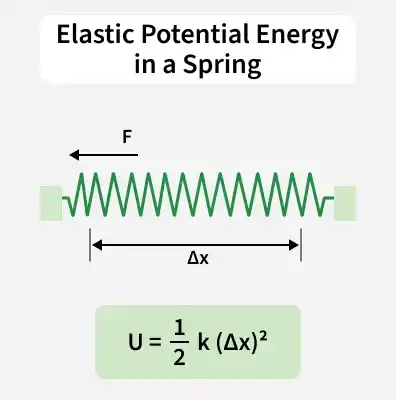
According to Hooke's Law, when a force F compresses a spring and changes its length by Δx, a restoring force works to bring it back to its original length. The work done during this deformation can be calculated using integration or by finding the area under the force-displacement curve. The elastic potential energy stored in the spring is equal to the work done on it.
Elastic Potential energy stored in the spring = Work done by the force
Elastic Potential energy stored in other elastic materials
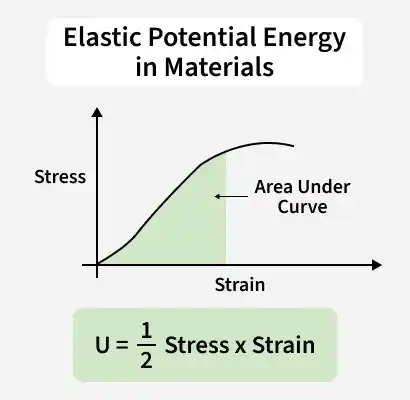
A spring is a common example of a device designed to utilize the elastic properties of a material. In general, the amount of energy stored in a material due to compression or extension is determined by its stress-strain curve. The area under the stress-strain curve represents the elastic potential energy stored in the material as a result of the work done by the restoring force.
In the case of three-dimensional materials that obey Hooke's Law,
Elastic Potential Energy =
Sample Problems
Question 1: A cube of side 2 m shrinks in size to a length of 0.5 m when hydraulic stress is applied. Find the volumetric strain.
Solution: Volumetric strain is given by,
\text{Volumetric Strain }= \frac{\Delta V}{V} The volume of a cube is given by A
V = a3
Initial radius: ai = 2 m
Final radius: af = 0.5m
Change in Volume =
a_f^3 - a_i^3 =
(0.5)^3-2^3 = -7.875
Original Volume = a3
= 8
Volumetric Strain =
\frac{\text{Change in Volume}}{\text{Original Volume}} =
\frac{a_f^3 - a_i^3}{a_i^3} =
\frac{-7.875}{8} = - 0.984
Question 2: A sphere with a radius of 2 m shrinks in size to a radius of 1 m when hydraulic stress is applied. Find the volumetric strain.
Solution:
\text{Volumetric Strain }= \frac{\Delta V}{V} The volume of a sphere is given by A
V =
\frac{4}{3}\pi r^3 Initial radius: ri = 2 m
Final radius: rf = 1 m
Initial Volume
V_i = \frac{4}{3}\pi (2^3)
= \frac{4}{3}\pi (8)
= \frac{32}{3}\pi Final Volume
V_f = \frac{4}{3}\pi (1^3)
= \frac{4}{3}\pi Change in volume
\Delta V = V_f - V_i
= \frac{4}{3}\pi - \frac{32}{3}\pi
= -\frac{28}{3}\pi Volume Strain =
\frac{\Delta V}{V_i}
= \frac{-\frac{28}{3}\pi}{\frac{32}{3}\pi}
= -\frac{28}{32}
= -0.875
Question 3: A spring with k = 50 N/m is compressed from its natural length of 1 m to 0.5 m. Find the elastic potential energy stored in the spring.
Solution: The energy stored in the spring is given by,
E.P.E =
\frac{1}{2}k(\Delta x)^2 Here, k = 50N/m and
\Delta x = 0.5 Plugging the values into the given equation,
E.P.E =
\frac{1}{2}k(\Delta x)^2 ⇒ E.P.E =
\frac{1}{2}(50)(0.5)^2 ⇒ E.P.E = (25)(0.25)
⇒ E.P.E = 6.25J
Question 4: A spring with k = 100 N/m is compressed from its natural length of 2 m to 1 m. Find the elastic potential energy stored in the spring.
Solution: The energy stored in the spring is given by,
E.P.E =
\frac{1}{2}k(\Delta x)^2 Here, k = 100N/m and
\Delta x = 1 Plugging the values into the given equation,
E.P.E =
\frac{1}{2}k(\Delta x)^2 ⇒ E.P.E =
\frac{1}{2}(100)(1)^2 ⇒ E.P.E = 50J
Question 5: A spring with k = 100 N/m is compressed from its natural length to 0.5 m. If the elastic potential energy stored in the spring is 10 J, find the natural length of the spring.
Solution: The energy stored in a spring is given
E = \frac{1}{2}k(\Delta x)^2 Given
k = 100\,\text{N/m}
E = 10\,\text{J} Final Length =
0.5\,\text{m} Let natural length = xi
Substituting into the formula
10 = \frac{1}{2}(100)(x_i - 0.5)^2
10 = 50(x_i - 0.5)^2
\frac{10}{50} = (x_i - 0.5)^2
0.2 = (x_i - 0.5)^2 Taking square root
x_i - 0.5 = \sqrt{0.2}
x_i - 0.5 = 0.447
\boxed{x_i = 0.947\,\text{m}}
Unsolved Problems
Question 1: A wire of length 5 m elongates by 5 mm under a tensile force. Calculate the longitudinal strain.
Question 2: A force of 800 N acts perpendicular on a surface area of 0.2 m². Find the stress produced in the material.
Question 3: A spring with spring constant k=150 N/m is compressed by 0.4 m. Find the elastic potential energy stored in the spring.
Question 4: A rod of length 2 m and cross-sectional area 0.01 m² is subjected to a tensile force of 20,000 N. If the modulus of elasticity of the material is 2×10¹¹ N/m2 . Find the extension produced in the rod.