
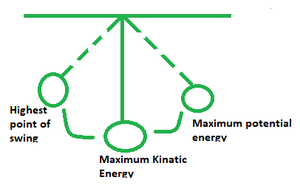
Oscillatory motion is a type of motion in which an object moves repeatedly about a fixed position called the equilibrium position. In an ideal condition, such as a perfect vacuum, oscillations can continue for a longer time because there is no air resistance or friction to oppose the motion.
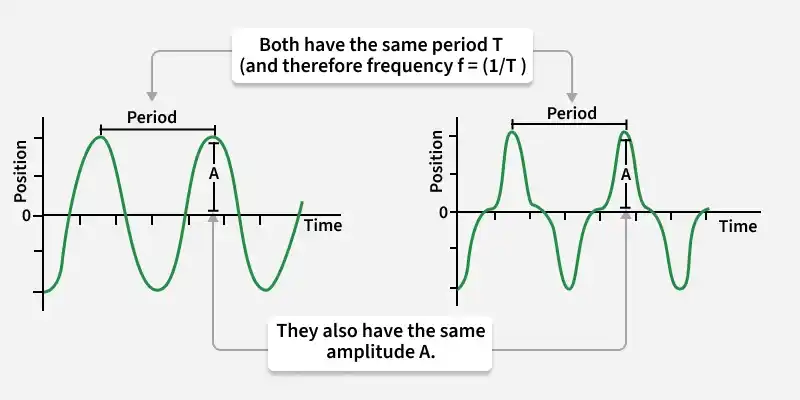
The graph shows how the displacement of an oscillating object changes over time. The smooth repeating curve represents periodic motion. The maximum height from the center is the amplitude (A), and the horizontal distance between similar points is the period (T). The object moves regularly and from its equilibrium position, illustrating oscillatory motion.
Hooke's Law
Basic Harmonic Motion (SHM) is a type of oscillatory motion where the restoring force is directly proportional to the displacement from the equilibrium position. This is known as Hooke's Law. Example: Assume a mass m block is linked at one end with a long spring (spring constant k), and the other end is anchored to the wall. Hooke's law expresses the restoring force that attempts to repair the deformation of a spring.
Formula:
T =
2\pi \sqrt{\frac{l}{g}} where,
- l denotes the length of the pendulum
- g denotes the acceleration due to gravity
Sample Problems
Question 1: Find the length of a pendulum with a period of 0.7 s.
Solution: The period of a pendulum of length l = T =
2\pi \sqrt{\frac{l}{g}} ⇒
T^2 = 4\pi^2 \times {\frac{l}{g}}\\⇒ L = \frac{T^2}{4\pi^2}\times g\\=\frac{(0.7)^2}{4\pi^2}\times 9.8 L = 0.121 m
Question 2: Assuming g is constant, when does a simple pendulum double its period?
Solution:
T = 2\pi \sqrt{\frac{l}{g}} If the length were to be made four times the original, the period becomes
T' = 2\pi \sqrt{\frac{4l}{g}}=2[2\pi \sqrt{\frac{l}{g}}] = 2T
Hence you need to make the length four times its original value in order to achieve double period, given g is constant.
Question 3: If the length of a simple pendulum is increased from 0.25 m to 1 m, how many times will the period increase?
Solution: Formula for period of pendulum
T = 2\pi \sqrt{\frac{L}{g}} Relate periods T1 and T2
\frac{T_2}{T_1} = \frac{2\pi \sqrt{\frac{L_2}{g}}}{2\pi \sqrt{\frac{L_1}{g}}}
= \sqrt{\frac{L_2}{L_1}} Substitute the given lengths
\frac{T_2}{T_1} = \sqrt{\frac{1}{0.25}}
\frac{T_2}{T_1} = \sqrt{4}=2 The period T2 is 2 times the original period T1
Question 4: A pendulum has a time period T = 1.5 s. Find the length of the pendulum. (g=9.8 m/s2).
Solution:
T = 2\pi \sqrt{\frac{L}{g}}
L = \frac{T^2 g}{4\pi^2} Substitute values
L = \frac{(1.5)^2 \times 9.8}{4\pi^2}
L = \frac{2.25 \times 9.8}{39.48}
L \approx 0.56 \, \text{m}
Unsolved Problems
Question 1: A simple pendulum has a length of 0.64 m. Calculate its time period.
Question 2: Find the length of a simple pendulum whose time period is 2.2 s.
Question 3: The length of a pendulum is increased from 0.40 m to 1.60 m. Determine the ratio of the new time period to the original time period.
Question 4: A pendulum has a time period of 1.8 s on Earth. What will be its time period if the acceleration due to gravity becomes one-fourth of its original value?
Question 5: If the time period of a simple pendulum is doubled, by what factor should its length be changed?