
Motion is the change in position of an object with respect to time and a reference point. In simple words, an object is said to be in motion if its position changes over time when compared to a fixed point around it. If an object does not change its position with time, it is said to be at rest.
Example
- A car moving on a road
- The hands of a clock moving
- A ball rolling on the ground
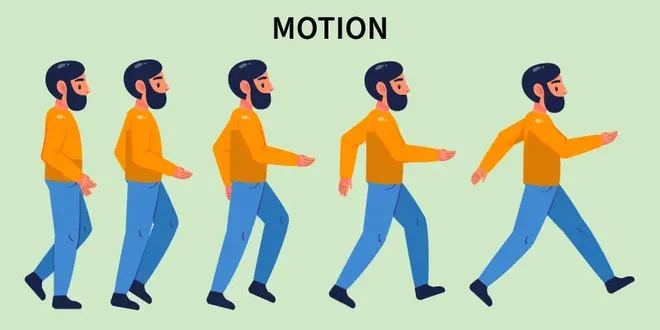
Note: Motion is always described relative to a reference point. For example, a person sitting in a moving bus appears at rest to another passenger inside the bus but appears in motion to a person standing on the roadside.
Parameters of Motion
There are five main parameters that affect the motion of the objects; they are:
1. Distance

Distance is the total length of the path traveled by an object, regardless of direction.
- It is a scalar quantity, meaning it has only magnitude and no direction.
- Distance always has a positive value.
- It gives information about the actual path followed by the object.
- Formula(only when speed is constant): d = v x t (Distance = Speed × Time)
- Unit: meter (m)
- Dimensional Formula: [L]
The distance of a body gives the descriptive route information being followed by an object from one point to another. The distance is denoted by the symbol 'd'.
2. Displacement
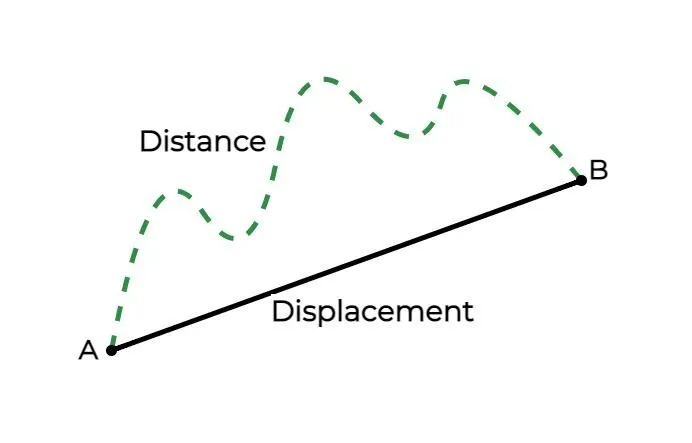
Displacement is the shortest straight-line distance between the initial and final positions of an object, including direction.
- It is a vector quantity, meaning it has both magnitude and direction.
- It depends only on the initial and final positions, not on the path taken.
- Displacement can be positive, negative, or zero.
- Formula: Δs = sf − si (Displacement = Final position - Initial position)
- Unit: meter (m)
- Dimensional Formula: [L]
Displacement is often denoted by the symbol s or Δx.
3. Speed
Speed is the rate at which an object covers distance.
- It is a scalar quantity, so it has only magnitude and no direction.
- Formula: v = d/t (Speed = Distance ÷ Time)
- Unit: meters per second (m/s)
- Dimensional Formula: [LT⁻¹]
The unit of speed is different in different systems, as shown below:
CGS system cm/s SI system m/s
4. Velocity
Velocity is defined as the rate of change of displacement with respect to time.
- It is a vector quantity, meaning it has both magnitude and direction.
- Velocity represents how fast an object is moving and in which direction it moves.
- Unit: meters per second (m/s)
- Dimensional Formula: [LT⁻¹]
- Formula: v = Δs / Δt
Speed describes only the magnitude of motion, while velocity includes both magnitude and direction. Therefore, velocity gives a more complete description of motion.
5. Time
Time is the duration over which motion occurs. It is a scalar quantity measured by the interval between two events.
- Common Units: seconds (s), minutes (min), hours (h)
- Dimensional Formula: [T]
Putting It All Together
By observing distance, displacement, speed/velocity, and time, you can describe any motion clearly—whether you’re watching a car drive, a ball roll, or a bird fly.
Try observing: Next time you’re outside, measure how far you walk (distance), where you started and ended (displacement), how fast you moved (speed/velocity), and how long it took (time). Then use these clues and formulas to explain your motion!
Types of Motions
The motion of an object does not depend on force for its continuation. However, force is needed to change its motion, such as starting, stopping, or changing direction.
A. Linear Motion
Linear motion is when an object moves along a straight line. It can be forward or backward but always in one direction.
Example: A car driving straight down a road or a person walking in a straight line.
B. Circular Motion
Circular motion occurs when an object moves along a circular path around a fixed center. In uniform circular motion, the speed remains constant, but the velocity continuously changes because the direction of motion changes at every point.
Example: A Ferris wheel spinning, or the hands of a clock moving.
C. Rotational Motion
Rotational motion is when an object spins around a fixed axis or point inside it.
Example: A spinning top, the Earth rotating on its axis, or a fan’s blades turning.
D. Periodic Motion
Periodic motion is a regular, repeating motion that happens over and over after equal intervals of time.
Example: A swinging pendulum, or a child rocking back and forth on a swing.
E. Oscillatory Motion
Oscillatory motion is a type of periodic motion where an object moves back and forth about a fixed position, often called to-and-fro motion.
Example: The motion of a vibrating guitar string or a playground swing.
F. Projectile Motion
Projectile motion is the curved path that an object follows when it is thrown or launched into the air under the influence of gravity. It combines horizontal and vertical motion.
Example: Throwing a ball or a stone thrown into the air.
G. Random Motion
Random motion has no fixed or predictable pattern and is often seen in tiny particles moving in fluids or gases.
Example: The movement of dust particles floating in the air or molecules in a gas.
Types of Motion Based on Direction
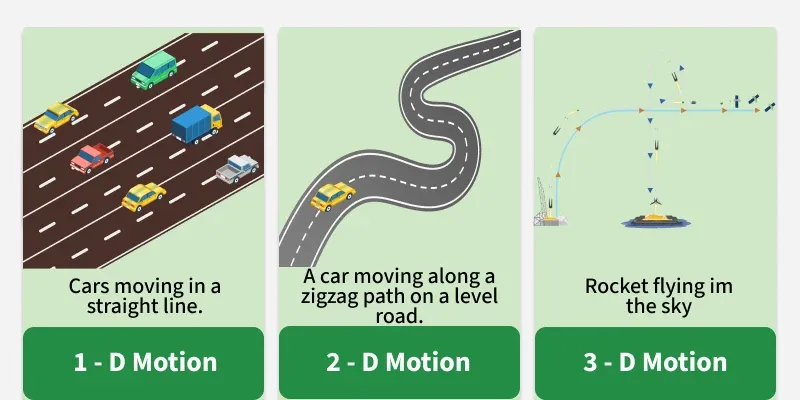
There are three types of motion in physics as per the direction of motion:
A. One-Dimensional Motion (1D)
When an object moves along a single straight line—forward or backward—its motion is called one-dimensional motion. The path is simple: just back and forth or straight ahead.
Example: A car driving down a straight road; a person walking in a hallway.
B. Two-Dimensional Motion (2D)
This happens when an object moves in a plane, changing position in two directions—usually horizontal and vertical or sideways as well as forward. The path is more complex than a straight line and can curve or zigzag.
Example: A soccer ball kicked across a field, planets orbiting the sun, or a Frisbee moving forward and sideways.
C. Three-Dimensional Motion (3D)
When an object moves freely in all three directions—up/down, left/right, and forward/backward—its motion is three-dimensional. The object can move through space in any possible direction.
Example: A drone flying through the sky changing altitude and direction, birds soaring and diving, and the motion of molecules inside the air.
Grab three toys:
- A car (straight—one-dimensional)
- A frisbee (forward + sideways—two-dimensional)
- A drone (up, down, left, right—three-dimensional)
Which motions can you see in your room? Draw a map or take pictures of different paths!
Periodic vs Non-Periodic Motion
The difference between periodic and non-periodic motion can be understood by the following table:
Periodic Motion | Non-Periodic Motion |
|---|---|
| Periodic motion is a type of motion in which an object repeats its path at equal intervals of time | In non-periodic motion, the path followed by the object is not fixed and can be random. |
| The position of the object after a specific period of time can be predicted. | The position of the object after a specific period of time is hard to predict. |
| Examples: Oscillatory motion, Motion of planets around the sun, etc. | Examples: Earthquake vibrations, Random walking, etc. |