
The radius of Gyration is defined as the distance from the axis of rotation at which the entire mass of a body can be assumed to be concentrated so that its moment of inertia about that axis remains unchanged. It represents how the mass of a body is distributed about the axis of rotation.
Mathematically, it can be described as the root mean square distance from the given axis,
k = \sqrt{\frac{r_1^2 + r_2^2 + r_3^2 + \dots + r_n^2}{n}}
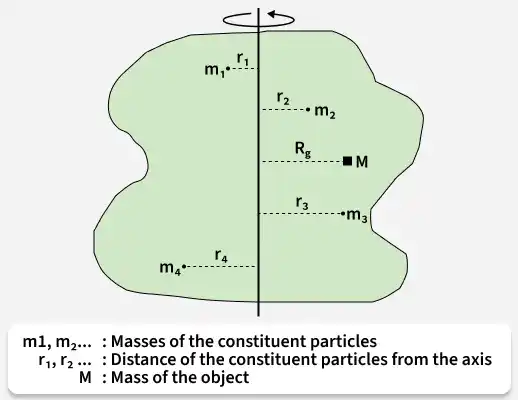
Formula
The radius of gyration can be expressed numerically as the root mean square distance of particles from the axis of rotation. The moment of inertia of a body of mass m is given by:
where k is the radius of gyration.
So, the formula for the radius of gyration can be given by:
Note: Equation (1) can be used to determine the moment of inertia of any rigid body by knowing its radius of gyration.
Now consider a body that consists of n particles, each with mass m, and the perpendicular distances of the particles from the axis of rotation are r1, r2, r3,..., rn.
Substituting these values in equation 1, the expression becomes:
But have to consider the mass of each particle as ' m ', so our equation becomes:
Multiply the right-hand side by n/n, the expression becomes:
Now, write mn as the M, which represents the body's overall mass.
So, the equation will become:
Substituting I = mk² in equation (4), the expression becomes:
From the above equation, the root-mean-square distance of the various body particles is referred to as the radius of gyration of that body.
Unit and Dimension: The radius of gyration is a distance, so its SI unit is meters (m), and its dimension is M0 L1 T0.
Factors Affecting Radius of Gyration
Shape and Size: Different shapes have different mass distributions, affecting the average distance from the axis. For example, a sphere has a smaller radius of gyration than a long, thin rod of the same mass.
Axis Position: The choice of rotational axis changes the radius of gyration. For instance, a cylinder’s value differs when rotated about its short or long axis.
Mass Distribution: Uneven mass distribution influences the radius parts farther from the axis, increasing the radius of gyration.
Radius of Gyration of Various Objects
The radius of gyration varies with distinct objects. The explanation of a few of them is below:
1. Radius of Gyration of Compound Pendulum
The radius of gyration of a compound pendulum depends upon its mass distribution. It is described as the distance from the axis of rotation to the point where the mass of the whole body is concentrated to produce the same moment of inertia as the actual mass distribution.
The formula to calculate the radius of gyration of a compound pendulum is given by:
K = \sqrt{\frac{I}{M}}
- I is the moment of Inertia of the pendulum and
- M is the mass of the pendulum
2. Radius of Gyration of a Solid Sphere
The moment of Inertia of a solid sphere about an axis passing through its center and perpendicular to its plane with mass M and radius R is given by:
I = \frac{2}{5} MR^2
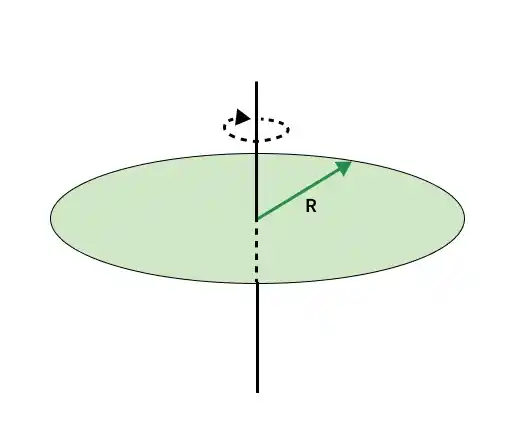
But Using I = MK2, so equation 1 becomes:
On canceling M from both sides and solving, the expression becomes:
By taking the square root, the expression becomes:
Hence, the radius of gyration of a sphere about its centre is given by
K = \sqrt{\frac{2}{5}}\, R
3. Radius of Gyration of Circular Ring
The Moment of Inertia of a Circular ring about an axis passing through the tangent of the ring in its plane with radius R can be calculated by the parallel axis theorem. According to this the expression becomes:
I = Icom + Md2 , Here d = R,
I = \frac{3}{2} MR^2
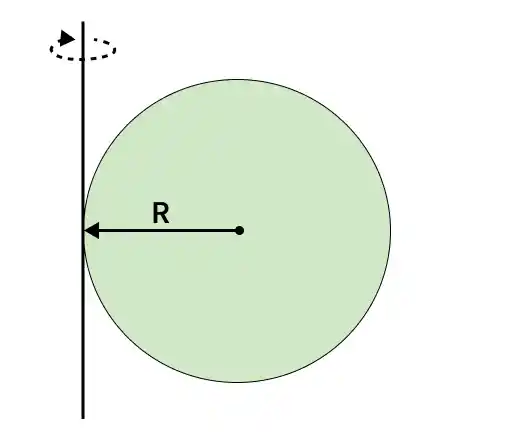
Using I = MK2, so equation 1 becomes:
On cancelling M from both sides and solving, the expression becomes:
By taking the square root on both sides, the expression becomes:
Hence, the radius of gyration of a Circular ring about its tangent is given by
K = \sqrt{\frac{3}{2}}\, R
4. Radius of Gyration of Disc
The Moment of Inertia of a disc about an axis passing through its center and perpendicular to its plane, with radius R and mass M, is:
I = \frac{1}{2} MR^2
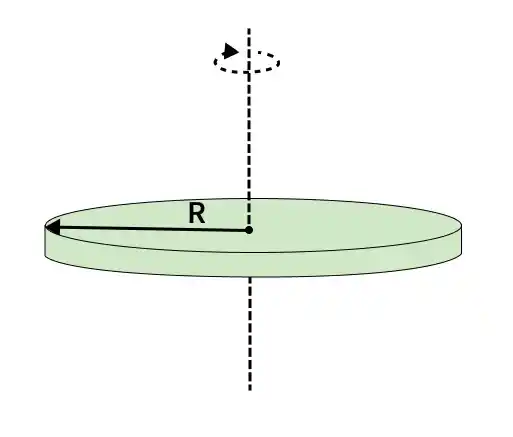
Using I = MK2, so equation 1 becomes:
On canceling M from both sides and solving, the expression becomes:
By taking the square root, we get:
Hence, the radius of gyration of a disc is given by
K = \frac{R}{\sqrt{2}}
5. Radius of Gyration of Thin Rod
The moment of inertia of a uniform rod about an axis passing through its center and perpendicular to its plane with mass M and length L is given by:
I = \frac{ML^2}{12}
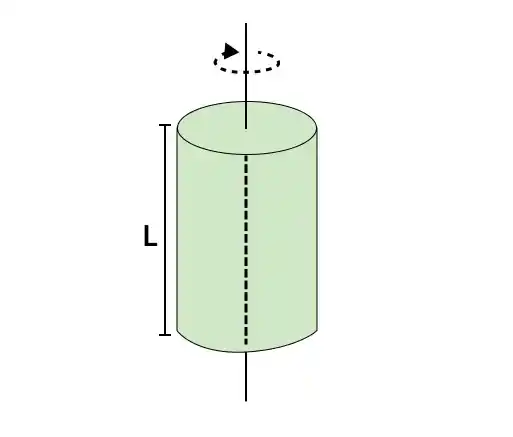
If K is the radius of the thin rod about an axis, then the equation will be
By equating the value of the moment of Inertia, the expression becomes:
On canceling M from both sides and solving, the expression becomes:
By taking the square root, we get:
Hence, the radius of gyration of a thin rod is given by Kence, the radius of gyration of a thin rod is given by
K = \frac{L}{\sqrt{12}}
Applications
- Structural Engineering: Helps assess the stability of structures and resistance to buckling.
- Mechanical Engineering: Determines moment of inertia, affecting rotating machinery performance.
- Biomechanics: Analyses mass distribution in body segments for movement and rehabilitation.
- Aerospace Engineering: Evaluates aircraft stability and control by considering component mass distribution.
- Sports Equipment Design: Optimizes mass distribution in equipment like tennis rackets or golf clubs for better performance.
Solved Problems
Question 1: Radius of gyration of a compound pendulum about the point of suspension is 100 mm. The distance between the point of suspension and the centre of mass is 250 mm. Considering the acceleration due to gravity is 9.81 m/s2. What will be the natural frequency (in radian/s) of the compound pendulum?
Solution: Given, Radius of Gyration(k) = 100mm = 0.1 m
Using Moment of Inertia(I) = mk2
Putting k = 0.1 in the above equation, we get
I = m(0.1)2 kg m2
Also, Using
I\ddot{θ} + mg. asinθ = 0 Here sinθ ≈ θ
I\ddot{θ} + mg. aθ = 0
\ddot{θ} + \frac{mga.θ}{I} = 0 We have,
I = m(0.1)2
a = 250 mm = 0.25 m
g = 9.81 m/s2
\ddot{θ} + \frac{m9.81\times 2.5 \times θ}{m(0.1)^2} = 0
\ddot{θ} + (245.25) θ= 0 ωn=√245.25 = 15.660 rad/s
Hence, the natural frequency of the compound pendulum is 15.660 rad/s.
Question 2: Find the radius of gyration of a disc of mass M and radius 2m rotating about an axis passing through the center of mass and perpendicular to the plane of the disc.
Solution: Using that the radius of gyration of a disc is given by K = R/√2.
Given R = 2 m, putting the value in the above equation, we get
K = 2/ √2
K = √2 m
Hence, the radius of gyration of the given disc is √2 m.
Question 3: A uniform thin rod of length L = 1.5 m and mass M is rotating about an axis passing through one end and perpendicular to its length. Find the radius of gyration about this axis.
Solution: Moment of inertia of a rod about one end
I = \frac{1}{3} M L^2 Radius of gyration
K = \sqrt{\frac{I}{M}}
K = \sqrt{\frac{\frac{1}{3} M L^2}{M}} = \frac{L}{\sqrt{3}} Substituting L = 1.5 m
K = \frac{1.5}{\sqrt{3}} \approx 0.866
K \approx 0.866\, \text{m} \\[1em]
Question 4: A thin circular ring of radius R = 0.8 m and mass M rotates about an axis in its plane passing through its centre. Find its radius of gyration.
Solution: Moment of inertia of the ring about the axis in the plane
I = M R^2 Radius of gyration
K = \sqrt{\frac{I}{M}} = \sqrt{\frac{M R^2}{M}} = R Substituting R = 0.8 m
K = 0.8\, \text{m}
Unsolved problems
Question 1: A thin uniform rod of length 2 m and mass 3 kg is pivoted at a point one-third from one end. Find its radius of gyration about the pivot.
Question 2: A solid cylinder of mass 5 kg and radius 0.5 m rotates about its central axis. Determine its radius of gyration.
Question 3: A rectangular plate of width 1 m and height 2 m has a mass of 10 kg. Find its radius of gyration about an axis along the width passing through the center of mass.
Question 4: A uniform thin ring of radius 1.5 m and mass 4 kg rotates about an axis tangent to the ring in its plane. Find its radius of gyration about the tangent axis.
Question 5: A sphere of mass 2 kg and radius 0.6 m rotates about an axis passing through its surface (not center). Determine its radius of gyration about this axis.