
Fluids are substances that can flow and take the shape of their container. They include liquids and gases such as water, air, and oil. Solids have a fixed shape and volume, liquids have a fixed volume but no fixed shape, and gases have neither. Fluids can easily move and change their form when subjected to external forces, making them essential in various aspects of daily life and industry. The properties of fluids are:
1. Density: Density refers to the mass of a substance per unit volume. In fluids, it indicates how much matter is contained in a given volume. A denser fluid has more mass per unit volume, while a less dense fluid has less mass per unit volume. Density is measured in kg/m³ or g/cm³.
2. Viscosity: Viscosity is the measure of a fluid’s resistance to flow. It represents the internal friction within the fluid. High-viscosity fluids resist flow more than low-viscosity fluids. E.g., honey has high viscosity and flows slowly, whereas water has low viscosity and flows easily. Viscosity depends on factors such as temperature and composition and is commonly measured in Pascal-seconds (Pa·s) or centipoise (cP).
3. Surface Tension: Surface tension is the cohesive force that makes the surface of a liquid behave like a stretched elastic membrane. It occurs due to the attraction between molecules at the liquid’s surface. Surface tension causes effects such as capillary action and droplet formation. E.g., liquid droplets form a spherical shape because surface tension minimizes the surface area.
4. Compressibility: Compressibility is the change in volume of a fluid when pressure is applied. Gases are highly compressible because their particles are far apart, while liquids are nearly incompressible under normal conditions. E.g., air gets compressed inside a bicycle pump, increasing its pressure.
5. Fluidity: Fluidity is the fluid's ability to flow easily. It depends on factors such as viscosity and temperature. High fluidity means the fluid flows with little resistance, while low fluidity means greater resistance to flow. E.g., water has high fluidity, whereas molasses has low fluidity due to its high viscosity.
6. Thermal Expansion: Thermal expansion is the tendency of a substance to change in volume with a temperature change. As the temperature of a fluid increases, its particles move more rapidly, causing the fluid to expand. The coefficient of thermal expansion quantifies this relationship between volume change and temperature change. Eg: The expansion of mercury in a thermometer as it is exposed to heat causes the mercury level to rise.
Types of Fluid Flow
- Steady and Unsteady Flow: In steady flow, the velocity, pressure, and other flow properties at any point in the fluid remain constant over time. Conversely, unsteady flow involves variations in flow properties over time.
- Laminar and Turbulent Flow: concerning the chaotic and irregular motion of fluid particles resulting in mixing and eddy formation.
- Compressible and Incompressible Flow: Incompressible flow occurs when the density of the fluid remains constant, regardless of changes in pressure and temperature. Compressible flow involves changes in fluid density due to variations in pressure and temperature.
- Internal and External Flow: Internal flow occurs within enclosed boundaries such as pipes, ducts, and channels. External flow occurs over surfaces exposed to the fluid, such as flow over wings, airfoils, and vehicle bodies.
Reynolds Number
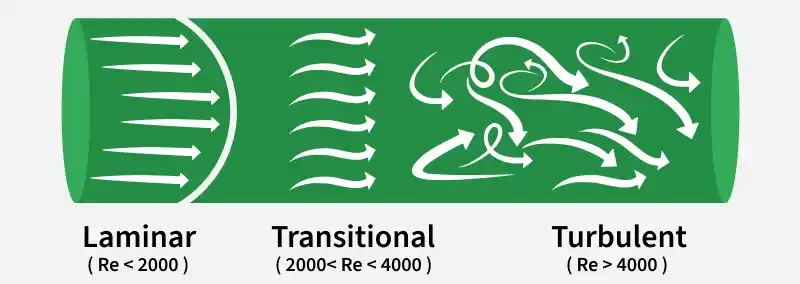
Reynolds Number is a dimensionless quantity used to predict the type of fluid flow in different situations. It helps determine whether the flow is laminar, turbulent, or transitional. It is calculated by dividing the product of fluid density, velocity, and characteristic length by the fluid’s viscosity.
Eg: In pipe flow, a low Reynolds number indicates laminar flow, which is smooth and orderly. A high Reynolds number indicates turbulent flow, which is chaotic and irregular. Therefore, the Reynolds number is important in designing pipelines and controlling fluid flow in engineering applications.
Poiseuille’s Equation
Poiseuille's equation describes the laminar flow of an incompressible fluid through a cylindrical pipe. It gives the volume flow rate and relates it to the pressure difference, viscosity of the fluid, length of the pipe, and radius of the pipe.
Stokes' Law
Stokes' Law describes the viscous force experienced by small spherical particles moving through a viscous fluid. It calculates the drag force on the particle and its terminal velocity, which depends on the fluid's viscosity, the particle's size, and the density difference between the particle and the fluid.
Where
- η = viscosity of fluid
- r = radius of particle
- v = velocity
Torricelli’s Law
Torricelli’s Law states that the velocity of a fluid flowing out of an orifice under gravity is equal to the square root of 2gh, where g is the acceleration due to gravity and h is the height of the fluid above the opening.
It is derived from Bernoulli’s equation and is used to calculate the speed of water flowing from tanks, dams, and similar containers.
Pascal’s Law
Pascal's Law states that when pressure is applied to a confined fluid at rest, it is transmitted equally and undiminished in all directions throughout the fluid. It is the fundamental principle behind hydraulic systems.
Applications include hydraulic lifts, jacks, and brakes. In hydraulic brakes, a small force applied to a small piston produces a larger force at a bigger piston, allowing heavy vehicles to be stopped efficiently.
Bernoulli’s Principle and Equation
Bernoulli's Principle Bernoulli’s Principle states that for an incompressible, non-viscous fluid flowing in a streamlined manner, the total mechanical energy per unit volume remains constant along a streamline. This means that if the velocity of a fluid increases, its pressure or potential energy decreases.
Equation:
Between two points:
Archimedes' Principle
Archimedes' principle states that when a body is fully or partially immersed in a fluid (liquid or gas), it experiences an upward force called the buoyant force. This buoyant force is equal to the weight of the fluid displaced by the body. Due to this upward force, objects appear lighter in a fluid and may float or sink depending on their density compared to the fluid.
Where:
- Fb = Buoyant force
- ρ = Density of fluid
- g = Acceleration due to gravity
- V = Volume of fluid displaced
Variation of Pressure with Height
According to hydrostatics, the pressure in a fluid at rest increases linearly with depth due to the weight of the fluid above. The hydrostatic pressure equation describes this variation, which is fundamental in understanding the fluid behavior in various natural and engineered systems.
For example, the pressure variation with height is essential in atmospheric science to understand weather phenomena such as atmospheric pressure gradients and the formation of high- and low-pressure systems. Meteorologists use this knowledge to forecast weather patterns and predict changes in atmospheric conditions.
Mechanical Properties of Fluid Formula
Law | Formula |
|---|---|
P = F/A (Pressure equals force divided by area) | |
Fb = ρ × g × V (Buoyant force equals density times gravitational acceleration times volume) | |
F = 6πηrv (Force equals six times pi times viscosity times radius times velocity) |
Related Articles:
Solved Problems
Question 1: Water of density 1000 kg/m³ and viscosity 0.001 Pa·s flows through a circular pipe of diameter 0.05 m with an average velocity of 2 m/s. Calculate the Reynolds number and state whether the flow is laminar, turbulent, or transitional.
Solution: Given
Density, ρ = 1000 kg/m³
Viscosity, η = 0.001 Pa·s
Pipe diameter, D = 0.05 m then radius, R = 0.025 m
Velocity, v = 2 m/s
Re = \frac{\rho v D}{\eta}
Re = \frac{1000 \times 2 \times 0.05}{0.001}
= \frac{100}{0.001} = 1 \times 10^5 Flow type
Laminar: Re < 2000
Turbulent: Re > 4000
Transitional: 2000 < Re < 4000
Re = 1 × 10⁵ > 4000, so the flow is turbulent.
Question 2: A solid cube of volume 0.02 m³ is completely submerged in water of density 1000 kg/m³. Calculate the buoyant force acting on the cube. (Take g = 9.8 m/s²)
Solution: Given
Volume of cube, V = 0.02 m³
Density of water, ρ = 1000 kg/m³
g = 9.8 m/s²
F_b=ρgV
Fb =1000×9.8×0.02
Buoyant force = 196 N
Question 3: Water flows steadily through a horizontal pipe. At point A, the pressure is 2 × 10⁵ Pa, and the velocity is 2 m/s. At another point (B), the velocity is 5 m/s. Calculate the pressure at point B. (Take density of water = 1000 kg/m³)
Solution: Given
P₁ = 2 × 10⁵ Pa, v₁ = 2 m/s
v₂ = 5 m/s
ρ = 1000 kg/m³
Horizontal pipe = h₁ = h₂ = ignore g terms
P_1 + \frac{1}{2} \rho v_1^2 = P_2 + \frac{1}{2} \rho v_2^2 Kinetic energy terms
\frac{1}{2} \rho v_1^2 = 0.5 \times 1000 \times 2^2 = 2000 \, \text{Pa}
\frac{1}{2} \rho v_2^2 = 0.5 \times 1000 \times 5^2 = 12500 \, \text{Pa} Bernoulli equation
P_2 = P_1 + \frac{1}{2} \rho v_1^2 - \frac{1}{2} \rho v_2^2
= 2 \times 10^5 + 2000 - 12500 = 187,500 \, \text{Pa}
\boxed{P_2 = 1.875 \times 10^5 \, \text{Pa}}
Question 4: A small spherical particle of radius 0.001 m and density 8000 kg/m³ falls through oil of density 900 kg/m³ and viscosity 0.5 Pa·s. Calculate the terminal velocity of the particle. (Take g = 9.8 m/s²)
Solution: Given
Particle radius, r = 0.001 m
Particle density, ρₚ = 8000 kg/m³
Fluid density, ρf = 900 kg/m³
Viscosity, η = 0.5 Pa·s
g = 9.8 m/s²
v_t = \frac{2 r^2 g (\rho_p - \rho_f)}{9 \eta}
\rho_p - \rho_f
= 8000 - 900 = 7100
r^2 = (0.001)^2 = 1 \times 10^{-6} \, \text{m²}
v_t = \frac{2 \times 1 \times 10^{-6} \times 9.8 \times 7100}{9 \times 0.5}
= \frac{0.13916}{4.5} \approx 0.0309 \, \text{m/s}
\boxed{v_t \approx 0.031 \, \text{m/s}}
Unsolved Problems
Question 1: Water in a tank is at a height of h = 8 m. Find the velocity of water as it exits through a small hole at the bottom. Use g=9.8 m/s².
Question 2: Water flows from a pipe section with a diameter of 0.12 m at a velocity of 1.5 m/s to a section with a diameter of 0.06 m. The pressure at the wider section is 120 kPa. Calculate the pressure at the narrower section.
Question 3: A cube of side 0.1 m and density 600 kg/m³ is fully submerged in water. Calculate the buoyant force acting on the cube. (Density of water = 1000 kg/m³)
Question 4: A hydraulic system has a small piston of area 0.02 m² and a large piston of area 0.4 m². If a force of 100 N is applied on the small piston, find the force exerted by the large piston.
Question 5: A pipe that is 5 m long and 0.02 m wide carries a thick fluid with a viscosity of 0.25 Pa. If the pressure difference across the pipe is ΔP = 20000 Pa, then the flow rate can be calculated. Calculate the volume flow rate (Q) of the fluid through the pipe.