
Coulomb’s Law is defined as a mathematical concept that defines the electric force between charged objects. Coulomb's Law states that the force between any two charged particles is directly proportional to the product of the charges but is inversely proportional to the square of the distance between them. It acts along the line that connects the two charges that are regarded as point charges.
-768.png)
Coulomb's law is a mathematical formula that describes the force between two point charges. When the size of charged bodies is substantially smaller than the separation between them, then the size is not considered or can be ignored. The charged bodies can be considered point charges.
Coulomb’s Law in Scalar Form
As we know, the force (F) between two point charges q1 and q2 separated by a distance r in a vacuum is,
Proportional to the product of the charges, F ∝ q1q2
Inversely Proportional to the square of the distance between them, F ∝ 1/r2
F ∝ q1q2 / r2
then,
where,
- k is a proportionality constant and equals 1/4πε0.
- Symbol ε0 is the permittivity of a vacuum.
- Value of k is 9 × 10⁹ Nm2/ C2 {when we take the S.I unit of value of ε0 is 8.854 × 10⁻¹² C2 N-1 m-2.}
Coulomb’s Law in Vector Form
Coulomb's law is better written in vector notation because force is a vector quantity. Charges q1 and q2 have location vectors r1 and r2, respectively. F12 denotes the force on q1 owing to q2, and F21 denotes the force on q2 owing to q1. For convenience, the two-point charges q1 and q2 have been numbered 1 and 2, respectively, and the vector leading from 1 to 2 has been designated by r21.
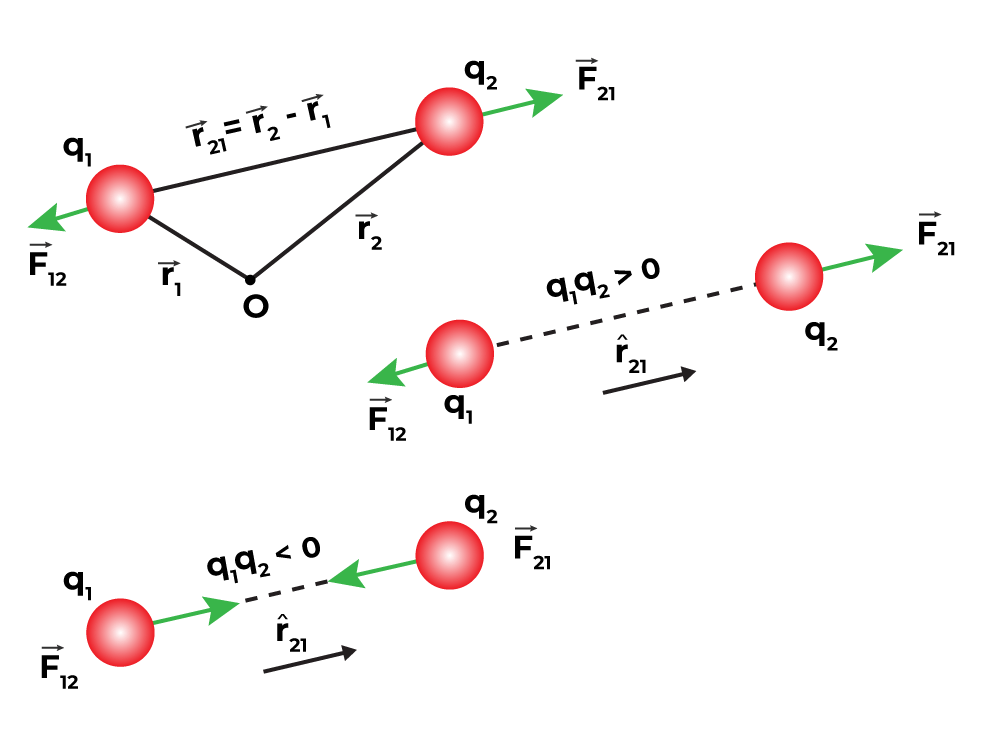
\overrightarrow{r}_{21} = \overrightarrow{r}_2– \overrightarrow{r}_1 Similarly, the vector leading from 2 to 1 is denoted by r12,
\overrightarrow{r}_{12} = \overrightarrow{r}_1– \overrightarrow{r}_2 r21 and r12 are the magnitudes of the vectors and
\overrightarrow{r}_{12} , respectively and magnitude r12 is equal to r21. A unit vector along the vector specifies the vector's direction. The unit vectors are used to denote the direction from 1 to 2 (or 2 to 1). The unit vectors are defined as,
\hat{r}_{21}=\dfrac{\overrightarrow{{r}}_{21}}{r_{21}} Similarly,
\hat{r}_{12}=\dfrac{\overrightarrow{{r}}_{12}}{r_{12}} Coulomb’s force law between two point charges q1 and q2 located at vectors r1 and r2 is then expressed as,
\begin{aligned}\overrightarrow{F}_{21}&=\dfrac{1}{4\pi{\epsilon}_\circ}\dfrac{q_1q_2}{{r}_{21}^2}\hat{r}_{21}\\&=\frac{1}{4\pi{\epsilon}_\circ}\frac{q_1q_2}{{r}_{21}^3}\overrightarrow{r}_{21}\end{aligned}
Key Points on Coulomb’s Law
- Coulomb’s Law holds regardless of whether q1 and q2 are positive or negative. F21 is toward
\hat{r}_{21} , which is a repulsive force, as it should be for like charges that are if q1 and q2 are of the same sign (either both positive or both negative). When the signs of q1 and q2 are opposite or like charges, F21 is toward-\hat{r}_{21} , that is, toward\hat{r}_{12} which shows attraction, as expected for dissimilar charges. As a result, we don't need to construct separate equations for like and unlike charges. Both instances are handled correctly by the above expression for Coulomb’s force law. - Coulomb’s force law can be used to calculate the force F12 on charge q1 due to charge q2 by simply swapping 1 and 2 as,
- Coulomb's law agrees with Newton's third law.
- In a vacuum, Coulomb's law expression determines the force between two charges q1 and q2. If the charges are deposited in matter or there is matter in the intervening area, the situation becomes more complicated due to the presence of charged matter constituents.
- Two identical conductors with charges q1 and q2 are brought into contact and subsequently separated, resulting in each conductor having a charge equal to (q1+q2)/2. Each charge will be equal to (q1-q2)/2 if the charges are q1 and –q2.
Conditions for Stability of Coulomb’s Law
If two charges are arranged in a straight line AB, and one charge q is slightly displaced towards A, the force acting on A FA increases in magnitude while the force acting on B FB decreases in magnitude. Thus, the net force on q shifts towards A. So we can say that for axial displacement, the equilibrium is unstable.
If q is displaced perpendicular to line AB, the forces FA and FB are changed in such a manner that they bring the charge to its original position. Now we can say that for perpendicular displacement, the equilibrium is stable.
Applications of Coulomb’s Law
Coulomb’s Law is one of the basic laws of Physics. It is used for various purposes; some of its important applications are discussed below.
- It is used to calculate the distance and force between the two charges.
- It is used to arrange the charges in a stable equilibrium.
- Coulomb's law is used to calculate the electric field.
An electric field is given by,
E = F / QT (N/C)
where,
- E is the Strength of the electric field
- F is the Electrostatic force
- QT is the Test charge measured in coulombs
Limitations of Coulomb’s Law
There are some limitations of Coulomb’s Law, which are discussed below:
- Coulomb’s Law applies to the point charges that are at rest.
- Coulomb's Law is only applicable in situations where the inverse square law is followed.
- Coulomb’s Law is applicable only for the charges that are considered to be spherical. For charges with arbitrary shapes, Coulomb’s Law is not applicable because we cannot determine the distance between the charges.
Solved Problems
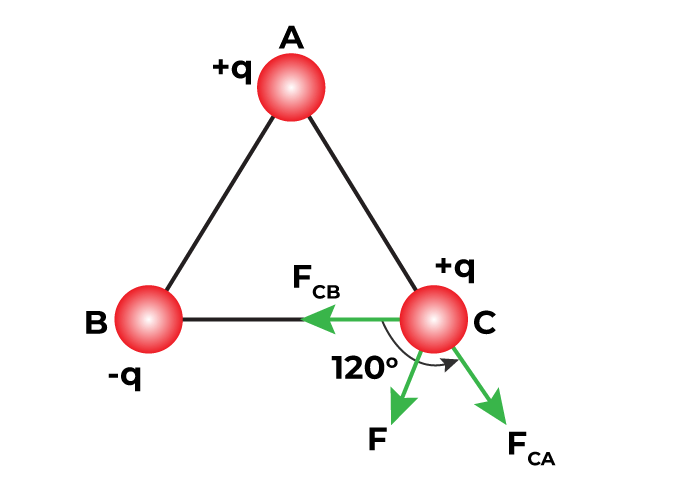
Example 1: Charges of magnitude 100 micro coulombs each are located in a vacuum at the corners A, B, and C of an equilateral triangle measuring 4 meters on each side. If the charges at A and C are positive and the charge at B is negative, what is the magnitude and direction of the total force on the charge at C?
Solution:Force FCA is applied toward AC, and the expression for the FCA is expressed as
F_{CA}=\dfrac{qq}{4\pi{\epsilon}_\circ} Substitute the values in the above expression,
F_{CA}=\dfrac{100\times10^{-6}\times100\times10^{-6}}{4\pi\times8.854\times10^{-12}}\\ F_{CA}=5.625\text{ N} The Force FCB is applied toward CB, and the expression for the FCB is expressed as
F_{CB}=\dfrac{qq}{4\pi{\epsilon}_\circ} Substitute the values in the above expression,
F_{CB}=\dfrac{100\times10^{-6}\times100\times10^{-6}}{4\pi\times8.854\times10^{-12}}\\ F_{CB}=5.625\text{ N} Therefore, the two forces are equal in magnitude but in different directions. The angle between them is 120º. The resultant force F is given by,
F=\sqrt{F_{CA}^2+F_{CB}^2+2F_{CA}F_{CB}\cos\theta}\\ F=\sqrt{5.625^2+5.625^2+2\times5.625\times5.625\times\cos120^\circ}\\ F=5.625\text{ N}
Example 2: A positive charge of 6×10⁻⁶ C is 0.040 m from the second positive charge of 4×10⁻⁶ C. Calculate the force between the charges.
Solution: Given,
First charge q1 = 6×10⁻⁶ C.
Second charge q2 = 4×10⁻⁶ C.
Distance between the charges r = 0.040 m
k = 9×10⁹
We know that, F = k q1q2 / r2
Substitute the values in the above expression,
F = k q1q2 / r2
F = 9×10⁹×[(6×10-6)× (4×10-6)] / (0.04)2
F= 134.85 N
Example 3: Two-point charges, q1 = +9 μC and q2 = 4 μC, are separated by a distance r = 12 cm. What is the magnitude of the electric force?
Solution: Given,
- k = 8.988 x 10⁹ Nm2C−2
- q1 = +9μC = 9 × 10⁻⁶ C
- q2 = +4μC = 4 × 10⁻⁶C
- r = 12cm = 0.12m
F = k (q1q2 ∕ r2)
F = (8.9875 × 10⁹ ) [(9x 10⁻⁶ ) × (4 x 10⁻⁶) / (0.12)2]
F = (8.9875 × 10⁹ ) [36 × 10-12 /0.0144]
F = 22470 N
The electric force between the charges is approximately 22.47 N