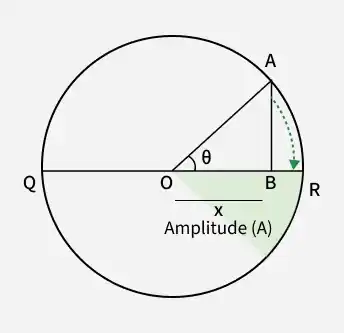
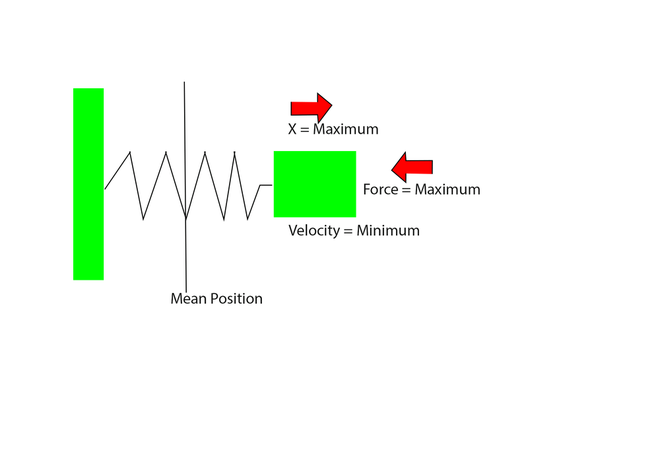
The motion of a body moving in a circle with constant speed is called uniform circular motion. If we consider the motion of the body sideways, it looks as if the body is moving in a straight-line path (along the diameter). This to-and-fro motion of the body along the diameter is called simple harmonic motion.
Considering the above diagram, the motion of the body along the diameter (QR) is SHM. 'O' is the center of the circle and, in turn, the equilibrium position of the system in SHM. x is the displacement from the mean position. 'θ' is the angular displacement.
Since, cos (θ) = (Base / Hypotenuse)
This implies,
cos (θ) = x / AO
where AO is the radius and is equal to the maximum displacement from the mean position, i.e., amplitude (A).
So,
cos (θ) = x / A
x = A cos (θ) ...... (1)
This is the equation for displacement from the mean position.
But since angular displacement is the product of the angular velocity and the time taken by the particle.
Therefore,
θ = ω t
This relation is valid when the particle starts from the extreme position at t = 0.
Now, equation (1) can be written as
x = A cos (ω t) ......(2)
Also, ω = 2πf, where f is the frequency of the particle.
Hence,
x = A cos (2πf t) ...... (3)
What is the equation for the displacement of a body under SHM? The maximum displacement of a body under SHM is called amplitude and is denoted by 'A.'. With the help of the above equation (the equation of motion or the equation of displacement), we can also find the equations for velocity and acceleration.
Sample Problems
Problem 1: Considering a body executing simple harmonic motion, find the equation of the time period in terms of displacement.
Solution:Considering the below diagram for SHM,
Simple Harmonic Motion
V = (2 × π × R) / T
where T is Time Period.
or
V = (2 × π × A) / T......(1)
Here V = Vmax
(V is the velocity of the body moving in circular motion and Vmax is the maximum velocity of the body moving in SHM along the diameter of the circle)
Vmax = √(k / m) × A......(2)
Putting the value of Vmax in equation (1) as,
√(k / m) × A = (2 × π × A) / T
T = 2 × π × √(m / k)
Now, k = FR / x, FR is the restoring force acting on the body at a displacement of x units from the mean position.
T = 2 × π × √((m × x) / FR)
Problem 2: Derive the equation for the instantaneous velocity of a body executing simple harmonic motion.
Solution:Since, it is known that:
Total Energy = Kinetic Energy + Potential Energy.
(1/2) × k × A2 = (1/2) × m × v2 + (1/2) × k × x2
where k is spring constant, m is mass, x is displacement and v is the velocity.
K × A2 = m × v2 + k × x2
v = √((K × A2 - k × x2) / m)
= √(k / m) × A × √(1 - (x2 / A2))
where √(k / m) × A is the maximum velocity.
= vmax × √(1 - (x2 / A2))
Problem 3: Calculate the ratio of displacement to amplitudewhen the kinetic energy of a body is twice its potential energy.
Solution: We know,
K = 1/2 × m × v2
U = 1/2 × k × x2
Given that,K = 2 × U
(1/2) × m × v2 = 2 × (1/2) × k × x2......(1)
Instantaneous velocity is given by,
v = √(k / m) * A * √(1 - (x2 / A2))
where √(k / m) × A is the maximum velocity.
Putting the value of v in equation (1) we get,
A2 - x2 = 2 × x2
A2 = 3 × x2
x / A = 1 / √3
or
x : A = 1 : √3
Problem 4: The force acting on a body under SHM is 200 N. If the spring constant is 50 N/m. Find the displacement from the mean position.
Solution: The formula to calculate the restoring force is,
FR= -k × x
Substituting the given values in the above equation as,
200 N = -(50 × x)
This implies,
x = -4 m
where negative sign indicates that the force and the displacement are opposite in direction.
Problem 5:Derive an expression for the amount of work done or potential energy of a body executing SHM.
Solution: Since, the work done is defined as,
Work Done = Force × Displacement
But the formula cannot be used directly to find the work done or potential energy because force acting on a body
under SHM is not constant. Force is a function of x, FR = -kx.
The formula for work done in the case of SHM :
W = (1/2) × k × x2 [ For mass-spring system, where k is spring constant and x is the displacement from the mean position.]
For variable force,
W = ∫ F dx
W = ∫ kx dx [F = kx]
W = (1/2) × k × x2
This is the formula for the work done or the potential energy of the mass-spring system denoted by U.
Unsolved Problems
Question 1: A particle executes SHM with amplitude 0.2 m and frequency 5 Hz. If at a certain instant its kinetic energy is one-third of the total energy, find the displacement of the particle at that instant.
Question 2: The displacement of a particle executing SHM is given by x = A cos (ωt+π/4). If the maximum acceleration is 16 m/s² and amplitude is 0.4 m, calculate the angular frequency and the velocity of the particle when x = 0.2 m
Question 3: A mass-spring system oscillates with amplitude 5 cm and maximum acceleration 10 m/s ². Find: (a) the mass of the particle if the spring constant is 50 N (b) the velocity when the displacement is half the amplitude.
Question 4: A particle with a mass of 0.5 kg is attached to a spring with a spring constant of 100 N/m and oscillates in simple harmonic motion (SHM). Find the maximum velocity and maximum acceleration of the particle.
Question 5: A body executes SHM with amplitude 0.1 m. If the displacement at some instant is 0.08 m, calculate the ratio of kinetic energy to potential energy at that instant.