
Specific heat capacity is the amount of heat required to raise the temperature of unit mass of a substance by 1 K (or 1°C). Different substances absorb heat differently. Specific heat capacity tells us how much heat is needed to increase the temperature of 1 unit mass of a substance.
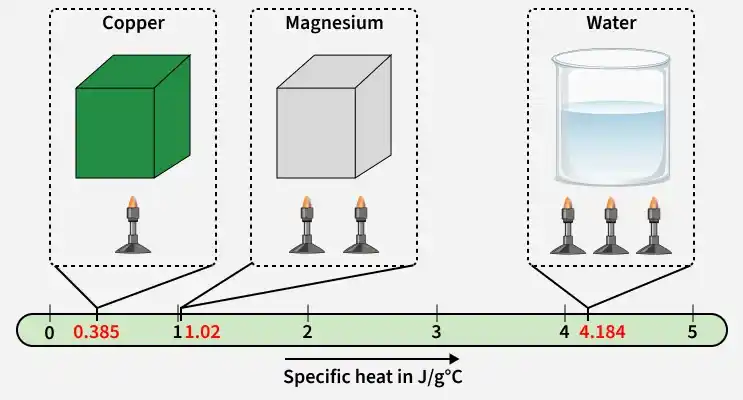
- A substance with high specific heat capacity requires more heat to raise its temperature.
- A substance with low specific heat capacity heats up quickly with less heat.
- SI unit = J kg⁻¹ K⁻¹.
Formula
c = \frac{Q}{m \Delta T}
Where:
- c = specific heat capacity
- Q = heat supplied
- m = mass of substance
- ΔT = change in temperature
Relation with Heat Capacity
C = mc
- Heat capacity depends on mass
- Specific heat capacity is per unit mass
Molar Specific Heat
Molar heat capacity is the amount of heat required to raise the temperature of 1 mole of a substance by 1 K (or 1°C). Instead of considering mass, molar heat capacity deals with 1 mole of a substance. It is very useful in chemistry because reactions and calculations are often done in terms of moles.
- A substance with higher molar heat capacity requires more heat to increase the temperature of 1 mole of that substance.
- SI unit = J mol⁻¹ K⁻¹.
C_m = \frac{Q}{n \Delta T}
Where:
- Cₘ = molar heat capacity
- Q = heat supplied
- n = number of moles
- ΔT = change in temperature SI unit = J mol⁻¹ K⁻¹
Specific Heat at Constant Pressure (Cₚ)
Specific heat at constant pressure is the amount of heat required to raise the temperature of unit mass of a substance by 1 K, when the pressure is kept constant. When heating occurs at constant pressure, the substance can expand.
- Some heat is used to do work against external pressure.
- The remaining heat increases the temperature.
C_p = \frac{Q _p}{m \Delta T}
Specific Heat at Constant Volume (Cᵥ)
Specific heat at constant volume is the amount of heat required to raise the temperature of unit mass of a substance by 1 K, when the volume is kept constant.
- When a substance is heated at constant volume, it cannot expand.
- Therefore, no work is done by the system.
- All the heat supplied is used to increase the internal energy and raise the temperature.
C_v = \frac{Q _v}{m \Delta T}
Relation between CP and CV
At constant volume, no work is done, so all heat supplied increases the internal energy. At constant pressure, the gas expands and does work against external pressure. Therefore, more heat is required at constant pressure than at constant volume.
For an ideal gas, the molar heat capacities at constant pressure and constant volume are related by:
C_p - C_v = R
Where:
- Cp = molar heat capacity at constant pressure
- Cv= molar heat capacity at constant volume
- R = universal gas constant
Solved Examples
Example 1: Calculate the heat required to raise 0.5 kg of sand from 30° C to 90° C? (Specific Heat of sand = 830 J ⁄ kg °C)
Solution:
Given:
- Mass of sand, m = 0.5 kg
- Temperature difference, ΔT = 90° C - 30° C = 60° C
- Specific heat of sand, c= 830 J ⁄ kg °C
The formula for specific heat capacity is given as:
C = ΔQ ⁄ m ΔT
Rearrange the formula in terms of Q.
Q = m C ΔT
= 0.5 Kg × 830 J ⁄ kg °C× 60° C
= 24900 J.
Hence, the required heat to raise the sand temperature is 24900 J.
Example 2: Determine the temperature difference if 40 kg of water absorbs 400 K J of heat.
Solution:
Given:
- Mass of water, m = 40 kg
- Heat transfer, Q = 400 KJ,
- Specific heat of water, c = 4.2 × 10³ J ⁄ Kg °C
The formula for specific heat capacity is given as:
c = ΔQ ⁄ m ΔT
Rearrange the formula in terms of ΔT.
ΔT = ΔQ ⁄ c m
= (400 × 103) ⁄ (4.2 × 103 × 40) °C
= 2.38 °C
Hence, the temperature difference is 2.38 °C.
Practice Questions
Question 1: Calculate the heat required to raise the temperature of 2 kg of copper from 25°C to 75°C. (Specific heat capacity of copper = 390 J kg-1K-1)
Question 2: A substance of mass 5 kg absorbs 50,000 J of heat and its temperature rises by 20°C. Calculate its specific heat capacity.
Question 3: Determine the temperature rise when 120,000 J of heat is supplied to 4 kg of water. (Specific heat capacity of water = 4200 J kg-1 K-1)
Question 4: Calculate the molar heat capacity of a gas if 10,000 J of heat is supplied to 2 moles of the gas, causing its temperature to increase by 25 K.