
A wave is the transfer of energy and momentum from one place to another, with or without a medium, without actual movement of particles. It propagates through oscillations of particles about their mean position. Energy may travel via pressure changes, elastic deformation, or electromagnetic fields.
A common example is wireless communication, where voice signals are transmitted as waves from sender to receiver.
Wave Parameters
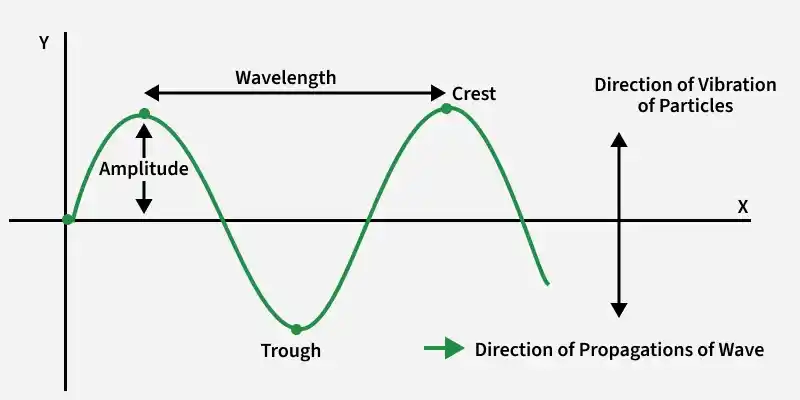
Wavelength (λ): Wavelength is the distance between two successive crests or troughs of a wave. It is related to wave velocity and frequency by λ = v / f
Amplitude (A): Amplitude is the maximum displacement of particles from their equilibrium position. It represents the energy of the wave; greater amplitude means higher energy.
Time Period (T): Time period is the time taken for one complete oscillation or for one wavelength to pass a point. It is related to frequency as T = 1 / f
Frequency (f): Frequency is the number of oscillations or waves passing a point per second. It is measured in Hertz (Hz).
Wave Velocity (v): Wave velocity is the speed at which the wave propagates through a medium. It is given by v = fλ
Wave Classification
There are mainly three Types of Waves:
1. Mechanical Waves
Mechanical waves require a material medium to propagate and transfer energy through oscillations of particles about their mean position.
- They cannot travel in vacuum and always require a material medium.
- The particles of the medium do not move forward; they only oscillate about their equilibrium position.
- Energy is transmitted through the interaction and collision of neighbouring particles.
The Mechanical Wave further can be classified in two different types
a. Transverse Waves
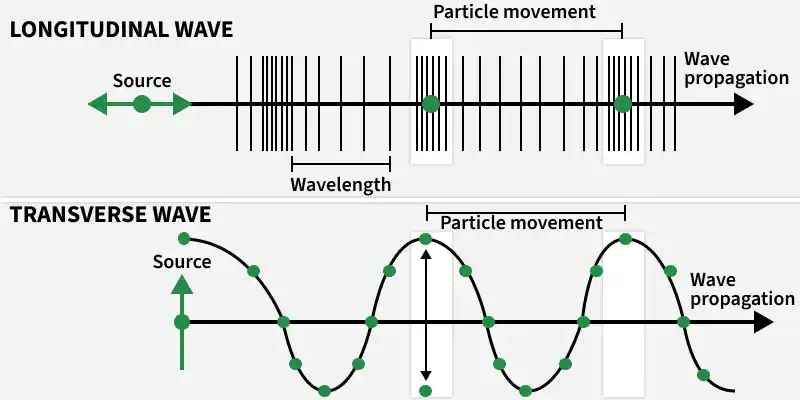
Transverse waves are those in which the particles of the medium oscillate perpendicular to the direction of wave propagation. The particles move about their mean position, creating crests (highest points) and troughs (lowest points). These waves can travel mainly in solids and on liquid surfaces and can also be polarised. Examples: Light waves, water waves, waves on a string
b. Longitudinal Waves
Longitudinal waves are those in which the particles of the medium oscillate parallel to the direction of wave propagation. These waves consist of compressions (regions of high pressure) and rarefactions (regions of low pressure). They can travel through solids, liquids, and gases. Examples: Sound waves, seismic P-waves
2. Electromagnetic Waves
Electromagnetic waves are waves that can propagate through a vacuum without the need for a material medium. They consist of oscillating electric and magnetic fields, which are perpendicular to each other as well as to the direction of wave propagation. These waves are produced by accelerating charged particles and carry energy through space in the form of radiation.
Types of Electromagnetic Waves
- Gamma Rays: Wavelength less than 10-11 m. They have very high energy and are used in cancer treatment. Sources include radioactive substances and cosmic rays.
- X-Rays: Wavelength ranges from 10-11 m to 10-8 m. They are used in medical imaging to view internal body structures. Produced by high-energy electrons.
- Ultraviolet (UV): Wavelength ranges from 10-8 m to 4 × 10⁻⁷ m. Found in sunlight; used in sterilisation and fluorescent lamps but can be harmful to skin.
- Visible Light: Wavelength ranges from 4 × 10⁻⁷ m to 8 × 10⁻⁷ m. It is the only part of the spectrum visible to the human eye and helps us see colours.
- Infrared (IR): Wavelength ranges from 8 × 10⁻⁷ m to 10-3 m. Associated with heat; used in remote controls, night vision, and thermal imaging.
- Microwaves: Wavelength ranges from 10-3 m to 10-1 m. Used in cooking, radar systems, and communication technologies.
- Radio Waves: Wavelength greater than 10-1 m. Used for radio and television broadcasting and wireless communication.
3. Matter Waves
The concept of matter waves was proposed by Louis de Broglie, stating that every moving particle exhibits wave-like properties. This concept is known as the wave–particle duality of matter.
The wavelength associated with a moving particle is called the de Broglie wavelength, given by:
\lambda = \frac{h}{p} where:
- h is Planck’s constant (6.62 × 10⁻³⁴ Js)
- p is the momentum of the particle
- m is the mass of the particle
- v is the velocity of the particle (p = mv)
The de Broglie relation shows that wavelength is inversely proportional to momentum. Thus, particles with higher mass or velocity have shorter wavelengths, while lighter or slower particles have longer wavelengths. This wave nature is significant mainly for microscopic particles such as electrons.
Wave Speed Formula
Wave speed is the distance travelled by a wave per unit time. It shows how fast a wave propagates through a medium. The relation is:
v = \frac{\lambda}{T} = f\lambda where:
- v is wave velocity
- λ is wavelength
- T is time period
- f is frequency
For a given medium, wave speed remains constant and depends on its properties like density and elasticity. If frequency increases, wavelength decreases accordingly.
Classification Based on Medium
Waves can be classified based on the requirement of a medium for propagation into two types:
Mechanical Waves: These waves require a material medium for propagation and cannot travel in vacuum. Energy is transmitted through oscillations of particles of the medium. Examples: Sound waves, water waves
Non-Mechanical Waves: These waves do not require a material medium and can propagate through vacuum. They transfer energy through fields rather than particle motion. Examples: Electromagnetic waves, matter waves
Classification Based on Nature of Motion
Waves are classified into two types based on their motion:
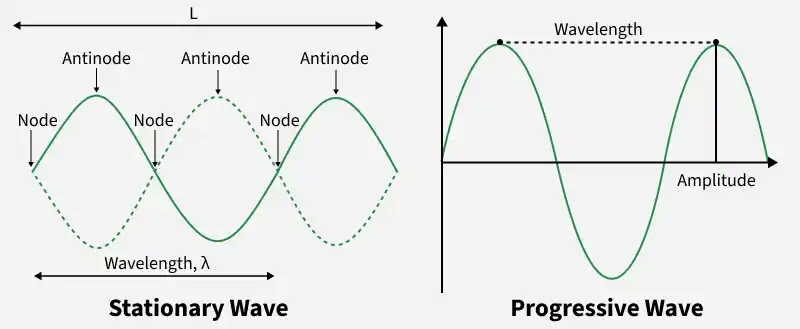
Progressive Waves (Travelling Waves): These waves propagate through the medium, transferring energy and momentum from one point to another. The particles of the medium oscillate about their mean position, while the disturbance moves forward.
Standing Waves (Stationary Waves): These waves are formed by the superposition of two waves of equal frequency and amplitude travelling in opposite directions. There is no net transfer of energy. The wave pattern remains stationary and is characterised by nodes (zero displacement) and antinodes (maximum displacement).
Classification Based on Dimensions of Propagation
Waves can be classified based on the number of dimensions in which they propagate energy:
- One-Dimensional (1D) Waves: Energy propagates in only one direction along a line. Example: Waves on a stretched string
- Two-Dimensional (2D) Waves: Energy propagates in a plane (two directions). Example: Water surface waves
- Three-Dimensional (3D) Waves: Energy propagates in all directions in space. Examples: Sound waves, electromagnetic waves
Some Important Types of Waves
Apart from the basic classifications, certain commonly observed waves are important for conceptual understanding:
1. Sound Waves: Sound waves are mechanical and longitudinal in nature. They propagate through a medium via oscillations of particles parallel to the direction of wave propagation. These waves consist of alternating regions of compressions (high pressure) and rarefactions (low pressure). Sound cannot travel in vacuum and requires a material medium.
2. Seismic Waves: Seismic waves are produced due to disturbances like earthquakes and travel through the Earth. They are of two main types:
- Body waves: Travel through the interior of the Earth (P-waves are longitudinal, S-waves are transverse)
- Surface waves: Travel along the Earth’s surface and have larger amplitudes
Their speed depends on the density and elasticity of the medium.
3. Water Waves: Water waves are surface waves in which particles move in circular or elliptical paths. They show a combination of both transverse and longitudinal motion. Energy propagates across the surface, while the particles mainly oscillate about their mean positions.
Solved Problems
Question 1: If the Time Period of a Wave is 0.5 seconds, what is the Frequency of the Wave?
Solution: Given
T = 0.5 seconds.
The relationship between Frequency (f) and Time Period is defined as
f = 1/T
Substituting the given Time Period into the formula:
f= 1/0.5 =2Hz
Therefore, the Frequency of the Wave is 2 Hertz.
Question 2: A wave has a wavelength of 700nm and frequency of 400THz. Find the velocity of the wave
Solution: Given:
wavelength = 700 nm = 700 × 10-9 m
Frequency = 400 THz = 400 × 1012 Hz
Hence, wave velocity = 700 × 10-9 × 400 × 1012 = 280000 × 103 m/s = 2.8 × 10⁸ m/s
Question 3: A wave travels with a velocity of 300 m/s and has a frequency of 50 Hz. Find its wavelength.
Solution: Given
Wave Velocity, v = 300 m/s
Frequency, f = 50 Hz
The formula for wavelength is:
\lambda = \frac{v}{f} Substituting the values:
\lambda = \frac{300}{50} = 6 \, \text{m} Therefore, the wavelength of the wave is 6 m.
Question 4: A wave travels with a speed of 240 m/s and has a frequency of 60 Hz. Find the wavelength of the wave.
Solution: Given that,
Wave Velocity, v = 240 m/s
Frequency, f = 60 Hz
The formula for wavelength is:
\lambda = \frac{v}{f} Substituting the values:
\lambda = \frac{240}{60} = 4 \, \text{m} Therefore, the wavelength of the wave is 4 m.
Unsolved Problems
Question 1: A wave has a frequency of 80 Hz and travels with a velocity of 320 m/s. Find the wavelength of the wave.
Question 2: The wavelength of a wave is 5 m and its velocity is 150 m/s. Calculate the frequency of the wave.
Question 3: A sound wave travels through air with a velocity of 340 m/s and has a wavelength of 0.85 m. Find the frequency and time period of the wave.
Question 4: A light wave has a frequency of (7.5 \times 10^{14}) Hz. Calculate its wavelength if the speed of light is (3 \times 10^8) m/s.
Question 5: A wave completes 500 oscillations in 25 seconds and travels with a wavelength of 2.4 m. Find the frequency and velocity of the wave.