
An inclined plane is a flat surface that is tilted at an angle with the horizontal. When an object is placed on such a surface, it tends to slide down due to gravity. The rate at which the object moves depends on the angle of inclination—a steeper plane results in greater acceleration.
Objects accelerate down an inclined plane because the force acting along the plane is unbalanced. To understand the motion of an object on an inclined plane, it is essential to analyze the forces acting on it using a free body diagram.
Even on a friction-free inclined plane, at least two forces always act on the object:
- Gravitational force (Weight, mg) acting vertically downward.
- Normal reaction (N) exerted by the surface, acting perpendicular to the plane.
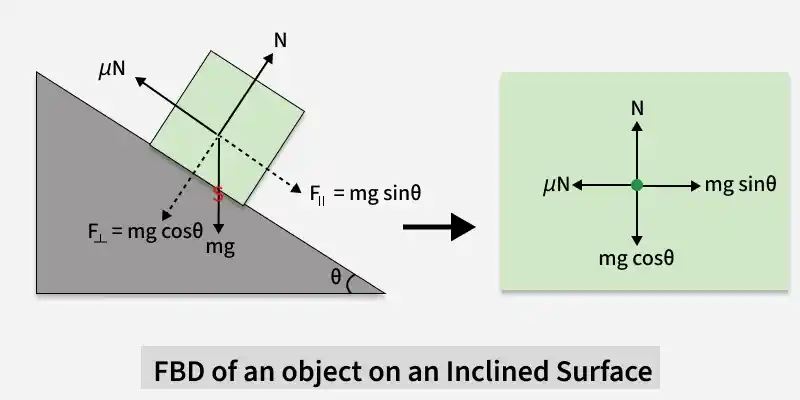
1. Normal Force in Inclined Planes
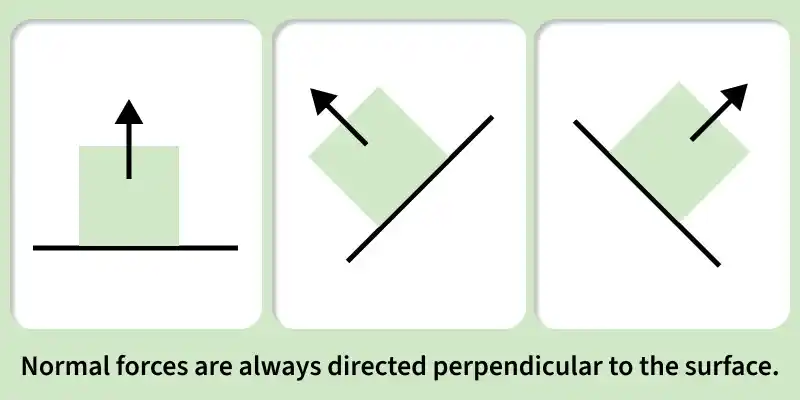
One important thing to consider in inclined plane problems is the direction of the normal force. In most basic problems, the normal force appears to act vertically upward, opposite to gravity. This happens only because those objects are placed on horizontal surfaces.
In reality, the normal force is not always vertical. The true nature of the normal force is that it always acts perpendicular to the surface of contact. On an inclined plane, since the surface itself is tilted, the normal force is also tilted and no longer points straight upward. This change in direction plays a crucial role in force analysis on inclined planes.
In a normal plane, which is a horizontal surface, the object's weight is completely counteracted by the normal force, N = mg
if θ represents the angle of inclination, the normal force N can be expressed as: N = mg cos(θ)
2. Components of the Gravitational Force
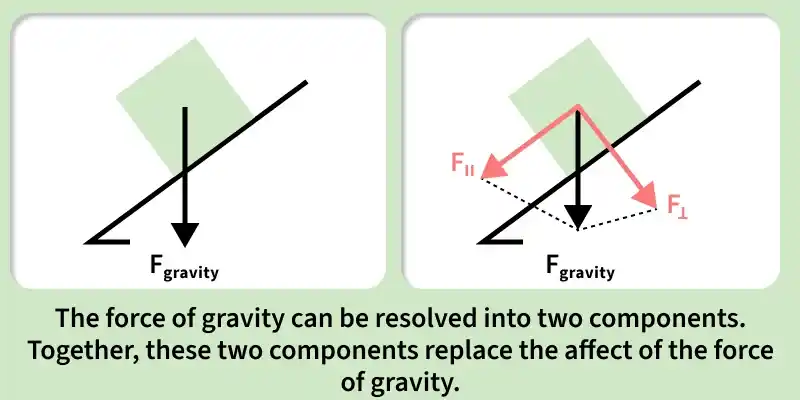
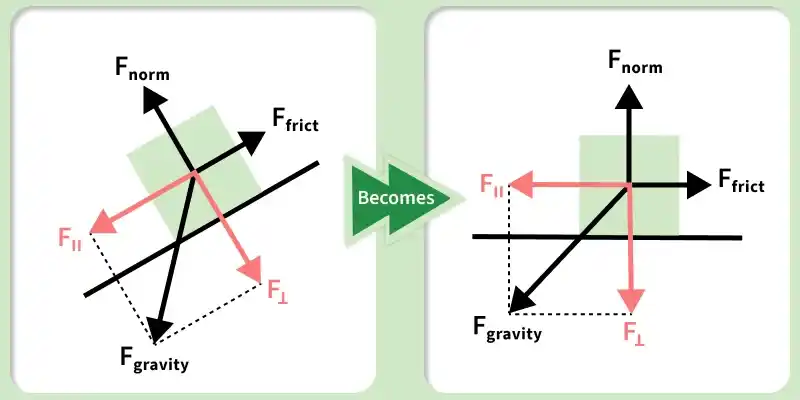
In inclined plane problems the forces acting on the object are not directly opposite to each other. As a result, we cannot add or subtract them easily in their original directions. To simplify the analysis, one of the forces must be resolved into components.
Instead of resolving forces into horizontal and vertical components, inclined plane problems are best handled by resolving the weight of the object (mg) into two components:
- One parallel to the inclined surface
- One perpendicular to the inclined surface
The perpendicular component of the gravitational force to the inclined plane is: Fg perpendicular = mg cosθ
This component acts into the surface and is balanced by the normal force. Hence,
The parallel component of the gravitational force to the inclined plane is: Fg parallel = mg sinθ
This component acts along the plane and is unbalanced in the absence of friction. It is responsible for pulling the object down the incline and causes acceleration.
3. Object on an Inclined Plane
If an object of mass m is placed on a smooth inclined plane (i.e. frictional force F = 0) and released it will slide down the slope. To find the acceleration of the particle as it slides we resolve in the direction of motion.
F = ma
mg cos(90 — θ) = ma
g cos(90 — θ) = a
g sin(θ) = a
We can see that the particle's mass does not affect the acceleration but only the angle of the slope does.
If a particle of mass m is placed on a rough inclined plane (i.e. the frictional force F is not 0), if sliding of F is large enough.
We resolve perpendicular to the plane, where acceleration is zero.
F = ma,
R - mg cos θ = m×0
R = mg cos θ
We resolve in the direction of the slope, if the particle is at rest then
F = ma
mg cos(90 - θ) - F = m × 0
mg sin θ = F
Where F is the force of friction. We know that the maximum frictional force is given by Fmax = uR
Therefore F ≤ uR
mg sin(θ) ≤ u mg cos(θ),
sin(θ)/cos(θ)=tan(θ)
tan(θ) ≤ u
Therefore the particle will remain at rest until tan(θ) > u, at this point it will accelerate down the slope.
Related Articles
Solved Examples
Example 1: A block of mass 5 kg rests on an inclined plane inclined at an angle of 30 degrees to the horizontal. If the coefficient of friction between the block and the inclined plane is 0.2, calculate:
- The normal force acting on the block.
- The frictional force acting on the block if it is on the verge of sliding down.
- The acceleration of the block if it is released from rest.
Solution: 1) The normal force (N) can be calculated using the formula:
N = mg cos(θ)
where m 5 kg, g =9.81 m/s (acceleration due to gravity), and θ = 30
N (5 kg)(9.81 m/s2) cos(30°)
N = (5)(9.81)(√3/2)
N = 42.73 N
2) The frictional force (f) can be calculated using the formula:
f = uN;
where u= 0.2 (coefficient of friction).
f = (0.2) (42.73)
f = 8.55 N
3) The net force acting on the block (Fnet) when it is released from rest is the component of the
gravitational force parallel to the inclined plane minus the frictional force:
Fnet = mg sin(θ) — f
Fnet = (5) (9.81) sin(30°) - 8.55
Fnet = 24.52 - 8.55
Fnet = 15.97 N
The acceleration (a) of the block can be calculated using Newton's second law (Fnet = ma)
15.97 = (5)a
a = 15.97/5
a = 3.194 m/s
Example 2: A 10 kg box is placed on an inclined plane inclined at an angle of 45 degrees to the horizontal. If the coefficient of friction between the box and the inclined plane is 0.3, determine the force parallel to the incline required to move the box up the incline at constant velocity.
Solution: The force parallel to the incline required to move the box up the incline at constant velocity is
equal to the force of friction acting down the incline.
f=uN
Where u = 0.3 (coefficient of friction).
N = mg cos(θ)
N = (I0 kg)(9.81 m/s2) cos(45°)
N = 69.3N
f = 20.79 N
Example 3: A block of mass 12 kg is placed on an inclined plane inclined at an angle of 30 degrees to the horizontal. If the coefficient of friction between the block and the inclined plane is 0.25, calculate the acceleration of the block when it is released from rest.
Solution: The net force acting on the block( net) when it is released from rest is the component of the
gravitational force parallel to the inclined plane
Fnet = mg sin(θ) — f
f = uN
N = mg cos(θ)
Fnet = mg sin(θ) — umg cos(θ)
Fnet =m(g sin(0) — ug cos(θ))
Fnet = 12(9.81 × sin(30°) - 0.25 × 9.81 × cos(30°))
Fnet = 12(4.905 - 0.25 × 8.484)
Fnet =12(4.905 - 2.121)
Fnet = 12 × 2.784
Fnet = 33.408 N
The acceleration (a) of the block can be calculated using Newton's second law (Fnet=m*a)
33.408 = 12 × a
a = 33.408/12
a = 2.784m s