
Relationships between stress and strain can be plotted on a graph for most materials. In this experiment, the force is gradually increased, which produces strain. The values of the stress and the strain are plotted on a graph. This graph is called the stress-strain curve. These curves vary from material to material and are very helpful in giving a fair idea of how the material performs in different load conditions.
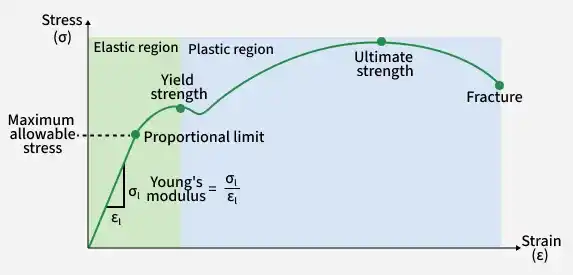
In the graph, it can be seen that from O to A (proportional limit), the graph is almost a straight line. It is the only region in this curve where Hooke's Law is obeyed.
1. Proportionality Limit
After point A, or the OA region, the graph doesn't obey the proportionality law or Hooke's law; thus, point A is called the proportionality limit.
2. Elastic Region
The initial region of the graph, which is represented by graph OA, is the elastic region. In this region, the material undergoes deformation under the applied stress but returns to its initial state as stress is removed. In this region, Hooke's Law is obeyed.
3. Elastic modulus
The slope of the stress-strain curve in the elastic region is called the elastic modulus, and this modulus represents the stiffness of the material. It is also called Young's modulus.
4. Yield point
The point in the stress-strain curve is where the material started to deform plastically and cannot fully regain its initial state after stress is removed. In other words, the yield point is defined as the stress at which the material starts to exhibit plastic deformation by a certain amount.
5. Yield strength
The required amount of stress to deform the given material 0.2-0.5% plastically is called the yield strength of the material.
6. Ultimate Tensile Strength (UTS)
Ultimate tensile strength is the maximum amount of stress a material can handle before it breaks or fractures. It is a measure of the toughness of the material and is generally measured in pounds per square inch (PSI).
7. Plastic Region
The plastic region is part of the stress-strain curve, where the material undergoes plastic deformation permanently and is unable to attain its initial state after the stress is removed.
8. Strain hardening modulus
The slope of the stress-strain curve in the plastic region is called the strain hardening modulus, and this modulus represents the ability of the material to resist further deformation.
9. Fracture point
The point in the stress-strain curve where the material breaks in the experiment is called the fracture point, and the stress or the force at this point is called the fracture strength.
Stress-Strain Curve of Different Materials
Materials can be classified into two categories based on the Stress-Strain curve.
- Brittle Materials
- Ductile Materials
A. Brittle Materials
Brittle materials are materials that fracture suddenly without significant plastic deformation or prior warning. Eg: glass, ceramic, cast iron, concrete, and some plastics.
Like ductile materials, brittle materials first undergo elastic deformation when a load is applied. However, unlike ductile materials, they do not show a clear yield point on the stress-strain curve. When the applied stress exceeds a certain limit, they fail suddenly and catastrophically with almost no plastic deformation.
The stress-strain curve of brittle materials ends abruptly at the fracture point. These materials generally have a high Young’s modulus, which means they are stiff and rigid.
B. Ductile Materials
Ductile materials are materials that can undergo a large amount of plastic deformation, such as stretching, bending, or compressing, without breaking. They can be shaped without losing their structural integrity. Eg: metals, polymers, rubber, and some composite materials.
In the stress-strain curve, ductile materials first follow a linear relationship between stress (σ) and strain (ε) in the elastic region. The elastic or proportional limit is the maximum stress the material can withstand without permanent deformation. At the yield point, the material changes from elastic to plastic behavior. Beyond this point, it enters the plastic region, where permanent and irreversible deformation occurs.
Related Articles:
Solved Questions
Question 1: A steel rod of 1 m increases by a length of 10 cm when tensile stress is applied. Find the longitudinal strain.
Solution: Longitudinal strain is given by the ratio of the change in length to the total original length.
Let the original length be L, and the change in length be ΔL
Longitudinal Strain = ΔL/L
Given:
- ΔL = 0.1 m
- L = 1 m
Plugging the values into the equation,
Longitudinal Strain = ΔL/L
⇒ Longitudinal Strain = 0.1/1
⇒ Longitudinal Strain = 0.1
Question 2: A steel ball of radius 1.5 m shrinks in size to a length of 1.4 m when hydraulic stress is applied. Find the volumetric strain.
Solution: Volumetric Strain is given by,
Volumetric Strain = -ΔV/V
Volume of a Sphere is given by,
V = 4/3πr3
- Initial Radius: ri = 1.5m
- Final Radius: rf = 1.4m
Therefore, Change in Volume = 4/3π(ri3 - rf3)
⇒ Change in Volume = 4/3π[(1.5)3 - (1.4)3]
⇒ Original Volume = 4/3πr3
⇒ Original Volume = 4/3π(1.5)3
Thus,
Volumetric Strain = Change in Volume/Original Volume
⇒ Volumetric Strain = 4/3π(ri3 - rf3)/4/3πri3
⇒ Volumetric Strain = 4/3π[(1.5)3 - (1.4)3]/4/3π(1.5)3
⇒ Volumetric Strain = [(1.5)3 - (1.4)3]/(1.5)3
⇒ Volumetric Strain = 0.631/3.375
⇒ Volumetric Strain = 0.18
Question 3: A cube of side 1 m shrinks in size to a length of 0.5 m when hydraulic stress is applied. Find the volumetric strain.
Solution: Volumetric Strain is given by,
Volumetric Strain = -ΔV/V
Volume of a sphere is given by, A
V = a3
- Initial radius: ai = 1 m
- Final radius: af = 0.5m
Change in Volume = af3 - ai3
⇒ Change in Volume = 13 - (0.5)3
⇒ Change in Volume = 0.875
Original Volume = a3
⇒ Original Volume = 1
Thus,
Volumetric Strain = Change in Volume/Original Volume
⇒ Volumetric Strain = af3 - ai3
⇒ Volumetric Strain = 0.875/1
⇒ Volumetric Strain =0.875
Question 4: A cube of side 2 m shrinks in size to a length of 0.5 m when the compressive force of 500 N is applied. Find the compressive stress.
Solution: Stress is given by,
Stress = F/A
In this case,
- F = 500 N
- A = side2.
Side is given as 2 m
A = side2
⇒ A = 22
⇒ A = 4
Stress = F/A
⇒ Stress = 500/4
⇒ Stress = 125 N/m2
Question 5: The axis of a cylindrical rod moves by 30° when a force is applied horizontally. The length of the cylinder is 0.5 m. Find the shearing strain and the displacement of the cylinder from its mean position.
Solution: Shearing strain is given by,
Shearing Strain = Δθ/θ
Here,
- θ = 30o
- L = 0.5 m
⇒ Shearing Strain = tan θ
⇒ Shearing Strain = tan(30°)
⇒ Shearing Strain = 1/√3
Let Displacement be x,
Shearing Strain = x/L
x/lL = (1/√3)
x = L/√3
x = 0.5/√3
x = 0.289 m
Unsolved Problems
Question 1: A steel wire of length 3 m and cross-sectional area 2 × 10⁻⁶ m2 is stretched by a force of 600 N if Young’s modulus is 2 × 10¹¹ N/m2. Find the extension produced.
Question 2: A cube of side 1 m decreases to 0.995 m under hydraulic pressure. Calculate the volumetric strain.
Question 3: A rod of length 2 m extends by 2 mm under a tensile stress of 4 × 10⁸ N/m; determine the Young’s modulus of the material.
Question 4: A cylindrical rod of length 2 m and radius 0.01 m is stretched by a force of 5000 N, producing an extension of 1 mm. Calculate Young’s modulus.
Question 5: A wire of length 1.5 m and cross-sectional area 1 × 10⁻⁶ m2 supports a 20 kg mass. If Young’s modulus is 2 × 10¹¹ N/m2, find the extension of the wire (take g=9.8 m/s2 ).