
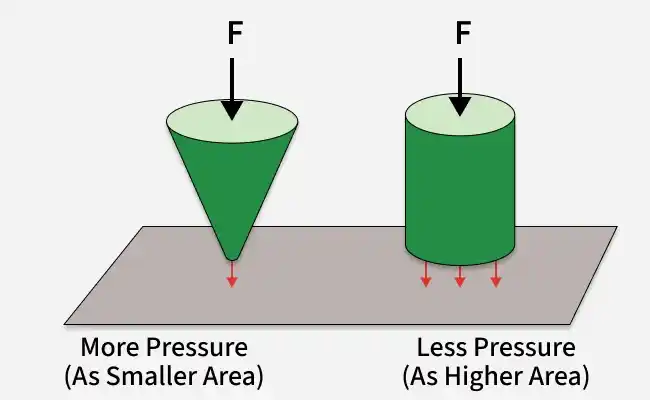
Pressure is defined as the force acting perpendicular to a surface per unit area. When the same force is applied over a smaller area, the pressure increases, and when applied over a larger area, the pressure decreases. This is why sharp objects cut easily and broad surfaces reduce discomfort.
Pressure Formula
where
P = pressure,
F = force applied perpendicular to the surface,
A = area of contact.
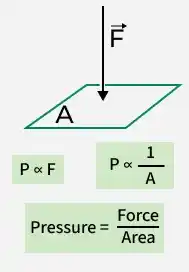
Pressure is directly proportional to force and inversely proportional to area.
i.e.,
Unit of Pressure
The SI unit of pressure is pascal (Pa).
The dimensional formula of pressure is [ML-1T-2].
Types of Pressure
1. Atmospheric Pressure
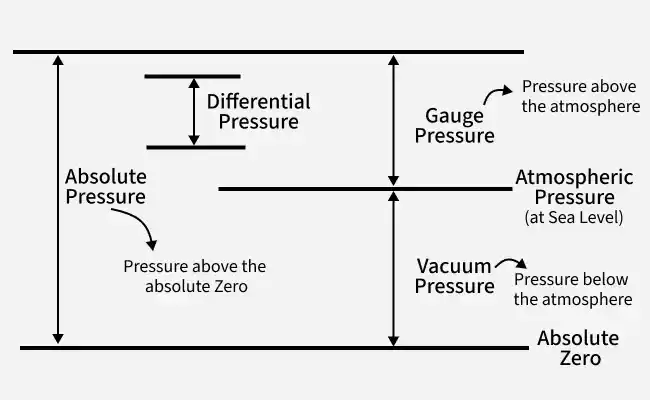
Atmospheric pressure is the pressure exerted by the weight of air above the Earth’s surface. It decreases with altitude and plays a major role in weather changes. It is measured using a barometer and is essential for sustaining life on Earth.
2. Absolute Pressure
Absolute pressure is measured relative to a perfect vacuum (zero pressure). It includes atmospheric pressure and is expressed as:
3. Gauge Pressure
Gauge pressure is the pressure measured relative to atmospheric pressure. It indicates how much pressure is above or below atmospheric pressure and is commonly used in tyres and pressure gauges.
4. Differential Pressure
Differential pressure is the difference between two pressure values:
It is widely used in fluid flow measurements and industrial systems.
Pressure in Liquids and Gases
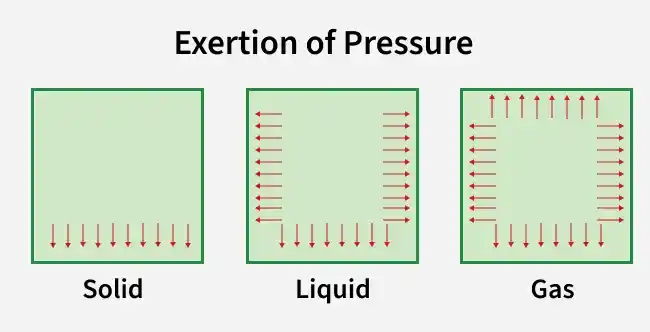
Liquids exert pressure due to their weight. The pressure at a depth in a liquid depends on the height of the liquid column and is given by:
Liquids exert equal pressure at the same depth in all directions.
Gases exert pressure due to constant collisions of molecules with container walls. Higher temperature or density increases gas pressure.
Red More:- Fluid Pressure , Gaseous Pressure
Factors Affecting Pressure
Pressure depends on:
- Magnitude of force applied: Greater force produces greater pressure.
- Area of contact: Smaller area results in higher pressure.
Applications of Pressure
- Hydraulic brakes and lifts work on pressure transmission.
- Sharp tools cut easily due to high pressure on small areas.
- Wide tyres reduce pressure on roads.
- Atmospheric pressure influences weather and climate.
- Medical devices like sphygmomanometers measure blood pressure.
- Fluid pressure explains dam design, diving, and water storage.
Difference Between Pressure and Stress
Pressure is an external force applied over a surface, while stress is the internal force developed within a material due to applied pressure. Pressure is always compressive, whereas stress can be tensile, compressive, or shear.
Solved Examples
Question 1 :- Three identical containers are filled with the same liquid up to the same height. One container is cylindrical, the second is conical, and the third is spherical. Compare the pressure at the bottom of the three containers.
Solution:- P1 = P2 = P3
As Pressure in a liquid depends only on depth, density, and gravity (P=ρgh)
It is independent of container shape.
Question 2 :- A diver is at a depth of 20 m below the surface of water. Find the absolute pressure acting on the diver.
( Given: ρ=1000 kg/m3,g=10 m/s2, Patm=1×10⁵ Pa )
Solution:- Pliquid = ρgh = 1000 × 10 × 20 = 2 × 10⁵ Pa
Pabs = Patm + Pliquid
Pabs = 1 × 10⁵ + 2 × 105 = 3 × 10⁵ Pa
Question 3 :-A hydraulic lift has two pistons of areas 5 cm² and 500 cm². A force of 50 N is applied on the smaller piston. Find the load that can be lifted on the larger piston.
Solution:-
\frac{F_1}{A_1} = \frac{F_2}{A_2}
F_2 = F_1 \frac{A_2}{A_1}
F_2 = 50 \times \frac{500}{5} = 5000 \, \text{N}
Question 4 :-The pressure inside a car tyre is 3 atm (gauge). Atmospheric pressure is 1 atm. Find the absolute pressure inside the tyre.
Solution:- Pabs = Pgauge + Patm
Pabs = 3 + 1 = 4atm
Unsolved Questions
Question 1 :- Three holes are made on the side of a tank at depths h, 2h and 3h below the water surface.
- Which jet has the maximum speed?
- Which jet travels the maximum horizontal distance before hitting the ground?
Question 2 :- Three liquids A, B, and C have densities in the ratio ρA:ρB:ρC=1:2:3. They are poured separately into identical containers up to the same height. Arrange the pressures at the bottom in increasing order.
Question 3 :- Two pistons of areas 10 cm² and 100 cm² are connected by an incompressible fluid. A force of 20 N is applied on the smaller piston. Find:
- The pressure transmitted in the fluid
- The force acting on the larger piston