
Sound is a form of energy produced by vibrating bodies. It requires a material medium for its propagation; therefore, sound cannot travel in a vacuum because there are no particles to transmit sound waves. Sound vibration refers to the back-and-forth motion of particles within a body, which is known as oscillatory motion.
A. Oscillations
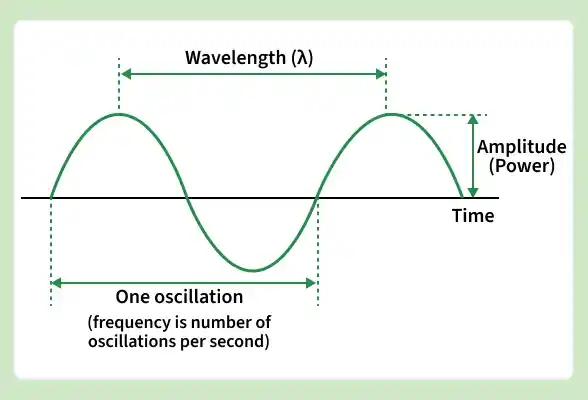
Oscillation refers to the regular rhythmic back-and-forth motion of particles. Sound travels in waves created by particle vibrations in a medium. A wave is a disturbance that carries energy from one location to another without any net movement of matter. Therefore, sound is classified as a type of wave.
B. Amplitude
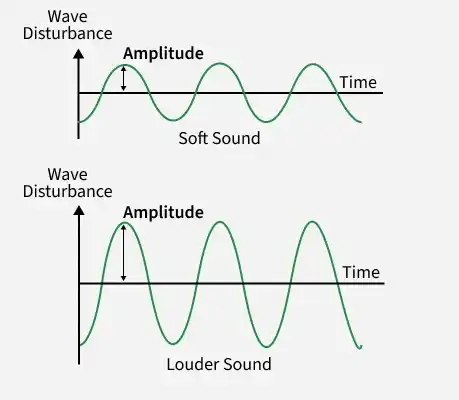
The amplitude of a sound wave measures the wave's maximum displacement from its mean position. It indicates how far the particles of the medium move from their rest position when the sound is produced. Amplitude is directly related to the loudness of the sound: the greater the amplitude, the louder the sound.
It is measured as the distance between the wave’s crest and its mean position. Amplitude is commonly represented by the letter A, and its SI unit is the meter (m).
C. Time Period
The time period of a sound wave is the time taken by a particle of the medium to complete one full vibration. It represents the duration of a single oscillation or cycle of the wave.
The time period is denoted by the letter T, and its SI unit is the second (s). It is related to the frequency (f) of the wave, which is the number of vibrations per second, according to the formula.
T = \frac{1}{f}
A higher frequency means a shorter time period, and a lower frequency means a longer time period.
D. Frequency
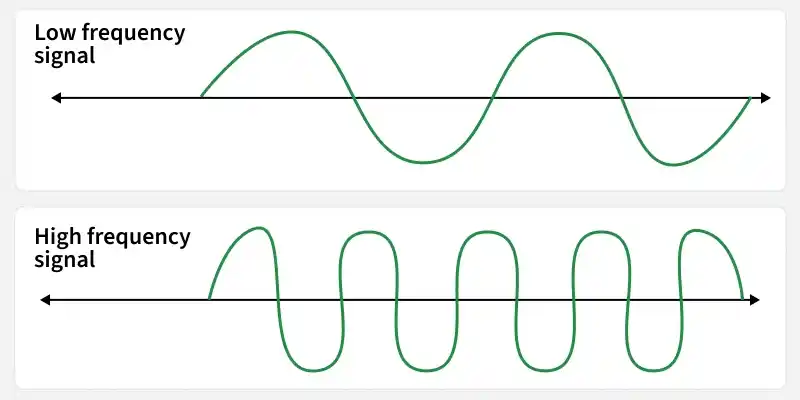
The frequency of oscillation is defined as the number of oscillations per second. Its unit is hertz, which is denoted by the symbol Hz. In general, the frequency of a wave refers to how often the particles in a medium vibrate as a wave passes through the medium.
The frequency of a sound wave is defined as the number of vibrations per unit of time.
The SI unit of frequency is Hertz (Hz).
Sample Problems
Question 1: A sound wave has a frequency of 600 Hz. Find its time period.
Solution:
T = \frac{1}{f}
= \frac{1}{600}s
= 0.00167 s
= 1.67 ms
Problem 2: A SONAR emits a sound wave that returns after 3 seconds. If the speed of sound in water is 1500 m/s, calculate the distance of the object.
Solution:
2d = v \cdot t
d = \frac{ v \cdot t}{2}
=\frac{1500 \cdot 3}{2}
= 2250 m
Question 3: A person is listening to a tone of 600 Hz sitting at a distance of 550 m from the source of the sound. What is the time interval between successive compressions from the source?
Solution: The time interval between two successive compressions is equal to the time period of the wave. This time period is reciprocal of the frequency of the wave and is given by the relation
T =1 / f
= 1 / 600 Hz
= 1.66 ms
Question 4: The speed of sound in air is 340 m/s. A whistle produces a sound with a frequency of 680 Hz. Find its wavelength.
Solution:
v=fλ
λ = \frac{v}{f}
=\frac{340}{680}
= 0.5 m
Unsolved Problems
Question 1: A person hears a sound whose frequency is 750 Hz. Calculate the time period of the sound wave.
Question 2: A SONAR emits a pulse of sound that returns after 5 seconds. Assume that the sound speed in seawater is 1480 m/s. Find the distance of the object.
Question 3: A sound wave of wavelength 0.68 m travels with a speed of 340 m/s. Find its frequency.
Question 4: A tuning fork produces a sound at 512 Hz. Find the time interval between two successive compressions.
Question 5: The speed of sound in air is 343 m/s. A whistle produces a sound with a wavelength of 0.5 m. Find the frequency of the sound.