
A projectile is any object that is thrown, launched, or projected into the air and then moves only under the influence of gravity. Air resistance is usually neglected to simplify the study of motion.
Projectile motion refers to the curved path followed by a projectile when it is thrown or projected into the air and moves under the force of gravity. In this type of motion, the object undergoes two independent motions.
- Horizontal motion – uniform motion with constant velocity along the x-axis.
- Vertical motion – uniformly accelerated motion along the y-axis due to gravity.
Examples: the motion of a stone thrown into the air, a ball kicked or thrown, a bullet fired from a gun, and a javelin after it is launched. Understanding projectile motion helps in predicting the path, range, and time of flight of objects and has applications in sports, military science, and photography.
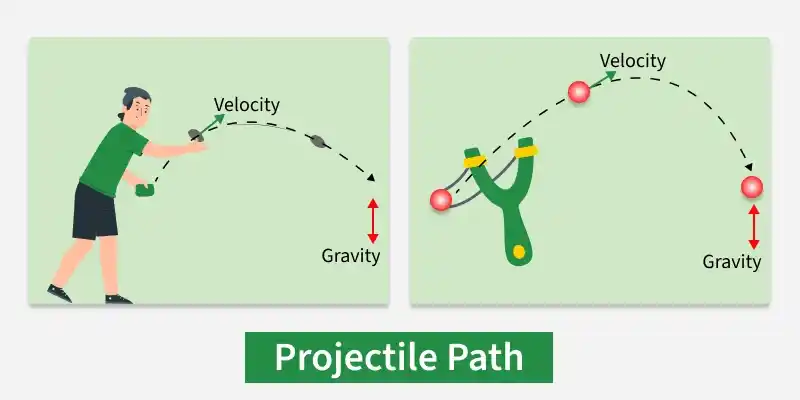
Properties of Projectile Motion
- Projectile motion takes place in a two-dimensional plane.
- The path followed by the projectile is a parabolic curve.
- Gravity is the only force acting on the projectile (air resistance neglected).
- The horizontal velocity remains constant, while the vertical velocity changes due to gravity.
- Horizontal and vertical motions are independent of each other.
Terms Related to Projectile Motion
Consider the following example of a ball that is projected at an angle θ from the point O with respect to the horizontal x-axis with an initial velocity u:

Before understanding the derivation of the relation for projectile motion let's first introduce some terms used in it, which are:
1. Angle of Projection
The angle at which the body is projected with respect to the horizontal is referred to as the angle of projection. In the above diagram, θ is the angle of projection
2. Velocity of Projection
The velocity with which the body is thrown is referred to as the velocity of projection. Here, u is the initial velocity of the projectile that has vertical and horizontal components as shown in the diagram.
3. Point of Projection
A point of projection is the point from which the body is projected in the air. In the above diagram, point O is known as the point of projection.
4. Projectile Trajectory
The path taken by a projectile in the air is referred to as the projectile's trajectory and in the diagram, the path followed by the projectile is the trajectory of a projectile.
5. Horizontal Range
The horizontal distance travelled by the body performing projectile motion is referred to as the range of the projectile, and in the above-mentioned diagram OB is Horizontal Range.
Equation of Motion for Projectile
We know that the linear equations of motion are:
v = u + at
S = ut + \frac{1}{2}at^2
v^2 = u^2 + 2aS
Applying the above equation for projectile motion the equation will be:
v_y = u_y - gt
S_y = u_y t - \frac{1}{2}gt^2
v_y^2 = u_y^2 - 2gS_y Horizontal motion (x-direction, no acceleration):
vx = ux
Sx = uxt
Where,
- uy = usinθ is the vertical component of the initial velocity
- ux=ucosθ is the horizontal component of the initial velocity
- g is the acceleration due to gravity (9.8 m/s2)
- t is the time
- Sx and Sy are horizontal and vertical displacements, respectively
Projectile Motion Formula
Projectile motion is described using three important quantities:
- Time of Flight
- Horizontal Range
- Maximum Height
These formulas are derived by assuming that gravity is the only force acting on the projectile and air resistance is neglected.
1. Time of Flight
Time of flight is the total time taken by the projectile from start to end. We can calculate it as,
In the Y direction total displacement (Sy) = 0
Taking motion in Y direction only,
S_y = u_y t - \frac{1}{2}gt^2 For object to achieve peak height uy = u sinθ and Sy = 0, and t it the time taken by object to achieve the peak height.
0 = u \sin\theta \, t - \frac{1}{2}gt^2 ⇒
t = \frac{2u\sin\theta}{g} Time of Flight
2t = \frac{2u\sin\theta}{g}
Now there can be various cases of the above-mentioned formula, let's consider the following cases:
Case 1: If θ = 90°
From the time-of-flight formula, it is clear that the time of flight depends on the angle of projection. For a fixed initial velocity and constant acceleration due to gravity (g=9.8 m/s2), the time of flight becomes maximum when the projectile is projected at an angle of 90° .
t_{\text{max}} = \frac{2u\sin\theta}{g} = \frac{2u}{g} [As sin 90° = 1]
Case 2: If θ = 30°
When the projectile is projected at an angle of 30° time of flight is half of the tmax as sin30° = 1/2.
t = \frac{2u\sin 30^\circ}{g} = \frac{t_{\text{max}}}{2}
2. Horizontal Range of Projectile
The horizontal range is the distance covered by the projectile horizontally and it can be calculated by the distance = speed/time formula, where speed is the horizontal component of initial speed or velocity and time is the total time of flight. Thus, the formula for Horizontal Range is given by:
Range (R) = ux × t
And as ux = u cosθ and t = 2usinθ/g
Range (R) = ucosθ × 2usinθ/g
As a result, the Horizontal Range of the projectile is given by (R):
Horizontal Range (R) =
\frac{u^2 \sin 2\theta}{g}
Now there can be various cases of the above-mentioned formula, let's consider the following cases:
Case 1: If θ = 90°
When projectile is projected at an angle of 90° Horizontal range will be zero, because projectile will strike at the same point where the projectile is projected.
R =
\frac{u^2 \sin 2\theta}{g} = 0 [As sin 2θ = sin 180 = 0, at θ = 90°]
Case 2: If θ = 45°
When projectile is projected at 45° Horizontal Range of the projectile is maximum.
Rmax =
\frac{u^2 \sin 2\theta}{g} = \frac{u^2}{g} As sin 90 = 1 and it is the maximum value of the trigonometric ratio sin.
3. Maximum Height of Projectile
It is the highest point of the particle (point A). When the ball reaches point A, the vertical component of the velocity (Vy) will be zero.
0 = (usinθ)2 - 2gHmax
[ Here, S = Hmax , vy = 0 and uy = u sin θ ]
Therefore, the Maximum Height of the projectile is given by (Hmax):
Maximum Height (Hmax) =
\frac{u^2 \sin 2\theta}{2g}
Now there can be various cases of the above-mentioned formula, let's consider the following cases:
Case 1: if θ = 90°
If we project a projectile at an angle of 90° it achieves maximum height (Hmax).
Hmax =
\frac{u^2 \sin 2\theta}{2g} = \frac{u^2}{2g} [As, sin2 90° = 1 ]
Case 2: if θ = 45°
When the projectile is projected at an angle of 45°, the height of the projectile is half of its maximum height (Hmax) as sin245° = 1/2.
H = \frac{u^2 \sin^2 \theta}{2g} = \frac{1}{2} \frac{u^2}{2g} = \frac{H_{\text{max}}}{2} We can also say that if the projectile angle is 45° than Horizontal range of projectile will be 4 time the height of projectile.
H = u2/4g = R/4
OR
R = 4H
[ As Horizontal range at θ = 45°, R = u2/g ]
Equation of Trajectory of Projectile
The equation of the trajectory is a path followed by the particle during the projectile motion. The equation is:
y = x \tan\theta - \frac{g x^2}{2 u^2 \cos^2\theta}
Derivation of Equation of Trajectory of Projectile
Let's consider a projectile launched at an angle θ to the horizontal with an initial velocity uo. Assuming there is no air resistance, the only force acting on the projectile is the force of gravity, which acts vertically downward.

The equation of motion in the x direction is given by:
x = u_0 \cos \theta \, t . . .(i)
Where,
- x is the horizontal distance travelled by the projectile,
- t is the time elapsed, and
- uo is the initial velocity, and θ is the angle of launch.
The equation of motion in the y direction is given by:
y = u_0 \sin \theta \, t - \frac{1}{2} g t^2 . . .(ii)
Where,
- y is the vertical distance travelled by the projectile,
- g is the acceleration due to gravity (approximately 9.8 m/s^2), and
- t is the time elapsed.
From equation (i), t = x/(uo cos θ), put this in equation (ii)
y = u_0 \sin \theta \, \frac{x}{u_0 \cos \theta} - \frac{1}{2} g \left(\frac{x}{u_0 \cos \theta}\right)^2 OR
y = x \tan \theta - \frac{g x^2}{2 u_0^2 \cos^2 \theta}
This is the equation of a parabolic trajectory, which describes the path followed by the projectile.
Parabolic Motion of Projectile
This is the equation of projectile motion it is similar to the parabola (y = ax + bx2) as a = tan θ and b = g/(2uo2 cos2 θ). So, we can say that projectile motion is always parabolic in nature.
Key Formulas for Projectile thrown from Ground
Key Formulas for Projectile thrown from a Height, h
Application of Projectile Motion
There are various applications of Projectile Motion, some of which are as follows:
- Sports: In games like football, cricket, archery, and shooting, understanding projectile motion helps players predict the path of the ball or object and improve performance.
- Military: Projectile motion is essential in military technologies such as missiles, tanks, and shell firing for accurate targeting and range estimation.
- Photography: Knowledge of projectile motion helps photographers predict the position of moving objects, allowing them to capture precise and well-timed shots.
Related Articles:
Solved Problems
Question 1: At what angle projectile should be projected so that the height and Range of the projectile will be equal?
Solution: If height and horizontal range will be equal, H = R.
⇒ u2sin2θ/2g = u2sin2θ/g
Cancel u2/g :
⇒ sin2θ/2 = sin2θ
Multiply both sides by 2:
sin2θ = 2sin2θ and sin 2θ = 2sinθcosθ
⇒ sin2θ = 4sinθcosθ
Divide by sinθ
So, tanθ = 4
Question 2: Define horizontal range and find the range of a projectile thrown at 98 m/s with an angle of 30 degrees from horizontal. (use g = 9.8 m/s2)
Solution: Horizontal Range: The horizontal distance travelled by the body performing projectile motion is referred to as the range of the projectile.
Horizontal Range, R = u2sin2θ/g
⇒ R = (98)2 × (60°) / 9.8
⇒ R = 490√3 m
Question 3: Name the physical quantities which will remain unchanged during the projectile motion.
Solution: The physical quantities that remain unchanged during the projectile motion are,
- Horizontal component of Velocity
- Horizontal component of Momentum
- Acceleration
- Total Energy
Question 4: What is the maximum height attained by a ball of mass 100 g projected at an angle of 30° from the ground with an initial velocity of 11 m/s and an acceleration due to gravity of g = 10 m/s2?
Solution: We know that the formula for maximum height is,
H = (usinθ)2/2g
Given: u = 11 m/s, θ = 30°, g = 10 m/s2
Hence, Putting the values we get,
H = 1.5125 m
Question 5: A Football is launched at a 45° angle from the ground with an initial velocity of 10 m/s; the gravity acceleration is g = 10 m/s2. What is the time of the flight?
Solution: We know that the formula for calculating the time of flight is,
t = 2(usinθ/g)
Given: θ = 45°, u = 10m/s, g = 10m/s2
Putting the values we get,
t = 1.4142 sec
Question 6: A projectile is projected from point O at an angle of 30° with an initial velocity of 30 m/s. The projectile hits the ground at point M. (Consider acceleration of gravity g = 10m/s2) Find the following:
- What is the total time of the flight?
- What is the Horizontal Range of the projectile (OM)?
- What is the maximum height of the projectile?

Solution: Given:
- Initial velocity u = 30m/s.
- Angle of projection, θ = 30°.
1. Time of Flight
We know that the total time of flight by the projectile is given by-
t = 2usinθ/g
Putting the given values,
t = 2 × 30 sin30°/10
⇒ t = 3 s
2. Horizontal Range
We know the formula for the horizontal range is:
R = u2sin2θ/g.
Putting the values we get,
R = (30)2 sin60° /10
⇒ R = 45 √3 m.
3. Maximum Height
Maximum height of the projectile is given by the formula:
Hmax = u2sin2θ/2g
Putting the values we get,
Hmax = (30)2sin230°/2 × 10
⇒ Hmax = 11.25 m.
Unsolved Problems
Question 1: A projectile is projected such that its horizontal range is equal to three times its maximum height. Find the angle of projection.
Question 2: Two projectiles are projected from the same point with the same speed u at angles θ and (90°−θ). If the difference in their maximum heights is H find the value of θ.
Question 3: A projectile is projected at an angle θ. If the ratio of maximum height to range is 1:3 find θ.
Question 4: A particle is projected such that its horizontal range is maximum. Find the ratio of Time of flight : Maximum Height.