
A capacitor stores electrical energy in the form of an electric charge, and its ability to do so is called capacitance.
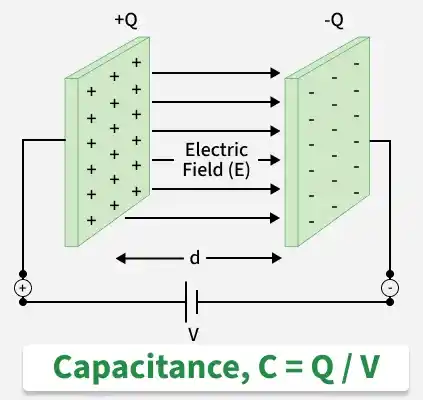
Capacitance measures the amount of charge a capacitor can store per unit voltage applied. Capacitors are essential components in electronic circuits used in power supplies, filtering, timing, and coupling applications. Understanding capacitors and capacitance is fundamental for working with or designing electronic circuits.
It is a two-terminal electronic device that stores electrical energy in the form of an electric charge within an electric field. It consists of two conductors, usually plates, separated by an insulator (dielectric) such as air, mica, or paper. The dielectric allows the plates to hold equal and opposite charges.
Capacitor Work
A capacitor is a basic electrical component that stores electric charge as electric potential energy. It consists of two conductive surfaces, such as plates or spheres, separated by a dielectric material like air, glass, or plastic.
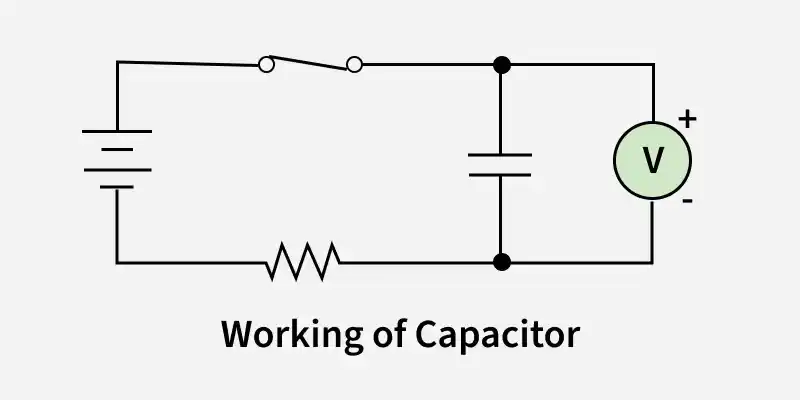
A capacitor is an electronic component used to store electric charge. It has two conductive plates separated by a dielectric material such as air or plastic. When a voltage is applied, a charge builds up on the plates. The amount of charge stored depends on its capacitance measured in farads (F), which is affected by the plate area and the distance between them and the dielectric material.
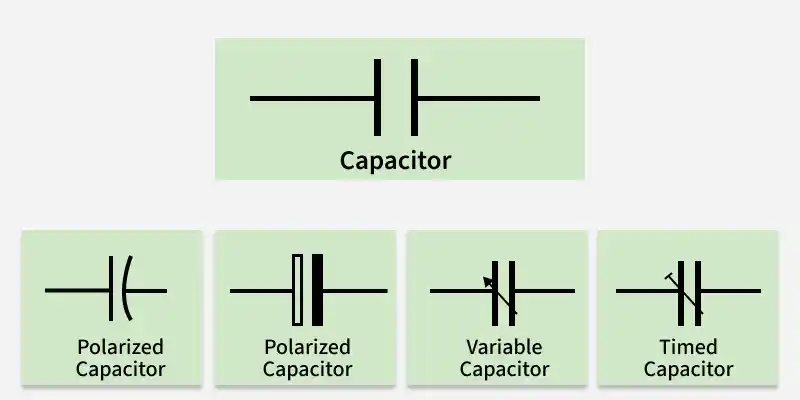
Capacitor Symbol
The symbol of a capacitor in an electric circuit is given in the following diagram:
Energy Stored in a Capacitor
Once a capacitor is connected to the power source, it starts to accumulate electrons on one surface and the opposite charges on the other surface. The work done by the power source for this is stored in the capacitor in the form of electrical potential energy, and this energy stored in a capacitor is given by the equation:
U = \frac{1}{2} C V^2 Where
- U is the energy stored in joules (J),
- C is the capacitance of the capacitor in farads (F), and
- V is the voltage across the capacitor in volts (V).
Derivation of Energy Stored in a Capacitor
Consider a capacitor of capacitance C charged to a potential difference V. The charge on the capacitor is given by
Q = CV During charging, the small work done in transferring a charge dQ is
dW = VdQ As V = Q/C, the equation can be written as
dW = \frac{Q}{C}dQ Integrating from Q=0 to Q,
W = \int \frac{Q}{C}\, dQ
W = \frac{1}{2}\frac{Q^2}{C} Substituting Q = CV
W = \frac{1}{2} C V^2 This work done is stored in the capacitor as the electric potential energy.
Thus,
U = \frac{1}{2} C V^2
Capacitance
The capacity of a capacitor to store charge in it is called its capacitance. It is an electrical measurement. It is the property of the capacitor.
When two conductor plates are separated by an insulator (dielectric) in an electric field. The quantity of charge stored is directly proportional to the voltage applied and the capacitance of the capacitor.
Q ∝ V
\boxed { Q = CV} where,
- Q = charge stored.
- C = Capacitance of the capacitor.
- V = voltage applied.
Unit of Capacitance
The standard unit OR the SI unit of capacitance is a farad, but 1 farad is a very large unit of capacitance. So, capacitance is measured in milifarads, microfarads, picofarads, nanofarads, etc.
As mili, micro, pico, and nano are the standard prefixes representing the following relations:
- 1 millifarad (mF) = 10-3 Farads
- 1 microfarad (μF) = 10-6 Farads
- 1 nanofarad (nF) = 10-9 Farads
- 1 picofarad (pF) = 10-12 Farads
Series and Parallel Combination of Capacitors
- When the capacitors are connected in a series one after the other, the total capacitance of the capacitors is
\frac{1}{C_{\text{total}}} = \frac{1}{C_1} + \frac{1}{C_2}
C_{\text{total}} = \frac{C_1 C_2}{C_1 + C_2}
- When the capacitors are connected in a parallel combination connected side by side
Ctotal = C1+C2
Capacitance of a Parallel Plate Capacitor
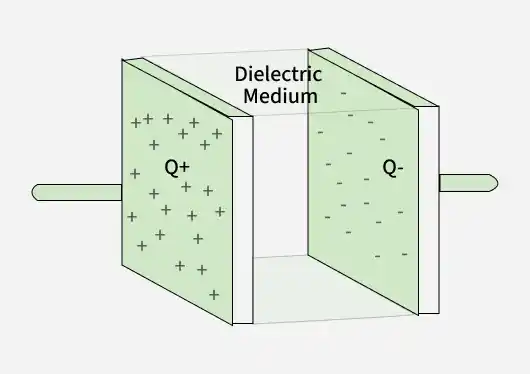
The capacitance of a parallel plate capacitor is directly proportional to the area (A) of the two parallel plates and inversely proportional to the distance of separation between the two plates (d)
C ∝ A/d
or
C = ∈oA/d
where :- ∈o = permittivity of free space = 8.854 × 10⁻¹²
Capacitance of Spherical Capacitor
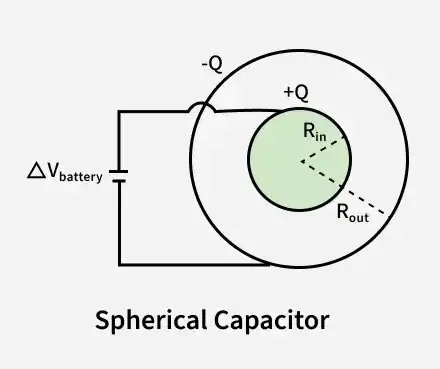
A spherical capacitor is made up of two hollow concentric conducting shells of radii R1 and R2 with a dielectric substance between them. These shells have equal and opposite charge Q. The capacitance of this capacitor is given by
\bold{C = 4\pi \epsilon_o \frac{R_1R_2}{R_1 - R_2}} where
- εo = permittivity of free space = 8.854 × 10⁻¹²
Factors affecting Capacitance
Some factors can affect the capacitance of capacitors, which are,
- Dielectric
- Distance Between Surfaces
- Area of the Surfaces
1. Dielectric
The dielectric material between the two surfaces can drastically affect the capacitance of capacitors. The capacitance of any capacitor is proportional to the permittivity of the dielectric, i.e., the higher the permittivity of the dielectric higher the capacitance of that capacitor.
The dielectric constant and permittivity of various dielectrics materials are given as follows:
Dielectric | Permittivity of Dielectric |
|---|---|
Vacuum | 1 |
Air | 1.0006 |
Glass | 4.5-10 |
Water | 80.4 |
2. Distance Between Surfaces
The distance between the surfaces of the capacitor is inversely proportional to its capacitance,e i.e., a higher distance between the surfaces implies a lesser capacitance of the capacitor. If the capacitance of a capacitor is C and the distance between surfaces i s d, then,
3. Area of the Surfaces
The area of the surface building up the capacitor can affect the capacitance of that capacitor in a direct proportion i.e., a higher surface area capacitor produces a higher capacitance. If C is the capacitance and A is the surface area of one side of the capacitor, then.
Applications of Capacitors
1. Capacitors are used for Energy Storage.
The major application of the capacitor is as an energy storage, the capacitor can hold a small amount of energy, which can power the electric circuit in case of power outages. Various appliances use capacitors as energy sources, which include,
- Audio equipment
- Camera Flashes
- Power supplies
- Magnetic coils
- Lasers
2. Capacitors are used for Power Conditioning
Capacitors are also used for Power Conditioning as they only allow AC to pass when they are charged, blocking DC.
3. Capacitors are used as Sensors.
Capacitors are used as sensors which are used to measure a variety of things, such as humidity, mechanical strain, and fuel levels.
4. Capacitors are used for Signal Processing.
In modern electronics, capacitors are also used as signal processors, they are used to build DRAM and other electronic devices.
Capacitor vs Capacitance
Capacitor | Capacitance |
|---|---|
| A Capacitor is a two-terminal electronic device that can store electrical energy in the form of electric charge in an electric field. | The capacity of the capacitor to store charge is called capacitance |
| It is a physical object or device | It is an electrical measurement. |
| The capacitor is a passive device. | It is not a device. It is the property of a capacitor. |
| It is also called an electric condenser. | It is only called capacitance. |
| It does not depend on size, shape, or distance. | The capacitance of a capacitor depends on the geometrical configuration, such as size, shape, and distance between the conductor plates. |
| It does not depend on the nature of the insulating material. | It depends on the nature of the insulating material. |
| It depends on the nature of the material of the conductor. | It doesn't depend on the nature of the material of the conductor. |
Solved Problems
Question 1: A capacitor of capacitance 10 μF is charged to a potential difference of 50V. Find the charge stored on the capacitor and the energy stored in the capacitor.
Solution: Given
C = 10 μF = 10 × 10-6 F
V = 50 V
Charge Stored
Q = CV
Q = 10 × 10-6 × 50
Q = 5 × 10⁻⁴ C
Energy Stored
U = \frac{1}{2}C V^2
U = \frac{1}{2} \times 10 \times 10^{-6} \times (50)^2 U = 0.0125 J
Question 2: How much charge is deposited on each plate of 6pF when it is connected to a 24V battery?
Solution: Given ,
V = 24V
C =6pF
Formula Q = CV
Q = 6 × 10-12 × 24
= 144 × 10-12C
Therefore, the charge required is 144 × 10-12C.
Question 3: The voltage applied is 15 V between the capacitors having a charge of 3μC. Find the capacitance.
Solution: Given,
V = 15V
Q = 3 μC
Formula: Q= CV
3 × 10-6 = C × 15
C = 3 × 10⁻⁶/15
= 0.2 × 10⁻⁶F
Therefore, the capacitance of the capacitor is 0.2 × 10⁻⁶F
Question 4: A capacitor is constructed from two metal plates with an area of 6m2 and is separated by a distance of 5m apart from each other. Calculate the capacitance of the capacitor.
Solution: Given
Area A = 6m2
Distance d = 5 m
Formula, C = ∈oAd
C = 8.854 × 10-12 × 6/5
C = 10.62 × 10⁻¹²F
Therefore, the capacitance of the capacitor is 10.62 × 10⁻¹²F.
Question 5: If 2 capacitors are connected in series combination with capacitances 15F and 12F. Calculate the total capacitance of the capacitors.
Solution: Given,
C1= 15F
C2 = 12F
Formula: Ctotal = C1C2/C1+C2
Ctotal = (15 × 12)/(15+12)
= 180/27
= 6.66F.
Therefore, the total capacitance of the capacitor is 6.66F
Unsolved Problems
Question 1: A capacitor of capacitance 8 μF is connected to a 40 V battery. Find the charge stored on the capacitor and the energy stored in the capacitor.
Question 2: Two capacitors of 6 μF and 12 μF are connected in parallel across a 30 V supply. Find the equivalent capacitance and the total charge drawn from the battery.
Question 3: A parallel plate capacitor of plate area 0.02 m2 and separation 2 mm is charged to 200 V and disconnected. A dielectric of constant 4 is then inserted completely between the plates. Calculate the final voltage and change in stored energy.
Question 4: A 2 μF and a 3 μF capacitor are connected in parallel,, and this combination is connected in series with a 6 μF capacitor across a 48 V supply. Calculate the equivalent capacitance and the energy stored in the system.
Question 5: A capacitor stores a charge of 5 μC at a potential difference of 25 V. Calculate its capacitance and stored energy.