
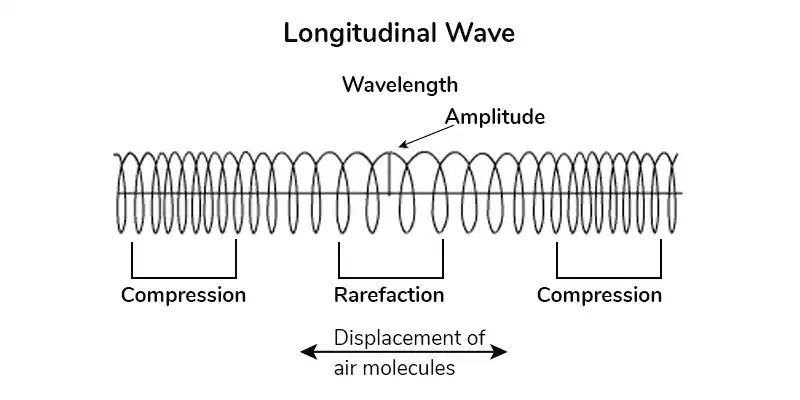
Longitudinal waves are mechanical waves in which particles of the medium vibrate parallel to the direction of wave propagation.
- This motion creates alternating regions of compression and rarefaction.
- The distance between two consecutive compressions or rarefactions is called the wavelength.
- These waves are also known as compression waves because they transfer energy through successive compressions and rarefactions while the particles oscillate about their mean positions.
Examples
- Sound Waves: Particles vibrate back and forth in air, forming compressions and rarefactions.
- Seismic P-waves: Travel through the Earth during earthquakes as longitudinal waves.
- Ultrasound Waves: High-frequency waves used in medical imaging.
- Spring Vibrations: Compression and expansion travel along a stretched spring.
Longitudinal Waves Formula
The following formula can describe longitudinal waves:
y(x,t)=A\cos\left(\frac{2\pi x}{\lambda}-2\pi ft+\phi\right) Where:
- y: displacement of the particle
- A: amplitude
- λ: wavelength
- f: frequency
- x: position
- t: time
- ϕ: phase constant
In the case of longitudinal harmonic sound waves, the formula can be written as:
y(x,t)=y_0\cos\left(\omega\left(t-\frac{x}{c}\right)\right) Where:
- y0 is the amplitude of the oscillations
- ω is the angular frequency of the wave
- c is the speed of the wave
A table containing all the formulas related to the longitudinal wave is given below:
Description | Formula |
|---|---|
Displacement | y(x, t) = A cos(kx - ωt + ϕ) |
Velocity | v = λ/T |
Frequency | f = v/λ |
Wave Length | λ = vT |
Period | T = 1/f |
Angular frequency | ω = 2πf |
Formation of Longitudinal waves
Longitudinal waves are produced when a disturbance (such as vibration or pressure change) causes particles of a medium to oscillate back and forth in the same direction as the wave travels. This creates successive compressions and rarefactions that propagate through the medium.
Longitudinal Nature of Sound (Pressure Waves)
Sound waves are longitudinal pressure waves in which particles oscillate parallel to the direction of propagation. A vibrating source (like a speaker) produces compressions and rarefactions in the medium, allowing sound to travel.
The displacement can be expressed as:
y(x,t)=y_0\cos(kx-\omega t+\phi) Where:
- y0: amplitude
- k: wave number
- x: position
- ω: angular frequency
- t: time
- φ: phase constant
Parts of Longitudinal Wave
- Compression: Region of high pressure where particles are close together.
- Rarefaction: Region of low pressure where particles are far apart.
- Wavelength (λ): Distance between two successive compressions or rarefactions.
- Amplitude: Maximum displacement of particles from their mean position.
- Time Period (T): Time taken to complete one oscillation.
- Frequency (f): Number of oscillations per second.
Characteristics of Longitudinal Waves
- Particle Motion: Particles vibrate parallel to the direction of wave propagation.
- Medium Requirement: These waves can travel through solids, liquids, and gases, but cannot propagate in vacuum.
- Wave Speed: The speed of longitudinal waves depends on the elasticity and density of the medium.
- Energy Transfer: They transfer energy without causing permanent displacement of particles.
- Nature of Motion: The wave consists of alternating compressions and rarefactions.
- Longitudinal Waves V/S Transverse Waves
Longitudinal Waves vs Transverse Waves
Property | Longitudinal Waves | Transverse Waves |
|---|---|---|
Vibration | Parallel to the direction of the wave | Perpendicular to the direction of the wave |
Energy Transfer | In the same direction as the wave motion | Perpendicular to the direction of the wave motion |
Medium | Travel in solids, liquids and gases | Travel in solids (and EM waves in vacuum) |
Vacuum | Cannot move in a vacuum | EM waves can travel in vacuum |
Key Features | Compressions and rarefactions | Crests and troughs |
Examples | Sound Waves, Ultrasonic Waves, etc. | Water Waves, Light Waves, etc. |
Solved Questions
Question 1: A sound wave travels in air with frequency 500 Hz and wavelength 0.68 m. Find its speed and time period.
Solution:
v = f\lambda = 500 × 0.68
= 340 m/s
T = \frac{1}{f}
= \frac{1}{500} = 0.002 s Speed = 340 m/s, Time period = 0.002 s
Question 2: A longitudinal wave is given by y(x,t) = 5 cos (4x − 20t) y. Find amplitude, wave number, angular frequency, and velocity.
Solution:
Amplitude A = 5
Wave number k = 4 rad/m
Angular frequency ω = 20 rad/s
v = \frac{\omega}{k}
= \frac{20}{4} = 5 \, \text{m/s} Amplitude = 5, Wave number = 4, angular frequency = 20, velocity = 5m/s
Question 3: Explain why sound waves cannot travel in vacuum.
Solution: Sound waves are mechanical longitudinal waves that require a material medium for particle vibration. In vacuum, there are no particles to vibrate, so sound cannot propagate. Sound cannot travel in vacuum due to absence of medium.
Question 4: A wave travels with velocity 300 m/s. If its frequency is doubled, what happens to wavelength?
Solution: v = f λ
Since the wave is travelling in the same medium, velocity remains constant.
Initial wavelength:
\lambda_1 = \frac{v}{f} If frequency is doubled:
f_2 = 2f New wavelength:
\lambda_2 = \frac{v}{f_2} = \frac{v}{2f} = \frac{\lambda_1}{2} The wavelength becomes half of its initial value.
Unsolved Questions
Question 1. A longitudinal wave is represented by the equation y(x,t)=4cos(2x−40t), determine the wave speed, wavelength, and frequency.
Question 2. A sound wave travels in a medium with speed 500 m/s and wavelength 2.5 m, determine its frequency and the new wavelength if the frequency is tripled while the speed remains constant.
Question 3. Two longitudinal waves of equal amplitude and frequency travel in the same direction; determine the phase difference required to produce maximum constructive interference.
Question 4. A wave is described by the equation y (x,t) = A cos (kx−ωt) where ω=100 rad/s and k=5 rad/m determine the wave velocity, wavelength, and frequency.
Question 5. The speed of a longitudinal wave in a medium depends on its elasticity and density explain how the wave speed changes when the density increases while elasticity remains constant.