
Stokes’ Law states that when a small spherical body moves slowly through a viscous fluid, it experiences a resistive (drag) force that opposes its motion. The drag force is directly proportional to the velocity of the sphere, its radius, and the viscosity of the fluid when the motion is slow (laminar flow). When a sphere falls through a liquid under gravity, the drag force increases until it balances the gravitational force, after which the sphere moves with a constant velocity known as terminal velocity.
Mathematical Expression
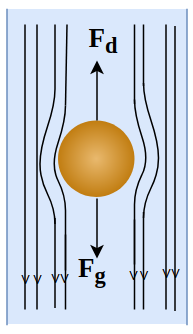
In Stokes's law, the drag force F acting upward to resist the fall is equal to 6πrηv, where r is the radius of the sphere, η is the viscosity of the liquid, and v is the fall velocity.
Where:
- F = drag force acting on the object,
- η (Greek letter) = dynamic viscosity of the fluid,
- r = radius of the spherical object
- v = velocity of the object relative to the fluid.
Importance of Stoke's Law
- Millikan employs this rule in his oil drop experiment to determine the electric charge.
- The working of a parachute is based on the principle of Stoke's Law.
- Cloud formation and floating are explained using Stoke's Law.
Stokes' Law Derivation
The viscous force acting on a sphere is directly proportional to the following factors:
Coefficient of viscosity (η) as F ∝ ηa ... (i)
Radius of the sphere (r) as F ∝ rb ... (ii)
Velocity of the object (v) as F ∝ vc ... (iii)
Combining the above three equations, we get,
F ∝ ηa rb vc
By removing the proportionality sign and adding the proportionality constant k, we obtain the following.
F = k ηa rb vc......(1)
Now, equating the dimensions of parameters on either side of equation (1)
[MLT–2] = [ML–1T–1]a [L]b [LT-1]c
Simplifying the above equation,
[MLT–2] = [Ma ⋅ L–a+b+c ⋅ T–a–c]...... (2)
LHS: [MLT−2]
RHS: [ Ma L−a+b+c T−a−c ]
Equating powers:
Mass: a=1
Time: − a − c = −2
Substitute a=1
−1 − c=−2
c = 1
Length:
−a + b + c = 1
− 1 + b + 1 = 1
b = 1
So:
F = k η r v
For any spherical body, the value of k was experimentally determined to be 6π.
Thus, the viscous force on a spherical body falling through a liquid is given by the equation,
F = 6πηrv
Limitations of Stoke's Law
1. Negative Density Difference in Stoke’s Equation
The density difference in Stokes’ equation is negative when the particles are lighter than the dispersion medium. This results in flotation or creaming, most commonly seen in emulsion systems.
2. High Content of Dispersed Solids
When a suspension has a high solid concentration, Stokes’ law does not give the correct sedimentation rate because it considers only the viscosity of the medium and ignores the increased viscosity and particle interactions in the system.
3. Brownian Movement
Brownian motion is the random movement of particles in a fluid due to molecular collisions. It opposes sedimentation and causes deviation from the settling rate predicted by Stokes’ law.
Conditions for Stoke's Law
- The fluid should be infinite in extent.
- The motion should be laminar (Re < 1).
- The body should be spherical, rigid, and smooth.
- There should be no slip between fluid and surface.
- The particle size should be large compared to molecular spacing but small enough for viscous effects to dominate.
Stokes' Law Applications
1. Velocity of Raindrops
Raindrops do not reach extremely high speeds during their free fall. Otherwise raindrops would strike the ground with extremely high speed and could cause injury. This phenomenon is because the viscous drag in the air opposes the velocity of raindrops as they descend due to gravity. The drop reaches a terminal velocity when the viscous force equals the force of gravity. As a result, raindrops reaching the earth have low kinetic energy.
2. Parachute
When we jump out of an airplane, a parachute assists us in landing safely on the ground. In this scenario, gravity accelerates the person's fall, but the air's viscous drag reduces the acceleration until they reach their terminal velocity. The person then drops at a constant speed and opens his parachute close to the ground at a predetermined period, allowing him to land safely near his destination.
Terminal Velocity
When a body falls through a viscous fluid, relative motion occurs between different layers of the fluid. As a result, the body experiences a viscous force that tends to retard its motion. The viscous force (F=6πηrv) increases with the velocity of the body. A stage is reached when the weight of the body becomes equal to the sum of the upthrust and viscous force. Then no net force acts on the body and it moves with a constant velocity called terminal velocity.
The maximum constant velocity acquired by a body while falling through a viscous medium is called its Terminal Velocity.
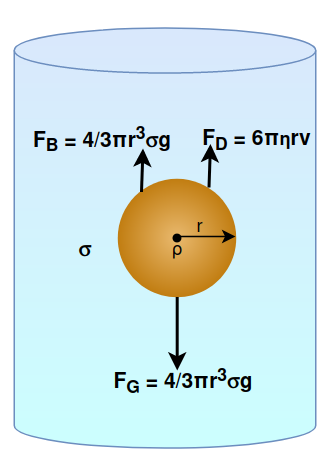
Drag force increases with an object's speed and depends on the substance it passes through (e.g., air or water). At some speed, the drag or force of resistance will equal the gravitational pull on the object (buoyancy is considered below). At this point, the object stops accelerating and continues falling at a constant speed called the terminal velocity (also called settling velocity).
Terminal Velocity Formula
The formula for terminal velocity (vt) is,
v_t = \frac{2 r^{2} (\rho - \sigma) g}{9 \eta} where
• ρ = density of sphere
• σ = density of fluid
• η = viscosity of fluid
Read More,
Solved Problems
Question 1: A raindrop of radius 0.3 mm falls through the air with a terminal velocity of 1 m/s. The viscosity of air is 18 × 10⁻⁵ poise. Find the viscous force on the raindrop.
Solution: Given,
Radius of the raindrop, r = 0.3mm = 0.03 cm.
Terminal velocity, v = 1 m/s =100 cm/s.
Viscosity of air, η = 18 × 10-5 Poise.According to Stokes law, the force of viscosity on rain drop is
F = 6π η r v
= 6 × 3.142 × 18 × 10-5 Poise × 0.03 cm × 100 cm/s
= 1.018 × 10⁻² dyne
Question 2: A solid metal ball falling in a liquid column attains a terminal velocity of 5 m/s. Find the viscosity of the liquid if the radius of the ball is r = 3 cm and its density is dl = 1000 kg/m3, and the density of the metal ball is ds = 7050 kg/m3 (Take g = 10 m/s2)
Solution: Given,
Radius of Sphere r = 3 cm = 0.03 m
Density of Sphere ds = 7050 kg/m3
Density of liquid dl = 1000 kg/m3
Terminal Velocity = 5 m/s
vt = 2r2 × (ρ−σ)g / 9η
Substituting the values in the terminal velocity equation,
3 = 2(0.03)2 × (7050 -1000)10 / 9η
3 = (6×10-4 × 60500) / 9η
3 = 36.3/9η
9η = 12.1
η = 12.1/9 = 1.344 kg/ms
Question 3: The speed of water in a water stream is 18 km/h near the surface. If the stream is 10 m deep, then determine the shearing stress between the surface layer and the bottom layer (coefficient of viscosity of water, η=10⁻³ Pa s).
Solution: Since the velocity of water at the bottom of the river is 0 m/s,
Therefore, dv = 18 km/h = (18 × 5/18) m/s = 5 m/s
Also, dx = 10 m and η=10−3 Pa s
Force of viscosity, F = η A (dv/dx)
Therefore,
Shearing stress = F / A = η (dv/dx)
= 10−3 Pa s × (5 m/s / 10 m)
= 5 ×10⁻² N m2
Question 4: A small spherical ball of radius 0.01 m moves through a liquid with velocity 2 m/s. If the viscosity of the liquid is 0.5 Pa·s, find the viscous force acting on the ball.
Solution: Stokes’ Law
F = 6πηrv
Substitute values:
F = 6 × 3.14 × 0.5 × 0.01 × 2
F = 6 × 3.14 × 0.01
F = 0.1884 N
Unsolved Problems
Question 1: A spherical ball of radius 0.01 m moves through a liquid of viscosity 0.4 Pa·s with velocity 3 m/s. Find the viscous force acting on it.
Question 2: A metal sphere of radius 2 mm falls in a liquid (η = 0.8 Pa·s, ρₛ = 8000 kg/m³, ρₗ = 1000 kg/m³, g = 9.8 m/s²). Find its terminal velocity.
Question 3: A sphere experiences a drag force of 0.12 N while moving at 1.5 m/s in a liquid of viscosity 0.5 Pa·s. Find its radius.
Question 4: A drop of radius 1 mm falls through oil (η = 1 Pa·s, ρₛ = 1200 kg/m³, ρₗ = 900 kg/m³, g = 9.8 m/s²). Calculate its terminal velocity.
Question 5: A spherical particle of radius 0.005 m moves in a fluid of viscosity 0.3 Pa·s. What velocity will produce a drag force of 0.0565 N ?