
Sound waves are those vibrations which when approaches our ears, are taken to the brain, and the brain then processes the information so that the sound is heard.
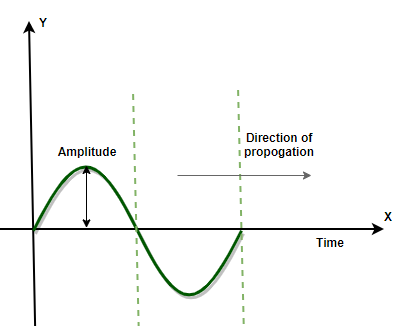
The characteristics of sound waves affect the waves and the propagation in different ways, there are 5 basic characteristics of the sound wave. When the vibration is drawn in form of a wave it becomes really easy to deduce the characteristics just by looking at the wave,
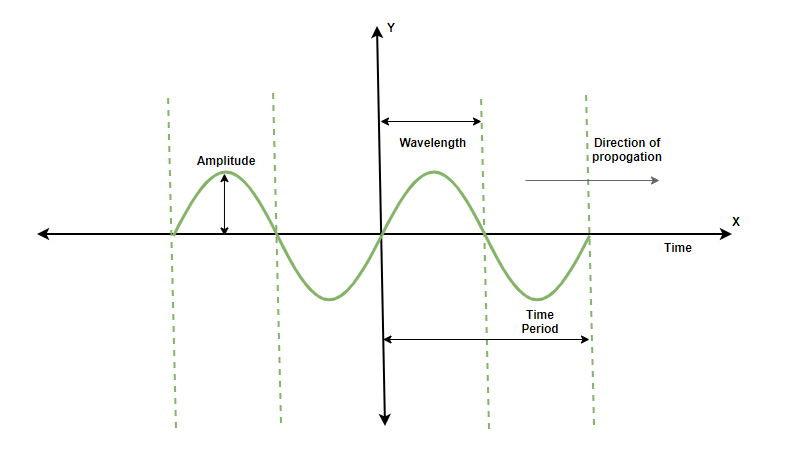
Note: The wave shown above is a transverse wave, but sound waves are known to be longitudinal in nature, they represented in longitudinal form for better understanding of the concepts
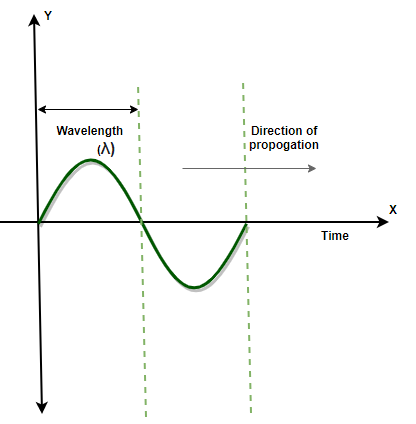
Wavelength (λ)
Wavelength is the minimum distance a wave travels before repeating itself. It is a length quantity so its SI unit is the meter. In a longitudinal sound wave one complete compression and one complete rarefaction together form a wavelength denoted by the symbol λ.
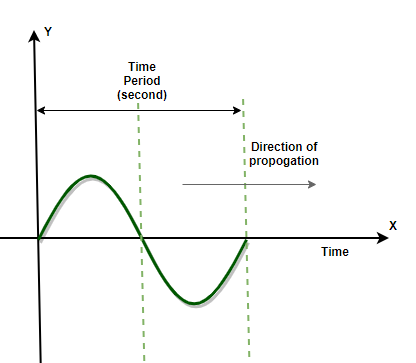
Time Period (T)
The time period of a sound wave is the time taken to complete one full cycle consisting of one compression and one rarefaction. It is measured in seconds the frequency of the wave is the reciprocal of the time period.
Frequency/Pitch (ν)
The frequency of a sound wave is the number of cycles (or vibrations) completed in one second. Its SI unit is hertz (Hz), represented by the symbol ν. Frequency does not change with the medium of propagation and therefore remains constant for a given wave.
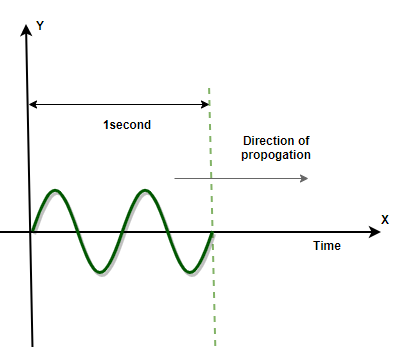
In the above figure, the frequency of the wave is to be determined. As it is clearly visible that two cycles are completed in 1 second. Hence, it can be concluded that the frequency of the wave is 2 Hz.
Formula to find out the frequency of the wave,
Frequency
\nu = \frac{1}{T} Where T= Time Period
Note: The Time period and frequency of a wave are reciprocal to each other and therefore, if a wave has more Time period, it will have less frequency and vice versa.
Velocity of the wave
The velocity of the wave is defined as the distance travelled by the sound wave per unit of time. The distance travelled is nothing but the wavelength of the wave. The SI unit of the velocity of the sound wave is meter/second (m/sec).
Velocity of the sound wave =
\frac{Wavelength}{Time Period} Velocity of the sound wave = Wavelength × Frequency
v = λ × ν (m/sec)
Amplitude/Loudness (A)
The Amplitude of the wave tells the amount of energy present in the wave. Amplitude is normally known as the loudness of the sound wave is defined by the maximum height (vertically) reached by the wave, the higher the magnitude, the higher will be the loudness. In a sound wave, the magnitude of one rarefaction or compression is defined as the amplitude of that wave.
Sample Problems
Question 1: Explain with the help of diagrams how a certain sound is louder than the other?
Answer:
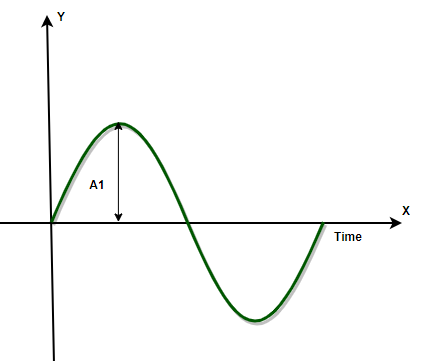
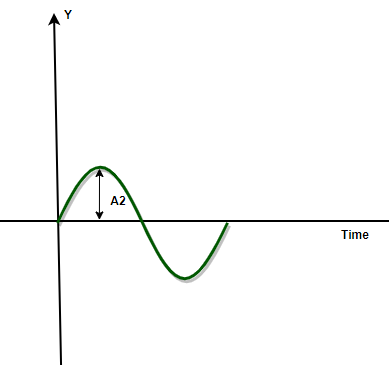
The loudness of any sound is determined by its amplitude. Higher the amplitude of the wave, louder is the sound. Below given two different figures are showing the sound waves of two different sounds, where the first sound is louder and the second sound is less loud (quieter)
Question 2: The Time period of a wave is given as 20 milliseconds. What will be the frequency of this wave?
Answer:
As the formula known for the frequency of the wave is,
Frequency= 1/time period
Frequency= 1/(20 × 10-3)
Frequency= 1000/20
Frequency= 50 Hz
Question 3: Two waves having Frequencies of 10 Hz and 50 Hz are given. Which wave has more Time period?
Answer:
The Time period for the first wave= 1/frequency
= 1/10
= 0.1 second.
The Time period for the second wave= 1/frequency
= 1/50
=0.02 second.
Hence, The time period of the first wave more than the Time period of the second wave.
Question 4: Explain how the characteristics of a sound wave and a light wave differ from each other?
Answer:
Difference between the characteristics of sound wave and light wave,
- Sound Waves are longitudinal waves while Light waves are transverse waves.
- Sound waves always require a medium to travel, that is, they cannot travel in vacuum, while light waves do not require any material medium since they are electromagnetic waves.
- The speed of light is approximately 330 m/sec while the speed of light wave is 3× 10⁸ m/sec.
- Sound waves are mechanical waves, but light waves are electromagnetic waves.
Question 5: The velocity of a wave is 300 m/sec and the wavelength is given as 20 Hz. What will be the wavelength of this wave?
Answer:
The velocity of a wave is given as,
Velocity = frequency × wavelength
300= 20 × λ
λ =15 meters
Hence, the wavelength of this wave is 15 meters.
Question 6: The Time period of a wave is 1 second and the wavelength is given as 10 meters. There is another wave with a time period of 3 seconds and the wavelength of 30 meters. Which of the two waves have more velocity.
Answer:
Velocity of the first wave= 10/1
Velocity = 10 m/sec
Velocity of the second wave= 30/3
Velocity = 10 m/sec
Hence, the velocity of both the waves are equal.
Unsolved Problems
Question 1: A sound wave has a wavelength of 1.5 m and a frequency of 220 Hz. Calculate the velocity of the wave.
Question 2: The time period of a sound wave is 0.004 s. Find the frequency and state whether the sound is audible to humans.
Question 3: A sound wave travels with a velocity of 340 m/s. How many vibrations will it complete in 5 seconds if its wavelength is 2 m?
Question 4: A sound wave travels through a medium with a velocity of 360 m/s. If its frequency is increased by 40 Hz, the wavelength decreases by 0.5 m. Find the original frequency of the wave.
Question 5: Two sound waves travel through the same medium. The frequency of the first wave is twice that of the second wave, while their wavelengths differ by 1.2 m. If the velocity of sound in the medium is 300 m/s, find the frequencies of both waves.
Question 6: A sound wave A has twice the frequency of sound wave B. If the wavelength of wave A is 1 m less than that of wave B and both travel with the same velocity, find the velocity of the waves.