
When a fluid such as a liquid or gas moves through a pipe, around an object, or inside a channel, its particles do not always move in the same manner. Under some conditions, the fluid flows smoothly in well-defined layers, while under other conditions, the motion becomes irregular and chaotic.
These two important types of fluid motion are known as:
- Laminar Flow
- Turbulent Flow
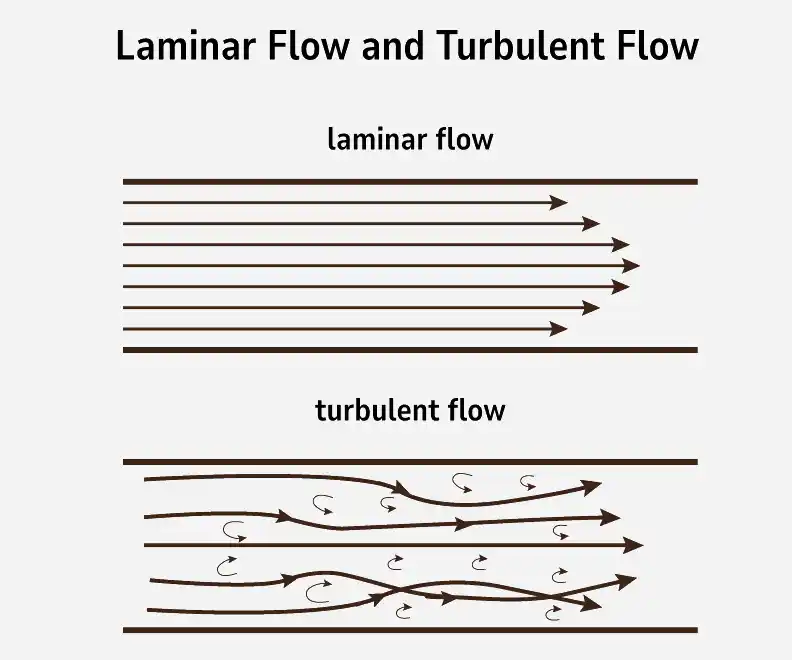
Laminar Flow
Laminar flow is a smooth and orderly type of fluid motion in which the fluid moves in parallel layers without mixing. The particles of the fluid travel in straight and fixed paths, making the flow stable and predictable. It generally occurs when the fluid velocity is low and the viscosity is high. Laminar flow is commonly seen in smooth pipes, capillary tubes, and medical equipment where controlled fluid motion is important.
The condition for laminar flow is Re<2000
- In laminar flow, fluid particles move in smooth and parallel layers without disturbance.
- The motion of particles is regular and predictable because there is almost no mixing between layers.
- Laminar flow generally occurs at low fluid velocity and in fluids having high viscosity.
- Energy loss is very small because friction and turbulence are minimal in this type of flow.
- Laminar flow is widely used in medical applications, lubrication systems, chemical experiments, and narrow pipe flow systems.
Turbulent Flow
Turbulent flow is a type of fluid motion in which the fluid moves irregularly and chaotically. The particles continuously mix with each other due to rapid changes in speed and direction, creating swirling motions called eddies. It usually occurs at high velocity and causes greater friction and energy loss compared to laminar flow.
The condition for turbulent flow is Re > 4000
- In turbulent flow, fluid particles move randomly with irregular changes in velocity and pressure.
- Strong mixing of fluid layers takes place due to swirling motions and eddies.
- Turbulent flow generally occurs at high fluid velocity and low viscosity.
- Energy loss is high because friction and resistance are greater in turbulent motion.
- Turbulent flow is commonly seen in river rapids, smoke movement, atmospheric winds, and water supply pipelines.
Origin of Turbulence
When fluid velocity becomes sufficiently large:
- inertial effects increase,
- disturbances grow rapidly,
- orderly layers break down.
The fluid then develops rotational motion, eddies, and random fluctuations. This transition produces turbulence.
Energy Loss in Turbulent Flow
Turbulent flow involves continuous mixing, internal friction, and eddy formation. Therefore, a large amount of mechanical energy converts into heat. Hence, turbulent flow produces a greater pressure drop as well as greater resistance to motion.
Examples of Turbulent Flow
Turbulent flow occurs in:
- river rapids,
- fast water pipelines,
- smoke rising irregularly,
- atmospheric winds,
- aircraft wake,
- ocean currents.
Laminar vs Turbulent Flow
Aspect | Laminar Flow | Turbulent Flow |
|---|---|---|
Flow Description | Smooth and orderly flow | Chaotic and irregular |
Layers | Flows in parallel layers without mixing | Layers mix due to eddies and fluctuations |
Fluid Resistance | Low resistance due to smooth flow | High resistance due to mixing and fluctuations |
Velocity | Velocity is consistent and predictable | Velocity varies significantly |
Application Example | Used in microfluidics and laminar airflow hoods | Found in fast-flowing rivers and HVAC systems |
Pressure Drop | Low Pressure Drop | High Pressure Drop |
Mixing Efficiency | Low mixing efficiency | High mixing efficiency |
Flow Stability | Stable flow | Unstable flow sensitive to disturbances |
How to Avoid Turbulent Flow
To avoid turbulent flow, follow these key strategies:
- Reduce Flow Speed: Decreasing the velocity of the fluid flow helps maintain a laminar state.
- Smooth Surface: Ensure that the internal surfaces of pipes and channels are smooth to reduce disturbances.
- Decrease Fluid Density: Using fluids with lower densities can help reduce the onset of turbulence.
- Increase Fluid Viscosity: More viscous fluids tend to flow more smoothly, which can help prevent turbulence.
- Choose Smaller Pipes: Smaller diameters in pipes encourage laminar flow by limiting the space in which turbulence can develop.
- Control Flow Rate: Regulating the flow rate to stay within a range that supports laminar flow is crucial.
Velocity Distribution in Turbulent Flow
In turbulent flow, the velocity of the fluid does not remain constant across the cross-section of a pipe or channel. Instead, it varies significantly due to the chaotic and swirling motions of the fluid particles.
- Near the Walls: The velocity of the fluid is lowest near the walls of the pipe or channel. This is due to the friction between the fluid and the walls, which slows down the fluid particles at the surface.
- Middle of the Flow: As you move away from the walls toward the center of the pipe or channel, the velocity of the fluid increases. This increase is most pronounced close to the walls, where the fluid accelerates rapidly away from the low-velocity boundary layer.
- Center of the Pipe: At the center of the pipe, the velocity reaches its maximum. This region is farthest from the walls and thus experiences fewer frictional effects. However, unlike in laminar flow where the velocity profile is sharply peaked at the center, the velocity profile in turbulent flow tends to be flatter at the top. This flatter profile is a result of the intense mixing and momentum exchange due to the turbulent eddies and fluctuations.
- Overall Shape of the Profile: The overall shape of the velocity profile in turbulent flow is more uniform across the cross-section compared to laminar flow. This is due to the high levels of turbulence, which enhance mixing and tend to equalize the velocity differences across the flow.
Reynolds Number
The transition between laminar and turbulent flow is determined using a dimensionless quantity called the Reynolds Number.
It is defined as \boxed
where:
- ρ = fluid density,
- v= fluid velocity,
- d = pipe diameter,
- η = viscosity.
Poiseuille’s Law and Laminar Flow
Poiseuille’s law applies only to laminar flow in narrow tubes. This equation fails in turbulent flow because orderly layer motion no longer exists.
According to Poiseuille’s law:
\boxed {Q=\frac{\pi Pr^4}{8\eta l}} where:
- Q = volume flow rate,
- P = pressure difference,
- r = radius,
- η = viscosity,
- l = tube length.