
An electric dipole is a pair of equal and opposite charges that are close together. The electric dipole moment is calculated by multiplying one of the charges by the distance between them, and it helps us understand how polar molecules are arranged and oriented in three-dimensional space.
The dipole has a definite direction along the line joining the charges, directed from −q to +q, with its center at the midpoint between them. Although the net charge of an electric dipole is zero, it produces a non-zero electric field due to the separation of charges. At distances much larger than the separation (r ≫ 2a), the fields due to the two charges nearly cancel each other.
Dipole Moment Formula
Dipole moment is represented by the Greek letter μ and is defined as the product of the magnitude of either charge and the distance separating them.
Dipole Moment (µ) = Charge (Q) × distance of separation (r)
μ = δ.d
where,
μ is the bond dipole moment
δ is the magnitude of the partial charges δ+ and δ–
d is the distance between charges
Unit and Dimension
Dipole moment is measured in Debye, denoted by 'D.'.
1 D = 3.33564 × 10⁻³⁰ C.m
where
C is Coulomb
m denotes a metre
Its dimensional formula is [M0L1T1I1].
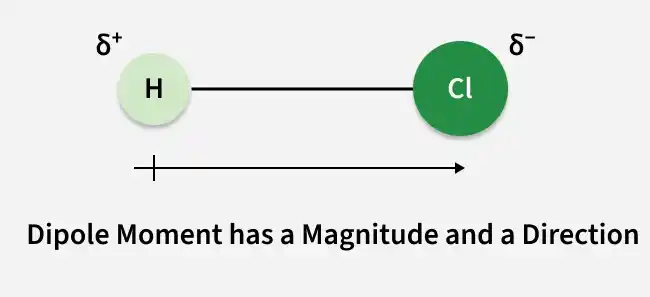
Dipole Moment (μ) is a vector quantity whose direction is measured from the +q to the -q charge.
The image given below shows the dipole moment of the HCl molecule.
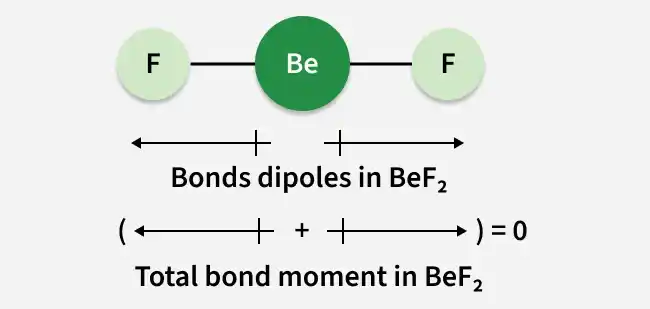
Dipole Moment of BeF2
The net dipole moment of the BeF2 Beryllium Fluoride molecule is zero. The bond angle between the BeF2 molecule is 180°, and the two dipole moments are opposite to each other, and they cancel each other out. The image given below shows the dipole moment of the BeF2.
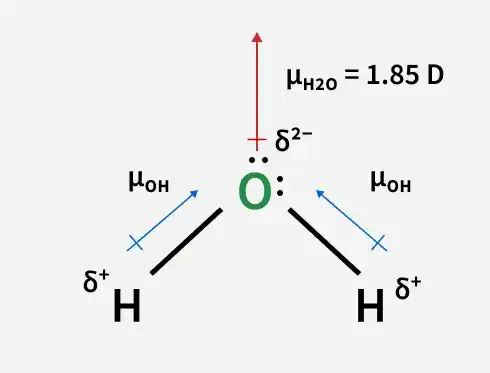
Dipole Moment of H2O (Water)
The net dipole moment of the H2O water molecule is found to be 1.84 D. The bond angle in the water molecule is 104.5°. The water molecule has two oxygen-hydrogen bonds that can individually be treated as dipoles, and their individual bond moment of an oxygen-hydrogen bond is 1.5 D. The image given below shows the dipole moment of the H₂O.
Dipole in an External Electric Field
If an electric dipole is placed in an external electric field, the electric dipole experiences some force called torque. It is represented by the Greek letter τ. The torque in any external electric field on the dipoles is given by,
\tau = P \times E
\boxed {\tau = P.E \, \, sin\theta } where,
P is the Dipole Moment
E is the Applied External Field
Significance of Electric Dipole Moment
Electric dipoles are important in chemistry, as they help in the classification of molecules based on their dipole moment.
On the basis of electric dipole moment, molecules are of two types:
- Polar Molecules: Molecules having a non-zero dipole moment are called polar molecules. Eg: HCI. In the absence of an external electric field, these molecules are randomly oriented, but when an electric field is applied, they align themselves along the field.
- Non-Polar Molecules: Molecules having zero net dipole moment are called non - polar molecules. Eg: BeF2.
Uses of Dipole Moment
- It helps determine the shape and symmetry of molecules.
- It is used to distinguish cis and trans isomers.
- It helps in calculating the percentage of ionic character of a molecule.
- It is useful in distinguishing ortho-, meta, and para-substituted compounds.
Related Articles:
Solved Question
Question 1: Two equal and opposite charges of magnitude 2 μC are separated by a distance of 5 mm. Find the electric dipole moment of the system.
Solution: Electric dipole moment
μ = q × d
here, q = 2 × 10⁻⁶ C and d = 5 × 10⁻³ m.
μ = (2 × 10⁻⁶) (5 × 10⁻³)
μ = 1 × 10⁻⁸ cm
Question 2: The dipole moment of a molecule is 1.5 D. Convert it into SI units.
Solution: We Know that:
1D = 3.33564 × 10⁻³⁰ cm
μ = 1.5 × 3.33564 × 10-30
μ = 5.003 × 10⁻³⁰ cm
μ ≈ 5.0× 10⁻³⁰ cm
Question 3: An electric dipole of moment 4 × 10-29 is placed in a uniform electric field of strength 5×10⁵ N/C. Find the maximum torque acting on the dipole.
Solution: Torque acting on a dipole in an electric field
T = pE sinθ
For maximum torque
\theta = 90^\circ , hencesin \theta = 1.Tmax = pE
T = (4 × 10-29) (5 × 10⁵)
T = 2 × 10-23 Nm
Question 4: The bond length of the O–H bond in a water molecule is 0.096 nm. If the charge on hydrogen is +0.33e calculate the dipole moment of one O–H bond. (e= 1.6 × 10⁻¹⁹ C)
Solution: Charge on hydrogen atom:
q = 0.33 × 1.6 × 10-19
q = 5.28 × 10⁻²⁰ C
Bond length
d = 0.096 × 10 -9 m
Dipole moment
μ = q × d
μ = (5.28 × 10⁻²⁰) (0.096 × 10 -9)
μ = 5.07 × 10⁻³⁰ cm
Converting into Debye
\mu = \frac{5.07 \times 10^{-30}}{3.33564 \times 10^{-30}} Answer:
\mu \approx 1.52\,D
Question 5 : An electric dipole consists of two equal and opposite charges separated by a distance of 2 cm. The magnitude of each charge is 4 × 10⁻⁸ C. Calculate the electric dipole moment of the dipole.
Solution: Electric dipole moment
μ = q × d
Given
q = 4 × 10⁻⁸ C
d = 2 cm = 2 × 10⁻² m
μ = (4 ×10⁻⁸) (2 × 10⁻²)
μ = (4 × 10⁻⁸) (2 × 10⁻²)
Answer
μ = 8 × 10⁻¹⁰ Cm
Unsolved Problems
Question 1: Two charges of magnitude +3μC and −3 μC are separated by a distance of 4 mm. Find the electric dipole moment of the system in SI units and Debye.
Question 2: An electric dipole has a dipole moment of 2.5 D. Calculate the distance between the charges if the magnitude of each charge is 1.2 × 10⁻¹⁹ C.
Question 3: An electric dipole of moment 6×10-30 C m is placed in a uniform electric field of strength 4×10⁵ N/C making an angle of 30o with the field. Find the torque acting on the dipole.
Question 4: The bond angle of an XY2 molecule is 120o. Each X–Y bond has a dipole moment of 1.8 D. Calculate the net dipole moment of the molecule.
Question 5: An electric dipole is placed in a uniform electric field. The dipole experiences maximum torque of 3 × 10-22 Nm.
If the applied electric field is 6×10⁵ N/C, find the dipole moment of the dipole.