
In everyday life, we observe many objects moving along circular paths—such as a rotating fan, a merry-go-round, a Ferris wheel, or a satellite orbiting the Earth. This type of motion is known as circular motion.
When an object moves along a circular path with a constant speed, the motion is called uniform circular motion. Although the speed remains constant, the motion is still considered accelerated because the direction of velocity changes continuously at every point.

Uniform circular motion is defined as the motion of an object along a circular path with constant speed but continuously changing direction.
Key Characteristics
- Motion occurs along a circular path
- Speed remains constant and Velocity changes continuously due to change in direction
- Motion is accelerated motion
- Acceleration always acts towards the center of the circle in Circular Motion.
- Velocity at any point is along the tangent to the circle
Examples of Uniform Circular Motion
- A car moving at constant speed on a circular track
- A rotating fan
- A satellite revolving around the Earth
Velocity in Uniform Circular Motion
Even though speed is constant, velocity is not constant because:
- Velocity is a vector quantity (depends on direction)
- Direction keeps changing at every point
At any instant, the velocity acts tangentially to the circular path.
Centripetal Acceleration
The acceleration acting on a body moving in a circular path, directed towards the center, is called centripetal acceleration.
- Always directed towards the center
- Responsible for change in direction of velocity
- Without it, the object would move in a straight line
Centripetal Force
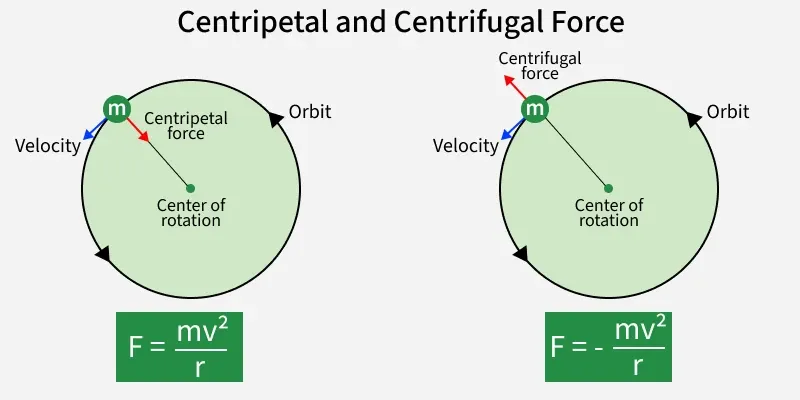
The force that acts on an object moving in a circular path is directed towards the center of the circle, keeping the object on its path. or in other words The force responsible for centripetal acceleration is called centripetal force.
Sources of Centripetal Force
- Tension (stone tied to string)
- Gravitational force (planets, satellites)
- Friction (vehicles on curved roads)
- Normal reaction (circular tracks)
Angular Quantities in Circular Motion
1. Angular Displacement (θ)
Angular displacement is the angle subtended by the radius vector.
2. Angular Velocity (ω)
Angular velocity is the rate of change for angular displacement.
3. Angular Acceleration (α)
Angular acceleration is the rate of change of angular velocity.
In uniform circular motion, angular acceleration = 0 (since angular velocity is constant).
Relation Between Linear and Angular Quantities
1. Velocity Relation:
2. Acceleration (Tangential) Relation:
| Circular Quantity | Linear Quantity | Relation |
|---|---|---|
| θ | S | θ = S/r |
| ω | v | ω = v/r |
| α | a | α = a/r |
Time Period and Frequency
- Time Period (T): Time taken for one complete revolution
- Frequency (f): Number of revolutions per second
Relations
1.
2.
3.
Vector Form of Uniform Circular Motion
Let the particle move in a circle of radius r with angular velocity ω.

1. Position Vector
2. Velocity Vector
3. Acceleration Vector
Important Relation
This shows acceleration is always directed towards the center.
Circular vs Uniform Circular Motion
| Circular Motion | Uniform Circular Motion |
|---|---|
| Speed may vary | Speed is constant |
| General motion | Special case |
| Acceleration may vary | Constant magnitude |
Read More,
Sample Questions
Question 1: An object is moving in a circular path of radius 7 m with uniform speed 14 m/s.. Find the centripetal acceleration of the object.
Solution: Centripetal acceleration
a_c = \frac{v^2}{r}
a_c = \frac{(14)^2}{7}
\frac{196}{7}
28\ \text{m s}^{-2} Answer
a_c = 28\ \text{m s}^{-2}
Question 2: A cyclist is taking a turn at a speed of 5 m/sec. If he doubles his speed, how will the force acting on his bicycle towards the center change?
Solution: Centripetal force is given as,
\sum F= Mass. Acceleration = ma_r= \frac{mv^2}{r} It is observed that,
F∝ v2
Therefore, if the velocity is doubled, the force acting on the bicycle will become 4 times than before.
Question 3: A plane is flying with a speed of 120 m/sec, and it makes a turn to join a circular path level with the ground. What will be the radius of the circular path formed if the centripetal acceleration is equal to the acceleration due to gravity?
Solution: Centripetal acceleration (ac ) is equal to the acceleration due to gravity (g), which is assumed to be 10m/s2
speed of plane(v) = 120m/s
Using the formula for centripetal acceleration:
ac =v2/r
given that ac = g = 10m/s2
r = v2/ac
Let's assume the acceleration due to gravity to be 10 m/sec2
r = (120)2 / 10
⇒ r = 14400 / 10
⇒ r = 1440m
Question 4: Suppose you are sitting in a room and feel the need to increase the speed of the fan; you increase the regulator, and the blades accelerate at 2 rad/sec2. It accelerated for 3 seconds, and the final angular frequency of the blades became 7 rad/sec. What was the initial angular frequency?
Solution: The formula for Angular velocity is,
\alpha = \frac{\Delta \omega}{\Delta t} Given:
- Time for which the blades accelerated = 3 seconds.
- Acceleration = 2 rad/sec2
⇒ 2 ={wf - wi}/ Δt
⇒ 2 = {7 - wi} / 3
⇒ 7- wi = 6
⇒ wi = 1 rad/sec
Question 5: A particle of mass 2 kg moves in a circular path of radius 5 m with a constant speed of 10 m/s. Calculate the centripetal force acting on the particle.
Solution: Given: Mass, m = 2 kg
Radius, r = 5 m
Speed, s = 10 m/s
formula used:
F_c = \frac{mv^2}{r}
F_c = \frac{2 \times (10)^2}{5}
\frac{200}{5} Centripetal force =
40N
Unsolved Problem
Question 1: A particle of mass m moves in a horizontal circle of radius r with constant speed v. The tension in the string suddenly becomes four times greater. Find the new radius of the circular path, assuming the speed remains unchanged.
Question 2: Two particles of masses m₁ and m₂ are moving in circular paths of radii r₁ and r₂, respectively, with the same centripetal force acting on them. If their speeds are v₁ and v₂, find the ratio
Question 3: A particle moves in a vertical circle of radius R with constant speed v. At what minimum value of v will the string remain taut at the highest point of the circle?
Question 4: A car of mass m is moving with constant speed v on a circular track of radius R. If the coefficient of friction between the tires and the road is μ, find the maximum speed with which the car can move without skidding.
Question 5: A particle executes uniform circular motion with angular speed ω. The magnitude of the rate of change of velocity is k. Find the radius of the circular path in terms of k and ω.