
Energy is the capacity of a body or system to do work. It exists in many forms, such as kinetic, potential, thermal, electrical, chemical, and nuclear energy.
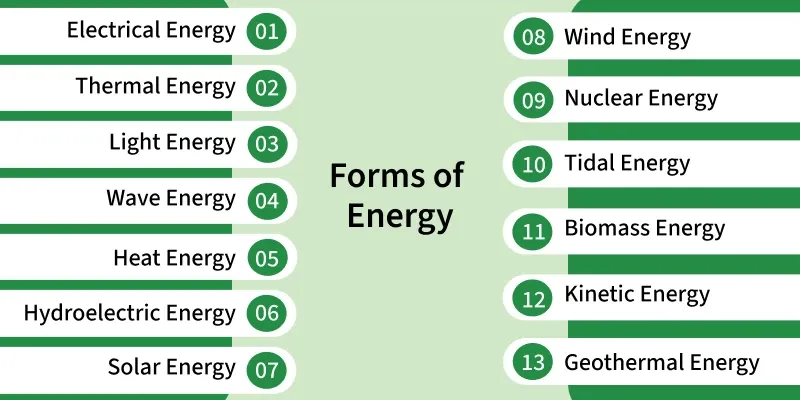
Energy is associated with motion or position.
- A moving object possesses kinetic energy.
- An object at rest but capable of motion (like a stretched spring or raised object) has potential energy.
Energy can neither be created nor destroyed; it can only be converted from one form to another. This principle is called the law of conservation of energy.
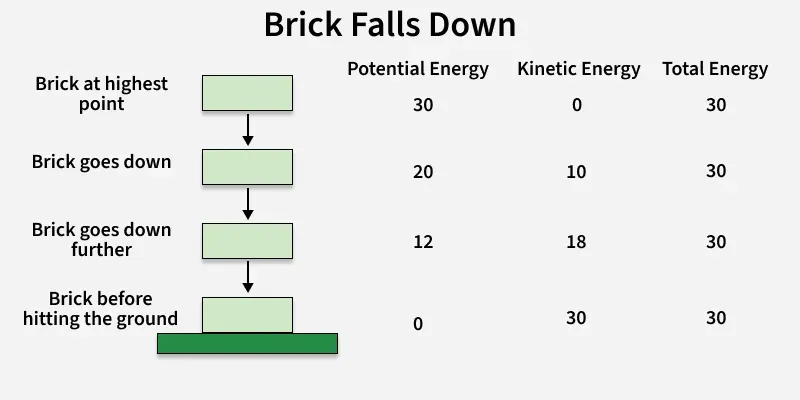
For example, when an object falls, its potential energy changes into kinetic energy, and due to friction, some of it converts into heat.
Units of Energy
The SI unit of energy is the joule (J), named after the physicist James Prescott Joule. "One joule is defined as the work done when a force of one newton moves an object through a distance of one metre".
Apart from the joule, energy can also be measured in other units such as calorie, kilocalorie, kilowatt-hour, and erg
➣ Read More: Unit of Energy
Note: Dimensional Formula of Energy is [ML²T-2].
Different Types of Energy
Energy comes in various forms, but they can all be grouped into two primary categories:
1. Kinetic Energy
Kinetic energy refers to the energy possessed by an object due to its motion. It depends on both the object's mass and its velocity of the object—the greater the mass or the faster it moves, the higher its kinetic energy. In simple terms, anything that is moving possesses kinetic energy.
Kinetic Energy Formula,
Suppose an object of mass 'm' moves with a velocity of 'v' then the formula use to calculate the kinetic energy of the object is,
K.E.= \frac{1}{2}mv^2
Units of Kinetic Energy
- SI unit of K.E. is Joule which is equal to 1 kg.m2.s-2.
- CGS unit of K.E. is erg.
Different Types of Kinetic Energy
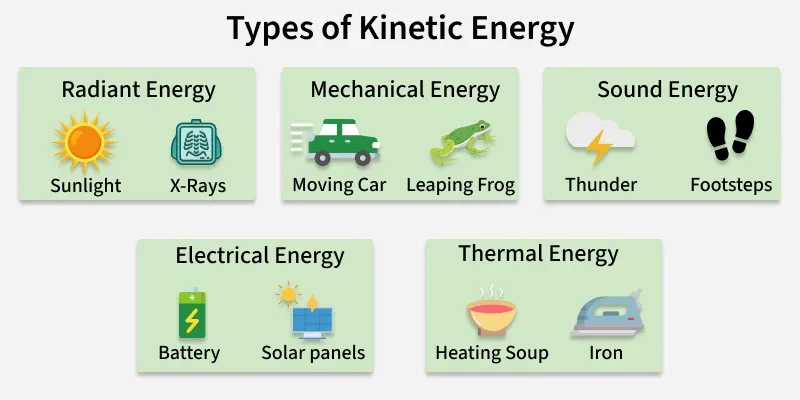
a. Radiant Energy:
- Radiant energy is the energy carried by electromagnetic waves that can travel through space without the need for a medium. It is emitted by all objects that have a temperature above absolute zero.
- Common examples of radiant energy include sunlight, visible light, infrared radiation, ultraviolet rays, X-rays, and radio waves. The Sun is the primary natural source of radiant energy on Earth, providing light and heat.
- Radiant energy travels at the speed of light and is widely used in daily life, such as in solar panels, communication systems, heating, medical imaging, and lighting.
- Radiant energy is a type of kinetic energy because it involves the movement of electromagnetic waves.
b. Sound Energy:
- Sound energy is a form of energy produced by vibrations and transmitted through a medium such as air, water, or solids. It is a type of mechanical energy because it requires particles of a medium to vibrate for its propagation.
- Sound energy is generated when an object vibrates and creates sound waves. These waves travel through the medium and are detected by the ear as sound. Eg: speech, music, ringing bells, and engine noise.
- Sound energy cannot travel through a vacuum and is widely used in communication, medical imaging (ultrasound), navigation (SONAR), and entertainment.
- Example: when you pluck a guitar string, it vibrates and produces sound energy that travels through the air to your ears.
c. Electrical Energy:
- Electrical energy is the energy associated with the flow of electric charges, usually electrons, through a conductor. It is produced when there is a potential difference that causes charges to move.
- Electrical energy can be generated from various sources such as batteries, generators, solar cells, and power stations. It is one of the most widely used forms of energy because it can be easily transmitted, controlled, and converted into other forms like light, heat, and sound.
- Common applications of electrical energy include lighting, household appliances, communication systems, computers, and industrial machines.
d. Thermal Energy:
- Thermal energy is the energy associated with the random motion of particles (atoms and molecules) within a substance. It depends on the temperature of the object—the higher the temperature, the greater the thermal energy.
- Thermal energy flows from a hotter body to a colder body in the form of heat. It is commonly produced by friction, combustion, and electrical processes.
- Thermal energy is widely used in cooking, heating systems, power generation, and industrial processes.
e. Mechanical Energy:
- Mechanical energy is the energy possessed by an object due to its motion or position. It is the sum of kinetic energy and potential energy.
- Mechanical energy is widely used in machines, transportation, power generation, and daily activities.
- For example, a moving car has mechanical energy because of its motion (kinetic), and a stretched rubber band has mechanical energy due to its position (potential).
2. Potential Energy
When work is done on an object, the energy is stored within it, and this stored energy is known as potential energy. Potential energy depends on the position or condition of the object. For instance, a stretched rubber band stores energy in the form of elastic potential energy, which is one type of potential energy.
Potential Energy Formula,
The energy of an object due to its position is called the potential energy of the object. Suppose an object of mass 'm' is placed at height 'h' against the gravitational acceleration 'g' then the work done is equal to the gain in potential energy of the object. Then the potential energy formula for the same is,
P.E. = m.g.h
Units of Potential Energy(P.E.)
- SI unit of P.E. is Joule which is equal to 1 kg.m2.s-2.
- In CGS system unit of P.E. is erg.
Different Types of Potential Energy
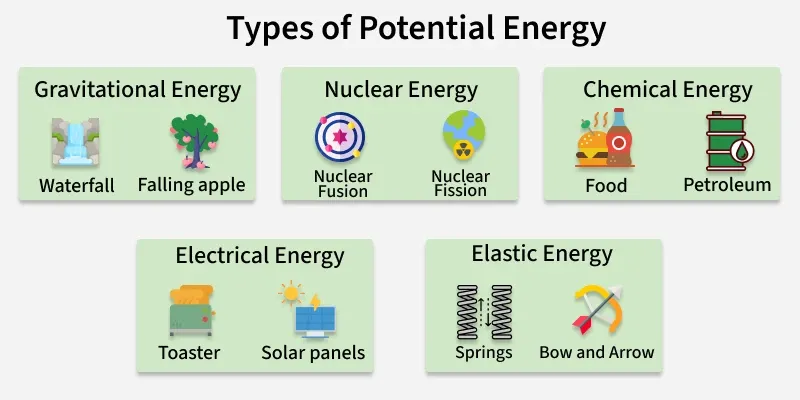
a. Gravitational Potential Energy:
- Gravitational potential energy is the energy possessed by an object due to its position in a gravitational field, usually because of its height above the ground.
- An object has more gravitational potential energy when it is placed at a greater height. When the object falls, this stored energy is converted into kinetic energy.
- Example: water stored in a tank on a rooftop has gravitational potential energy. When the water flows down, that stored energy is released as it moves. Gravitational potential energy plays an important role in hydropower generation and mechanical systems.
- The gravitational potential energy of an object is given by:
\boxed{GPE=mgh}
b. Elastic Potential Energy:
- Elastic potential energy is the energy stored in an object when it is stretched, compressed, or deformed, and it returns to its original shape when the deforming force is removed.
- This energy arises due to the elastic nature of materials such as springs, rubber bands, and bows.
- The elastic potential energy stored in a spring is given by:
\boxed{E=\frac{1}{2}kx^2 } - Example: A compressed spring in a toy car stores elastic potential energy. When released, this energy helps move the car forward.
c. Nuclear Energy:
- Nuclear energy is the energy stored in the nucleus of an atom. It is released during nuclear reactions, such as nuclear fission (splitting of heavy nuclei) or nuclear fusion (combining of light nuclei).
- A very large amount of energy is produced because a small amount of mass is converted into energy, as described by Einstein’s equation E=mc2
- Examples: Nuclear power plants producing electricity, The Sun and stars, where fusion reactions occur, Nuclear reactors used in submarines, Atomic bombs (fission-based energy release)
- Nuclear energy is used for electricity generation, medical treatments, space missions, and scientific research.
d. Chemical Potential Energy :
- Chemical potential energy is the energy stored in the bonds of chemical substances. It is released or absorbed during chemical reactions when these bonds are broken or formed.
- This energy is present in fuels, food, batteries, and chemical compounds. When a chemical reaction occurs, chemical potential energy can be converted into other forms such as thermal, electrical, or mechanical energy.
- Examples: in an electrochemical cell (such as a battery), chemical potential energy is stored in the substances inside the cell. When the battery is connected in a circuit, a chemical reaction occurs, converting this stored energy into electrical energy to power devices like flashlights, phones, or remote controls.
- Read More
e. Electric Potential Energy:
- Electric potential energy is the energy possessed by a charged object due to its position in an electric field. It arises because of the attractive or repulsive forces between electric charges.
- When electric charges are separated or moved against an electric field, work is done, and this work is stored as electric potential energy. This energy can later be converted into other forms, such as electrical, thermal, or light energy.
- Example:Charges stored in a capacitor, A charged balloon attracting small pieces of paper, Electrostatic charges on objects after rubbing, Energy stored in batteries
- Electric potential energy is important in electrical circuits, capacitors, electrostatic devices, and energy storage systems.
Law of Conservation of Energy
Law of Conservation of Energy states that, "Energy can neither be created and nor be destroyed, and it can only change its form from one form to another."
In other word we can also say that, "In a closed and isolated system the total energy of the system is always conserved."
This is one of the basic law of the physics and help us to explain various astronomical and physical phenomenon.
Energy Conversion: Transfer and Transform
It is a well-known fact that energy can be transformed from one form to another form. The transfer of energy from one form to other form is known as energy transfer. The transformation of energy generally categorised into four ways,
- Mechanical Energy Conversion
- Electrical Energy Conversion
- Energy Conversion By Radiation
- Energy Conversion By Heating
➣Read More: Energy Conversion
Work-Energy Theorem
The Work–Energy Theorem states that the net work done on an object is equal to the change in its kinetic energy.
If the work done is positive, the kinetic energy increases; if the work done is negative, the kinetic energy decreases.
⇒ Wnet = (KE)final – (KE)initial
\boxed{W_\text{net} = \frac{1}{2}m(v^2-u^2)}
Power
Power is the rate at which work is done or energy is transferred from one form to another. It tells us how fast energy is being used. It is denoted by P.
In other words, the the ratio of the work done by the object by the time taken is defined as the power of the object.
Power(P) = Work Done / Time
- SI unit of Power is Watt (Js−1).
- Commercial unit of power is kWh, i.e., energy used in 1 hour at 1000 Joules/second.
1kWh = 3.6×10⁶ J
Energy vs Power
- Energy is the capacity to do work, while power is the rate at which work is done or energy is transferred.
- Energy is measured in joules (J) in the SI system. It can exist in various forms such as kinetic, potential, thermal, electrical, chemical, and nuclear energy.
- Power indicates how fast energy is used or delivered. Its SI unit is the watt (W), where
\text{W} = 1\,\text{J s}^{-1} - A device with higher power can do the same amount of work in less time compared to a device with lower power.
- The relationship between energy and power is given by:
\text{Power} = \frac{\text{Energy}}{\text{Time}}
Related Articles:
Solved Examples on Energy Formula
Example 1: How much work is required to stop the car in 30 s if the kinetic energy of the car is 6000 J and what is its power?
Work done to stop car = change in Kinetic energy
W = K.E. at stop - KE at start
W = 0 - 6000
W = -6000 J (negative sign means work is done against car)
Time = 30 sec (given)
Power = Work Done /Time = 6000/30 = 200 Watt
Example 2: Two passengers of mass 40 kg each sit in the car then find the Kinetic energy of car if the mass of the car is 700 kg and velocity of the car is 18 km/h.
Given,
- Mass of Car = 700 kg
- Mass of Each Person = 40 kg
- Total Mass(m) = 700 + 40 + 40 = 780 kg
- Velocity = 18 km/hr = 18(5/18) = 5 m/s
K.E. = 1/2 mv2
K.E. = 1/2(780)(5)2
K.E. = 9750 J
Example 3: Find the work done by the 10 N force acting on the object at the angle of 60°, which displaces the object 10 m.
Given,
- F = 10 N
- s = 10 m
- θ = 60°
W= F.s.cosθ
cos 60° = 1/2
W = (10).(10).(1/2)
W = 50J
Example 4: 245 × 102 J of work done to raise a 50 kg boy above the ground. How high would he be raised? (g = 9.8 m.s-2)
Given,
- Work Done = 24500 J
- m = 50 kg
- g = 9.8 m.s-2
Work Done = m.g.h
245 × 102 = 50 × 9.8 × h
h = 50 m
The height at which the boy is raised is 50 m.