
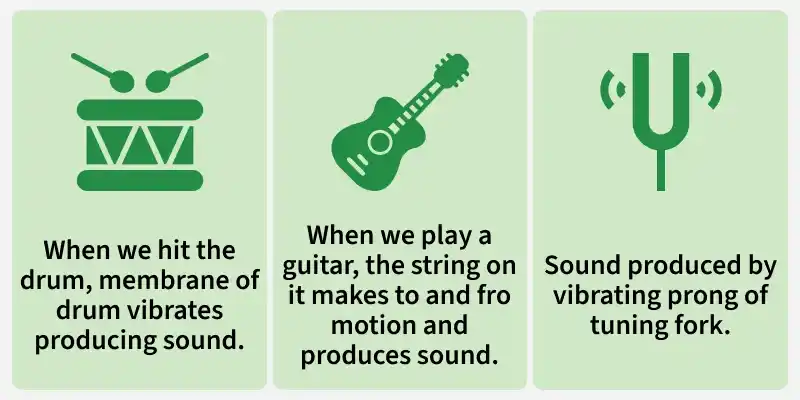
Sound is produced by the rapid to-and-fro movement of an object, i.e., vibration. The object set to vibration disturbs the equilibrium state of the particles in the medium, and vibration keeps transmitting from one particle to another. The vibration of the body is the primary source of sound's genesis. The emission of sound continues as long as a body's vibration remains. By travelling across a continuous elastic membrane, this sound generates a hearing experience in our ears.
For example, when a tuning fork is struck, it vibrates and produces sound. Touching it with your hand stops the vibration, reducing the sound. A pinball in contact with the fork’s arm moves away as the fork vibrates. Thus, all sound is generated by the vibration of a body, converting mechanical energy into sound.
Propagation of Sound
Sound is produced by the rapid back-and-forth motion of an object, known as vibration. When an object vibrates, it disturbs the equilibrium of the particles in the surrounding medium. This vibration is then transmitted from one particle to another, allowing the sound to propagate.
For example, when a tuning fork is struck against a rubber pad, the prongs begin to vibrate. If we bring it close to our ears, we can hear the sound produced. Similarly, guitar strings produce sound when plucked or struck. The propagation of sound refers to the travel of sound waves from the source to the surrounding medium. Sound cannot travel through a vacuum, as there are no particles to transmit the vibrations.
Speed of Sound in Different Mediums
The average speed of sound is 343 m/s. Sound travels in the form of waves from one medium to another. Speed of sound varies in different mediums. It is affected by factors like temperature, density, and elasticity of the medium through which sound waves travel. We have listed the speed of sound in different mediums in the table below:
Materials | Speed of sound |
|---|---|
Air at 20° C | 343 m/s |
Rubber | 60 m/s |
Lead | 1210 m/s |
Gold | 3240 m/s |
Glass | 4540 m/s |
Sound Travel in a Vacuum or Space
Sound always requires a medium to travel from one point to another. Sound cannot propagate in a vacuum because there are no particles or molecules present to set vibration. The music produced by vibrating guitar strings can be heard as the vibrations travel through the air to our ears. In this process, air acts as a medium of transmission of sound.
Hearing Process in Humans
Sound waves travelling through a medium reach our ears, allowing us to hear sound. These waves are collected by the pinna and guided into the ear canal, where they strike the eardrum. The vibrations of the eardrum are transmitted to three small bones, the hammer, anvil, and stirrup, and then passed to the inner ear. The sensitive cells in the inner ear convert these vibrations into electrical signals, which are transmitted to the brain through the auditory nerve and perceived as sound.
Related Articles:
Sample Problems
Question 1: A person standing near a cliff hears the echo of a sound after 4 seconds. If the speed of sound in air is 340 m/s, find the distance of the cliff.
Solution:
\text{Distance} = \frac{vt}{2}
= \frac{340 \times 4}{2}
= 680 \, \text{m}
Question 2: A tuning fork A vibrates at 300 Hz. Another tuning fork B completes 900 vibrations in 3 seconds. Identify which tuning fork produces a shriller sound and find the difference in their time periods.
Solution:
f_B = \frac{900}{3} = 300 \, \text{Hz} Both have same frequency ⇒ same shrillness
T_A = \frac{1}{300} = 0.0033 \, \text{s}
T_B = \frac{1}{300} = 0.0033 \, \text{s}
\text{Difference} = 0 Both are equally shrill
Difference in time period = 0 s
Question 3: A sound wave has a frequency of 500 Hz. Find its time period.
Solution:
T = \frac{1}{f}
= \frac{1}{500}
= 0.002 \, \text{s}
Question 4: Sound travels a distance of 686 m in air. If the speed of sound is 343 m/s, find the time taken.
Solution: Given
Distance d = 686 m
Speed of sound v = 343 m/s
Time taken is given by
t = \frac{d}{v}
t = \frac{686}{343}
t = 2 \, \text{s}
\text{Answer: } 2 \, \text{seconds}
Problem 5: The sound from a mosquito is produced when it vibrates its wings at an average rate of 250 vibrations per second, what is the time period of the vibrations?
Solution: Given that,
The total vibrations are 250 Hz.
Therefore,
Time is taken to complete one vibration =1/250=0.004 seconds.
Hence, the time period = 0.004 seconds.
Unsolved problems
Question 1: A sound wave travels a distance of 1029 m in air. If the speed of sound is 343 m/s, calculate the time taken by the sound to travel this distance.
Question 2: A tuning fork produces a sound of frequency 800 Hz. Find the time period of the sound wave.
Question 3: A sound wave completes 1200 vibrations in 4 seconds. Calculate its frequency and state whether the sound is audible to humans.
Question 4: An echo is heard after 2.5 seconds in air. If the speed of sound is 340 m/s, calculate the distance between the person and the reflecting surface.
Question 5: A sound wave travels through rubber with a speed of 60 m/s and through glass with a speed of 4540 m/s. Calculate the time taken by the sound to travel 120 m in rubber and 120 m in glass. Also find the difference in time taken.
Question 6: A sound source produces vibrations at a frequency of 18000 Hz. Another source produces vibrations with a time period of 0.00004 s. Determine which sound is shriller and state whether each sound is audible to humans.