
The Law of Conservation of Energy states that
Energy can neither be created nor destroyed; it can only be transformed from one form to another. This law governs all physical processes in nature.
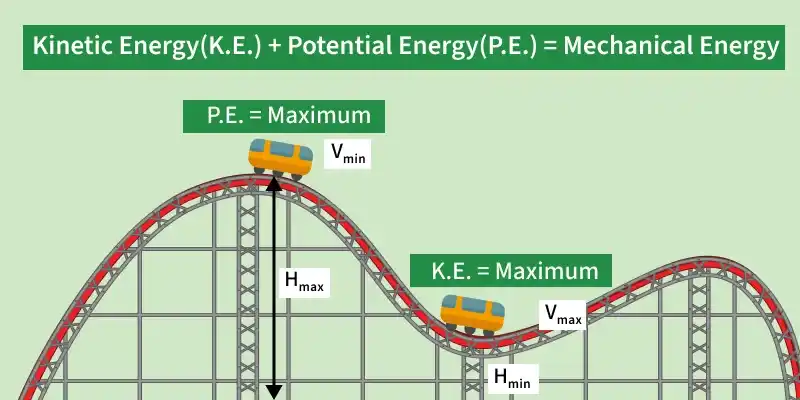
Example: As the roller coaster moves, potential energy and kinetic energy keep converting into each other, while their sum (mechanical energy) remains constant
Other examples:
- A moving car has kinetic energy. When brakes are applied, that energy is converted into heat energy.
- In a light bulb, electrical energy is converted into light energy and heat energy.
- Engines convert chemical energy into mechanical energy.
- An electric motor converts electrical energy into mechanical energy.
- Hydroelectric power plants convert the potential energy of water into electrical energy.
- Loudspeakers convert electrical energy into sound energy.
Mathematical Expression
The total amount of energy in any system is calculated using the following equation:
UT = Ui + W + Q
Where,
- UT is total energy of a system,
- Ui is initial energy of a system,
- Q is heat added or removed from the system, and
- W is work done by or on the system.
Also, change in the internal energy of the system is calculated using,
ΔU = W + Q
Derivation
Consider a ball of mass m dropped from a height H above the ground. Initial velocity is zero, and potential energy at ground is taken as zero.
At point A (height H):
⇒
Since v = 0
⇒
⇒ Etotal = mgH...(A)
At point B (height X):
Potential energy:
Etotal = Epotential + E kinetic
From the third equation of motion:
Total Energy
At point C (ground):
From the third equation of motion:
Total Energy
From A, B, and C, total mechanical energy remains constant.
Why Can Perpetual Motion Machines Never Work?
A perpetual motion machine is a hypothetical device that, once supplied with some energy, would continue running indefinitely, converting energy from one form to another. Theoretically, such a machine could run forever, but the second law of thermodynamics prevents its realization because during every energy transformation, some energy is inevitably lost as heat, friction, or other forms of dissipation.
Example: consider a perpetual motion machine that uses the potential energy of water stored at a height, converts it into mechanical energy, and then uses that energy to lift the water back to the same height in a continuous loop. While this seems possible in theory, in reality, energy is lost in each cycle due to friction, air resistance, and other inefficiencies, eventually causing the machine to stop. Perpetual motion machines cannot operate indefinitely; they can only work for a finite period before stopping.
Related Articles
Solved Problems
Question 1: Find the work done when a force of F = x + 3 produces a displacement of 3 m.
Solution: Work done by a variable force is given by,
W = ∫Fdx
F(x) = x + 3
Calculating the work done.
W =
\int^{x}_{0}Fdx \\ = \int^{x}_{0}(x + 3)dx \\ = [\frac{x^2}{2} + 3x]^{x}_{0} \\ = \frac{x^2}{2} + 3x Here, the displacement is x = 3
W = x2/2 + 3x (at x = 3)
⇒ W = 32/2 + 3(3)
⇒ W = 13.5 J
Question 2: The work being done on a system is given by the following equation, W = 3t2. Calculate the instantaneous power at t = 4.
Solution: Instantaneous power is given by,
P = dW/dt
Given: W = 3t2
Calculating power, P = dW/dt
P = \frac{d(3t^2)}{dt} ⇒ P = 6t
At, t = 4
P = 6(4)
⇒ P = 24 W
Question 3: The work being done on a system is given by the following equation: W = t3 + 5t + 10. Calculate the instantaneous power at t = 2.
Solution: Instantaneous power is given by,
P = dW/dt
Given:
W = t3 + 5t + 10
Calculating power,
P = dW/dt
⇒
P = \frac{d(t^3 + 5t + 10)}{dt} ⇒ P = 3t2 + 5
At, t = 2
P = 3(t2) + 5 W
⇒ P = 3(22) + 5
⇒ P = 3(4) + 5
⇒ P = 17 W
Question 4: An object is kept at a height of 20 m. It starts falling towards the ground. Find the velocity of the object just before it touches the ground.
Solution: Potential energy at the start will be equal to the kinetic energy just before touching the ground.
P. E = K. E
mgh = 1/2mv2
Given:
g = 10
h = 20 m
Plugging the values inside the equation,
mgh = 1/2mv2
⇒ 2gh = v2
⇒ v =
\sqrt{2gh} ⇒ v =
\sqrt{2 \times 10 \times 20} ⇒ v = 20 m/s.
Question 5: A particle of mass m is projected vertically upward with speed u. Due to air resistance, a constant force F acts downward throughout the motion. Find the maximum height reached by the particle.
Solution: Initial Kinetic energy of the practical
\text{K.E.} = \frac{1}{2} m u^2 As the particle moves upward, work is done against gravity and air resistance.
Work done against gravity.
W_g = m g h Work done against air resistance.
W_r = F h At the maximum height, velocity becomes zero, so final kinetic energy is zero.
Using work–energy principle.
\frac{1}{2} m u^2 = m g h + F h
\frac{1}{2} m u^2 = h (m g + F)
\boxed{h = \frac{u^2}{2\left(g + \frac{F}{m}\right)}}
Unsolved Problems
Question 1: A 5 kg block slides down a frictionless inclined plane of height 4 m. Calculate its speed at the bottom of the incline.
Question 2: A pendulum of length 2 m is released from an angle such that its vertical height from the lowest point is 0.5 m. Find its speed at the lowest point.
Question 3: A spring with spring constant k = 200 N/m is compressed by 0.1 m. A 2 kg block is placed on it and released. Find the maximum speed of the block.
Question 4: A roller coaster of mass 500 kg starts from rest at a height of 20 m. The track then dips to 5 m and rises to 15 m. Neglect friction. Find the speed at 5 m and 15 m points.
Question 5: A particle slides down a smooth hemispherical dome of radius R = 3 m. Starting from the top, find the speed of the particle at a height h = 1 m from the base.
Question 6: A block of mass 3 kg slides along a rough horizontal surface with coefficient of friction μ = 0.2. Its initial speed is 10 m/s. Find the distance travelled before coming to rest.