
Angular momentum is the property of objects in rotational motion, defined as the product of their moment of inertia and angular velocity. It is conserved in a system when no external torque acts, and the total angular momentum of a composite system equals the sum of the angular momenta of its components, making it an extensive quantity. For continuous rigid bodies or fluids, it is calculated as the volume integral of angular momentum density. The Earth's rotation and revolution provide clarity. E.g., its daily rotation around the axis represents spin angular momentum, while its annual orbit around the Sun represents orbital angular momentum
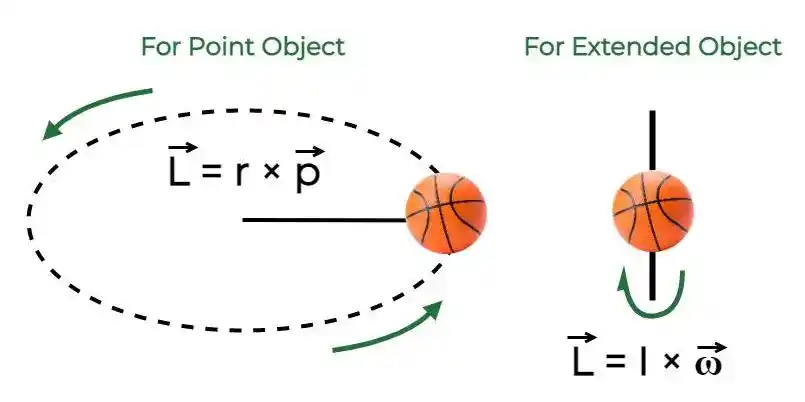
The angular momentum for an object in rotational motion can happen in two ways.
A. Angular Momentum of a Single Particle
Angular momentum can be experienced by a single particle when it moves around a fixed point. For example, the Earth revolves around the Sun, which is considered fixed.
\vec{L} = \vec{r} \times \vec{p} where,
\vec L is Angular Momentum\vec{ r} is Radius of Rotational Path\vec p is Linear Momentum of Object
B. Angular Momentum for Extended Object
Angular momentum can be experienced by a point object when it is rotating around a fixed position. For example, in the case of the earth rotating on its axis.
\vec L = I \times \vec \omega where,
\vec L is Angular Momentum\vec{ I } is Rotational Inertia\vec \omega is Angular Velocity of Object
Angular Momentum of a System of Particles
Angular momentum of a system of particles is the vector sum of all the individual angular momenta of the single particles. The angular momentum of any particle is l = r × p, where r is the distance the particle is from the origin. Here, p represents the linear momentum of the particle. The angular momentum of the system of n particle is,
L = l1 + l2 + l3 +...+ ln
Angular Momentum of a Rigid Body
Consider a rigid body made of N particles with masses m1, m2, …, mn at perpendicular distances r1, r2, …, rn from a fixed axis of rotation. Each particle moves in uniform circular motion with angular velocity ω\omegaω, giving linear speeds
The angular momentum of the i-th particle is
All angular momenta point along the rotation axis, so the total angular momentum of the body is
where
Unit of Angular Momentum
- The SI unit of angular momentum is kg·m/s.
- The CGS unit of angular momentum is g.cm2/s.
- The dimensional formula for angular momentum is [MLT⁻¹].
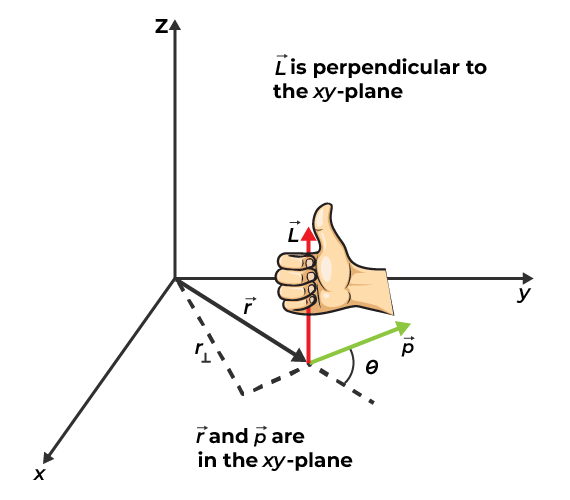
Right-Hand Thumb Rule
The direction of angular momentum can be determined by the right-hand thumb rule. Position your right hand so that the fingers point in the direction of r. The curl is thus oriented in the direction of linear momentum (p). The outstretched thumb depicts the direction of angular momentum (L).
Angular Momentum and Moment of Inertia
Let's assume that the object is made up of N particles with masses m1, m2, ... mN and perpendicular distances r1, r2, ... rN from the rotation axis. As the object rotates, all of these particles are in Uniform Circular Motion with the angular speed ω but their linear speeds are,
- v1 = r1ω
- v₂= r₂ω
- vN = rNω
Individual velocity directions, v1, v2, and so on, are along the tangents of their respective tracks. The initial particle's linear momentum is p1 = m1v1 = m1r1ω. It travels in the same direction as v1.
The magnitude of its angular momentum is, L1 = p₁r₁ = m₁r₁ω.
Similarly, L2 = m2r22ω, L3 = m3r32ω, ... LN = mNrN2ω
All of these angular momenta are directed along the axis of rotation for a rigid body with a fixed axis of rotation, which may be determined using the right-hand thumb rule. Their magnitudes may be summed algebraically because they all have the same direction. As a result, the magnitude of the body's angular momentum is given by,
L = m₁r₁ω + m₂r₂ω + ... + mₙrₙω
L = (m1r12 + m2r22 + ... + mNrN2)ω = Iω
The moment of Inertia of body around the given axis of rotation is,
I = m1r12 + m2r22 + ... + mNrN2
If the moment of inertia I replaces mass, the angular momentum statement L = Iω is comparable to the linear momentum expression p = mv, which is its physical significance.
Examples
- Gyroscope: A gyroscope maintains its orientation due to conservation of angular momentum. When its wheel spins rapidly, it resists changes in direction and is used in spacecraft and navigation systems for stability.
- Ice Skater: When an ice skater pulls their arms and legs closer to the body, their moment of inertia decreases and angular velocity increases due to conservation of angular momentum, making them spin faster.
Law of Conservation of Angular Momentum
Everyone has seen the conservation of linear momentum, which states that in the absence of an external unbalanced force, the linear momentum of an isolated system is conserved. In rotational dynamics, torque and angular momentum are similar to force and linear momentum, as previously stated. With the right modifications, these concepts can be turned into angular momentum conservation, which means that in the absence of external torques, the angular momentum of an isolated system remains constant.
Angular momentum is given by the formula.
L = r × p
Where,
- r is Position Vector from Axis of Rotation
- p is Linear Momentum
Differentiating with respect to time,
dL/dt = d/dt(r × p)
dL/dt = r × (dp/dt) + (dr/dt) × p... (i)
Now,
(dr/dt) = v and (dp/dt) = F
From eq(i)
dL/dt = r × F + m(v × v)
Now, (v × v) = 0
∴ dL/dt = r × F
But, r × F = τ
∴ τ = dL/dt
Thus, if τ = 0, dL/dt = 0 or L = constant
As a result, in the absence of uneven external torque τ, angular momentum L is conserved. This is the principle of angular momentum conservation, which is similar to linear momentum conservation.
Torque
The force that may cause an object to rotate along an axis is measured by torque. In linear kinematics, force is what propels an object forward. An angular acceleration is also caused by torque. As a result, torque can be thought of as the linear force's rotating equivalent. The axis of rotation is the point around which an object rotates. Torque is defined as a force's proclivity to turn or twist in physics.
τ = r × F
where,
- r is Perpendicular Distance
- F is Force Applied of Object
Read More,
Solved Problems
Question 1: A particle of mass 2 kg moves with speed 5 m/s at a distance of 3 m from the origin. The angle between r and v is 30°. Find angular momentum.
Solution:
L = mvr\sin\theta
L = 2 \times 5 \times 3 \times \sin 30^\circ
L = 2 \times 5 \times 3 \times 0.5
{L = 15 \, \text{kg}\cdot{m}^2/\text{s}}
Question 2: A solid sphere of mass 4 kg and radius 0.5 m rotates with 10 rad/s. Moment of inertia I = 2/5 MR. Find angular momentum.
Solution:
I = \frac{2}{5}(4)(0.5)^2
I = \frac{2}{5}(4)(0.25) = 0.4
L = I\omega = 0.4 \times 10
{L = 4 \, \text{kg}\cdot{m}^2/\text{s}}
Question 3: A rotating disc has I₁ = 6 kg and ω₁ = 4 rad/s. Its moment of inertia becomes 3 kg. m2. Find the new angular velocity.
Solution:
I_1 \omega_1 = I_2 \omega_2
6 \times 4 = 3 \times \omega_2
24 = 3\omega_2
{\omega_2 = 8\,\text{rad/s}}
Question 4: A torque of 5 N.m acts on a wheel for 4 s. Find the change in angular momentum.
Solution:
\tau = \frac{dL}{dt}
\Delta L = \tau \, t
\Delta L = 5 \times 4
{\Delta L = 20 \, \text{kg}\cdot{m}^2/\text{s}}
Unsolved Problems
Question 1: A particle of mass 4 kg moves with speed 5 m/s at a perpendicular distance of 3 m from the origin. Find its angular momentum.
Question 2: A solid sphere of mass 6 kg and radius 0.2 m rotates with angular velocity 12 rad/s. (I = 2/5 MR2). Find angular momentum.
Question 3: A rotating disc has a moment of inertia of 8 kg and an angular velocity of 5 rad/s. Its moment of inertia decreases to 4 kg. ·m2. Find the new angular velocity.
Question 4: A torque of 15 N·m acts on a wheel for 3 s. Find the change in angular momentum.
Question 5: A thin rod of mass 3 kg and length 1.5 m rotates about one end with angular velocity 7 rad/s. (I = 1/3 ML). Find its angular momentum.