
The center of gravity is considered the point where the body's weight acts. Finding this point is especially important for bodies with large sizes or non-uniform mass distribution.
- Knowing the center of gravity allows us to predict the motion of such bodies under its influence.
- If a body is balanced at this point, it is in both rotational and translational equilibrium.
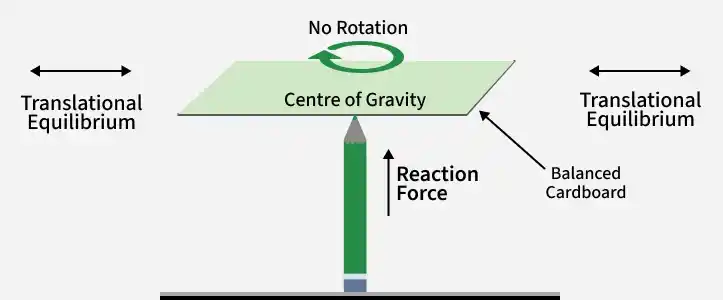
The figure shows a piece of cardboard balanced on a pencil placed beneath it.
- The tip of the pencil exerts a reaction force at the point of contact, keeping the cardboard in translational equilibrium.
- The cardboard is in rotational equilibrium, as it has no angular acceleration.
Formula
Let us assume that the cardboard is made up of tiny individual point masses m1, m2, m3... Gravity is acting on all these point masses, creating torque around the point. The Centre of Gravity (CoG) is located such that the total torque on the CoG due to forces on individual point masses is zero. If ri is the position vector of the ith particle with respect to the CoG, then the torque on it due to the gravitational force is given by,
\tau_i = \vec{r_i} \times m_ig
For a point that is the center of gravity, the total torque about that point must be zero.
Notice that in the equation above, the gravitational force "g" is the same for every point. It can come out of the equation as a common factor across all the terms.
Since g is a constant and non-zero. It can be concluded that,
\sum \vec{r_i} \times m_i = 0
Method to Find the Center of Gravity (Experimental Method)
The center of gravity of an irregular lamina can be determined using the suspension method. When a body is freely suspended, its center of gravity lies along the vertical line through the point of suspension.
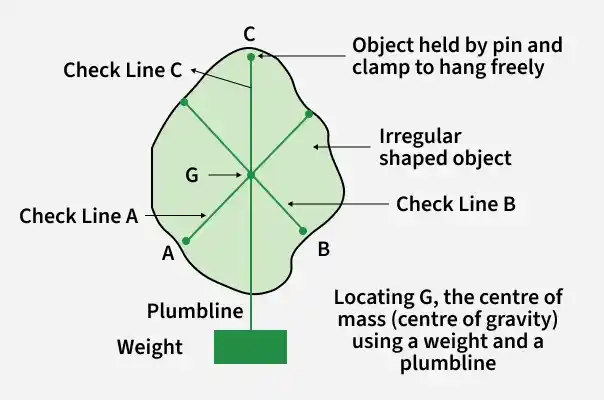
Procedure
- Make a small hole near the edge of the lamina.
- Suspend the lamina from a nail or pin.
- Hang a plumb line from the same point.
- Draw the vertical line along the plumb line.
- Repeat the process from another point.
- The intersection of the lines gives the center of gravity.
Conditions for Stability of a Body
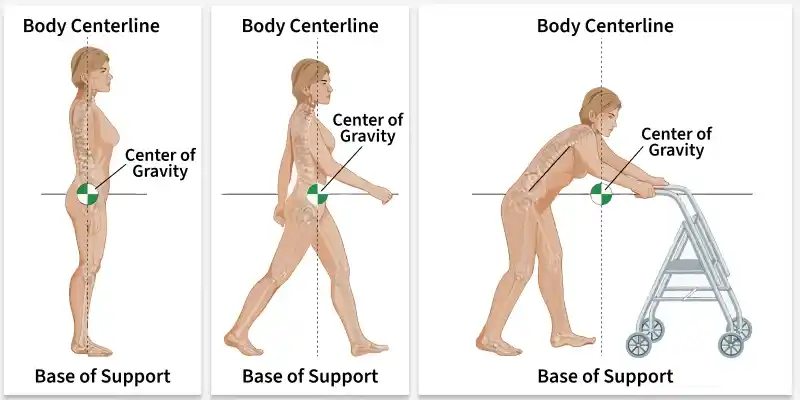
The stability of a body depends on the position of its center of gravity (CoG) relative to its base of support. A body is said to be stable if the vertical line passing through its center of gravity falls within its base of support. If this vertical line passes outside the base of support, the body becomes unstable and may topple.
Types of Equilibrium
1. Stable Equilibrium
A body is said to be in stable equilibrium if, when it is slightly displaced, it tends to return to its original position. In this case, the center of gravity rises slightly when the body is displaced, and the gravitational force tends to restore the body to its original position. E.g., a ball resting at the bottom of a bowl.
2. Unstable Equilibrium
A body is said to be in unstable equilibrium if a small displacement causes the body to move further away from its original position. In this case, the center of gravity lowers when the body is displaced, which causes the body to move farther from its initial position. E.g., a ball balanced on the top of a hill.
3. Neutral Equilibrium
A body is said to be in neutral equilibrium if a small displacement does not change the position of its center of gravity, and the body remains in its new position. In this situation, the center of gravity remains at the same height before and after displacement. E.g., a ball placed on a flat horizontal surface.
Applications of Center of Gravity
- Vehicle design—Cars and buses are designed with a low center of gravity to prevent overturning.
- Architecture—Engineers calculate the center of gravity to ensure building stability.
- Robotics—Robots must maintain their center of gravity within the support base to avoid falling.
- Ship design—Proper center of gravity prevents ships from capsizing.
Solved Problems
Question 1: Two point masses, m1 = 5 kg and m2 = 2 kg, are located at x = 2 m and x = 6 m, respectively. Determine the center of gravity.
Solution: The formula for the Centre of gravity is equal to the centre of mass when gravity is constant
xcm =
\frac{ m_1x_1 + m_2x_2 + ...}{M} m1 = 5Kg, m2 = 2Kg and x = 2 m and x = 6 m.
M = m1 + m2
⇒ M = 5 + 2 = 7
xcm =
\frac{ m_1x_1 + m_2x_2 + ...}{M} ⇒ xcm =
\frac{ m_1x_1 + m_2x_2}{M} ⇒ xcm =
\frac{ (5)(2) + (2)(6)}{7} ⇒ xcm =
\frac{22}{7} = 3.14 m
Question 2: Two-point masses, m1 = 5 kg and m2 = 2 kg, are located at y = 10 m and y = -5 m, respectively. Determine the center of gravity.
Solution: The formula for the Centre of gravity is given by,
ycm =
\frac{ m_1y_1 + m_2y_2 + ...}{M} m1 = 5 kg, m2 = 2 kg and y = 10 m and y = -5 m.
M = m1 + m2
⇒ M = 5 + 2 = 7
ycm =
\frac{ m_1y_1 + m_2y_2 + ...}{M} ⇒ ycm =
\frac{ m_1y_1 + m_2y_2}{M} ⇒ ycm =
\frac{ (5)(10) + (2)(-5)}{7} ⇒ ycm =
\frac{40}{7} = 5.71 m
Question 3: Two-point masses, m1 = 1 Kg and m2 = 2 Kg, are located at vector a = 6i + 4j and vector b = -5i + 2j, respectively. Determine the center of gravity.
Solution: Formula for the Centre of gravity in the vector notation is given by,
rcm =
\frac{ m_1\vec{r_1} + m_2\vec{r_2} + ...}{M} m1 = 1Kg, m2 = 2Kg and a = 6i + 4j, b = -5i + 2j
M = m1 + m2
⇒ M = 1 + 2 = 3
rcm =
\frac{ m_1\vec{r_1} + m_2\vec{r_2} + ...}{M} ⇒ rcm =
\frac{ m_1\vec{a} + m_2\vec{b}}{M} ⇒ rcm =
\frac{ (1)(6\hat{i} + 4\hat{j} ) + (2)(-5\hat{i} + 2\hat{j})}{3} ⇒ rcm =
\frac{ 6\hat{i} + 4\hat{j} + -10\hat{i} + 4\hat{j})}{3} ⇒ rcm =
\frac{ -4\hat{i} + 8\hat{j} }{3}
Question 4: Two-point masses, m1 = 4 Kg and m2 = 2 Kg, are located at vector a = i + j and vector b = +i - j, respectively. Determine the center of gravity.
Solution: Formula for the Centre of gravity in the vector notation is given by,
r_{cm} = \frac{ m_1\vec{r_1} + m_2\vec{r_2} + ...}{M} m1 = 4Kg, m2 = 2Kg and a = i + j, b = +i - j
M = m1 + m2
⇒ M = 4 + 2 = 6
r_{cm} =\frac{ m_1\vec{r_1} + m_2\vec{r_2} + ...}{M}
\Rightarrow r_{cm} =\frac{ m_1\vec{a} + m_2\vec{b}}{M}
\Rightarrow r_{cm} =\frac{ (4)(\hat{i} + \hat{j} ) + (2)(\hat{i} -\hat{j})}{6}
\Rightarrow r_{cm} =\frac{ 4\hat{i} + 4\hat{j} + 2\hat{i} -2\hat{j})}{6}
\Rightarrow r_{cm} =\frac{ 6\hat{i} + 2\hat{j} }{6}
Unsolved Problems
Question 1: A uniform triangular lamina of base 6 m and height 8 m has its base along the x-axis and vertex on the positive y-axis; identify the coordinates of its center of gravity.
Question 2: A system consists of four point masses: 2 kg at (−1,2), 3 kg at (4,−2), 5 kg at (0,3), and 6 kg at (−3,−1); determine the position vector of the center of gravity.
Question 3: A semicircular lamina of radius 4 m lies above the x-axis with uniform surface density; determine the distance of its center of gravity from the diameter.
Question 4: A rod of length 5 m has linear mass density λ(x) = 3x² + 2 (kg/m), where x is measured from one end; identify the position of its center of gravity.
Question 5: A uniform square plate of side 2 m has a circular hole of radius 0.5 m cut from one corner; determine the new position of the center of gravity of the remaining plate.