
A frame of reference is a coordinate system or viewpoint used to measure the position and motion of objects. It helps us describe whether an object is at rest or moving.
Motion is relative, meaning it depends on the observer. For example, if you throw a ball inside a moving train, it appears to move straight up to you, but to someone standing outside, it follows a curved path. Both are correct in their respective frames.
Frame of reference is essential in mechanics because all motion is measured relative to it. Eg:- Relative Velocity
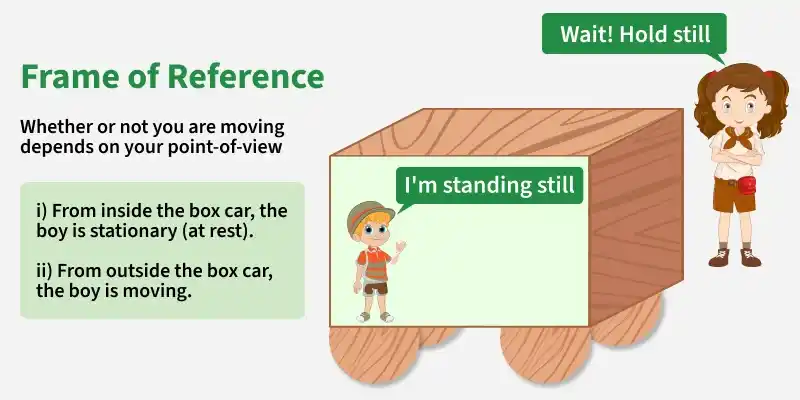
Here are some key features of a frame of reference:
- It provides a space or area where observations are made.
- It offers a specific viewpoint from which measurements are taken.
- Most frames of reference use a coordinate system to pinpoint exact locations.
- It helps in understanding motion relative to the observer’s position and condition.
Types of Frames of Reference
Frames of reference can be classified into different types based on their characteristics and uses. There are two types of frame of reference, which are
- Inertial Frames of Reference
- Non-inertial Frames of Reference
Inertial Frame of Reference
An inertial frame of reference is one in which an object remains at rest or moves at a constant velocity unless acted upon by an external force. This type of frame follows Newton's first law of motion, which is also called the law of inertia.
For example, if you toss an apple straight up while sitting calmly in a park, it will come back down to your hand (ignoring air resistance and other forces). The park is an inertial frame since the system has no acceleration.
Non-inertial Frames of Reference
A non-inertial frame of reference is one where the observer is undergoing acceleration. This can make objects appear to move in unusual ways due to the effects of the acceleration. This frame of reference is useful for analyzing situations where forces, like friction and gravity, interact in ways that cause acceleration.
An example of a non-inertial frame of reference is when you're in a car that suddenly accelerates. If you have a balloon in the car, it will seem to move forward as the car (and you) move backward.
Difference between Inertial and Non-inertial Frames of Reference
Here are the key differences between inertial and non-inertial frames of reference:
| Aspect | Inertial Frames of Reference | Non-inertial Frames of Reference |
|---|---|---|
| Definition | This is a frame in which objects either remain at rest or move at a constant velocity in the absence of any external forces. | This is a frame that is experiencing acceleration, either in terms of speed or direction. |
| Force Interaction | No net external forces are acting. Only internal forces are considered. | External forces, like friction or gravity, influence the observations. |
| Laws of Motion | Newton's laws of motion hold true in their simplest form. | Newton's laws do not apply without including fictitious forces. |
| Examples | A car moving at a constant speed on a straight road. | A car accelerating or decelerating, or moving in a curved path. |
| Motion Perception | Motion is perceived relative to a stable, non-accelerating background. | Motion may include perceived forces that are not acting on objects (like centrifugal force). |
Frame of Reference Examples
Here are a few examples of frames of reference:
- Inside a Moving Train: If you toss a ball straight up while sitting on a moving train, it goes straight up and comes back down to your hand. To an observer outside the train, the ball moves in a curved path, following the train's motion.
- Driving a Car: To a driver, the car ahead appears to move away as they accelerate. To a pedestrian watching from the sidewalk, both cars might be moving forward. Each observer's frame of reference affects how they see the cars moving.
- Observing the Stars: If you look at the stars from the earth, they seem to move across the sky. This movement is due to the Earth's rotation, which is your frame of reference. From space, the motion would appear different.
Also, Check