
Surface tension is the property of a liquid’s surface that makes it behave like a stretched elastic membrane due to cohesive forces between molecules. It minimizes the surface area and causes effects like droplet formation and floating objects. In the figure, the line XY on the liquid surface experiences equal forces in opposite directions at every point, showing the effect of surface tension.
- The SI unit of surface tension is N/m, while its CGS unit is dyn/cm. It is represented by the symbols T or σ.
- The dimensional formula of surface tension is [MT⁻²] because it is defined as force per unit length.
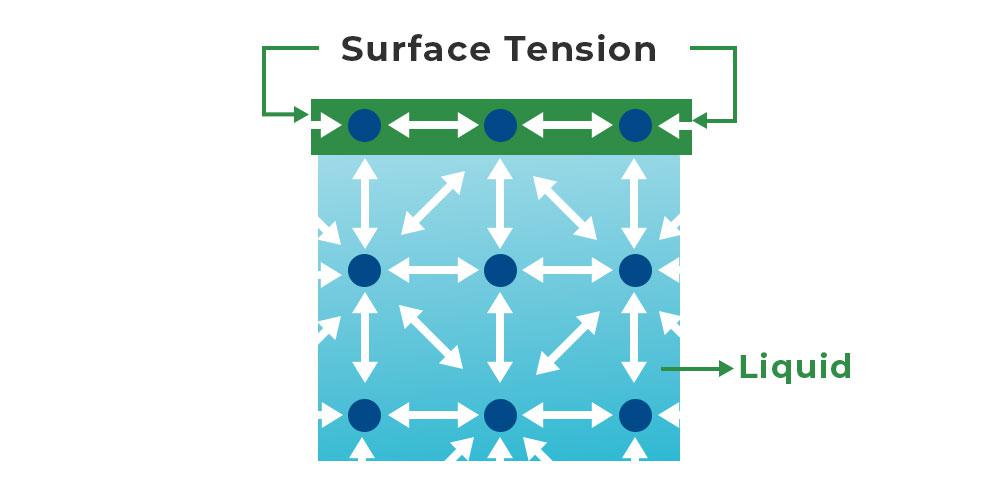
Thus, In equilibrium, surface tension is defined as the force acting per unit length on an imaginary line drawn on the free surface of a liquid, acting tangentially to the surface. The table below shows the surface tension of various liquids.
| Liquid | Surface Tension (N/m) |
|---|---|
| Water | 0.072 |
| Sodium Chloride | 114 |
| Helium | 0.16 |
| Ethanol | 22.0 |
| Hydrogen | 2.4 |
Formula
Mathematically, the surface tension is defined as the force (F) acting on the surface and the length (l) of the surface, so is given as:
T = \frac{F} {l} Where:
- T = Surface tension
- F = Force acting on the surface
- l = Length of the surface
Surface tension can also be expressed as the work done per unit increase in surface area:
T = \frac{W} {A} Where:
- W = Work done
- A = Change in surface area
Unit of Surface Tension
- Surface tension is the ratio of the dragging force to the length and thus its SI unit is N/m as force is measured in N and length is measured in m.
- In the CGS system, its unit is dyn/cm. Surface tension is denoted by σ or T symbol.
- The dimension of surface tension is derived as force per unit length.
- Its dimensional formula is [MT-2], where M is mass and T is time.
Causes of Surface Tension
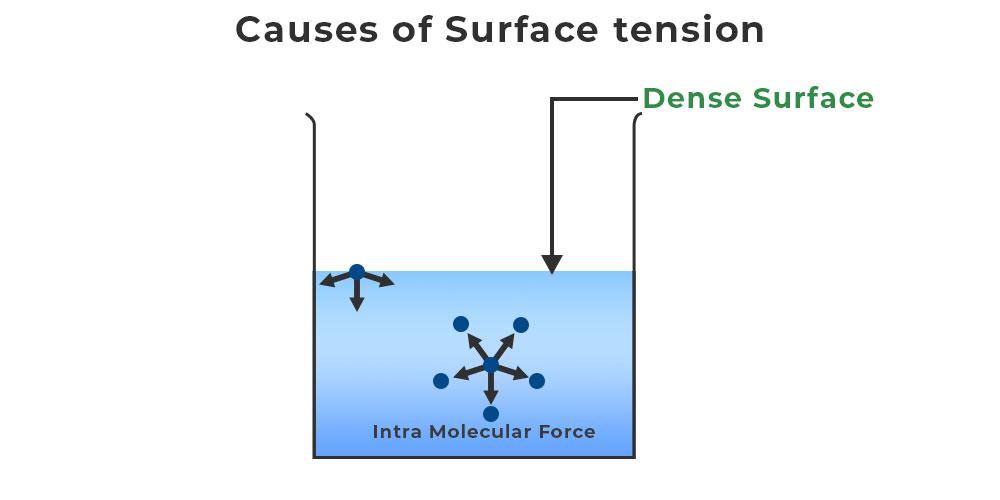
- Surface tension is produced due to the cohesive forces of attraction between liquid molecules.
- Molecules inside the liquid are attracted equally in all directions, so the net force on them becomes zero.
- Molecules present at the surface do not have molecules above them, causing an unbalanced inward force.
- This inward pull makes the liquid surface behave like a stretched elastic membrane and minimizes the surface area.
- Liquids with stronger cohesive forces, such as water, show higher surface tension compared to many other liquids.
Examples
- Water droplets form spherical shapes because surface tension pulls the molecules together and minimizes the surface area.
- Small insects like water striders can walk on water because the liquid surface acts like a thin elastic film due to surface tension.
- Water rises in narrow tubes and plant roots because surface tension helps pull the liquid upward.
- Soap bubbles maintain their shape because surface tension holds the thin layer of liquid together.
- A small needle can float on water because the surface tension of water supports it without letting it sink.
Factors affecting Surface Tension
- Solubility of the Solute: If the solute is highly soluble in the fluid, the surface tension of the fluid increases. Conversely, if the solute is less soluble, the surface tension of the fluid decreases.
- Presence of Dust or Lubricants: The presence of dust particles or lubricants on the surface of the fluid reduces the surface tension, as they interfere with the cohesive forces between the liquid molecules.
- Temperature: Increasing the temperature of the liquid decreases its surface tension, while decreasing the temperature increases the surface tension, as higher temperatures reduce the attractive forces between molecules.
Angle of Contact
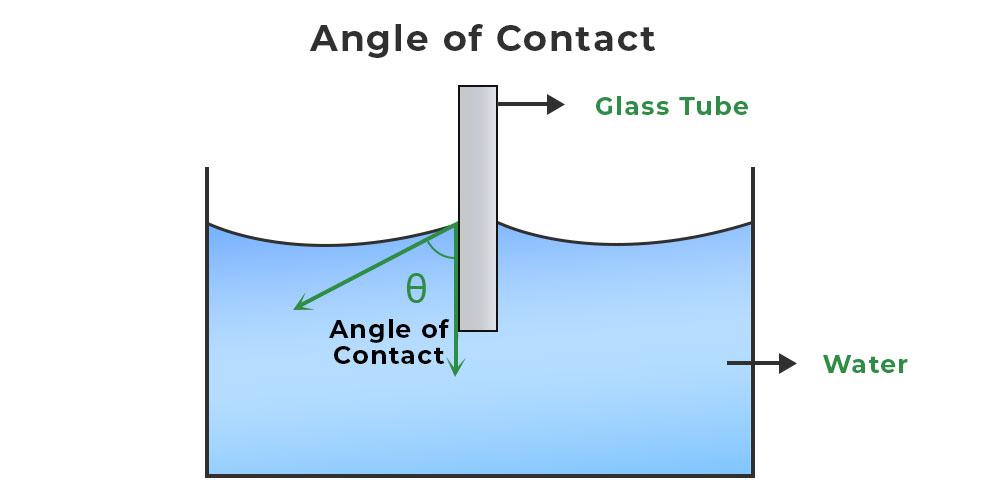
The angle of contact, also called the contact angle (θ), is the angle formed between the tangent to the liquid surface and the solid surface at the point of contact. It represents the interaction between the liquid and the solid surface.
The angle of contact depends on the following factors:
- The nature of the liquid and the solid surface it comes into contact with.
- The medium above the free surface of the liquid.
- The temperature of the liquid; as the temperature rises, the angle of contact increases.
- The presence of soluble impurities; when added to a liquid, they cause a decrease in the angle of contact.
Solved Problems
Question 1: A force of 0.36 N acts on a liquid surface of length 6 m. Calculate the surface tension.
Solution: Given
Force, F = 0.36 N
Length, l = 6 m
Formula:
T = \frac{F}{l} Calculation:
T
= \frac{0.36}{6} T = 0.06 N/m
Question 2: A liquid has a surface tension of 0.072 N/m. If the length of the liquid surface is 4 m, calculate the force acting on the surface.
Solution: Given
Surface tension, T = 0.072 N/m
Length, l = 4 m
Formula:
F = T × l
Calculation:
F = 0.072 × 4
F = 0.288 N
Question 3: A liquid surface area increases by 0.5 m² and the surface tension is 0.08 N/m. Calculate the surface energy.
Solution: Given
Surface tension, T = 0.08 N/m
Change in area, ΔA = 0.5 m2
Formula:
Es = T × ΔA
Calculation:
Es = 0.08 × 0.5
Es = 0.04 J
Question 4: A force of 1.2 N acts tangentially on a liquid surface of length 15 m. Find the surface tension.
Solution: Given
Force, F = 1.2 N
Length, l = 15 m
Formula:
T = \frac{F}{l}
= \frac{F}{l} Calculation:
T
= \frac{1.2}{15} T = 0.08 N/m
Unsolved Question
Question 1: A force of 0.48 N acts on a liquid surface of length 8 m. Calculate the surface tension of the liquid.
Question 2: The surface tension of a liquid is 0.05 N/m and the length of the liquid surface is 10 m. Find the force acting on the surface.
Question 3: A liquid has a surface tension of 0.09 N/m and its surface area increases by 0.4 m². Calculate the surface energy produced.
Question 4: A force of 2 N acts tangentially on a liquid surface of length 25 m. Find the surface tension.
Question 5: The surface tension of water is 0.072 N/m. Calculate the force acting on a liquid surface of length 5 m.