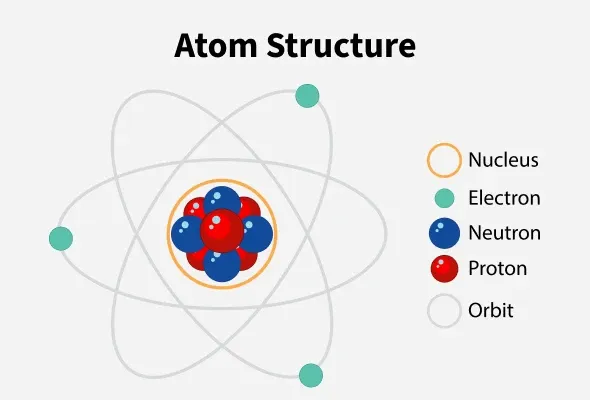
Atomic structure describes how an atom is formed and how its particles are arranged. An atom consists of a tiny, dense nucleus at the center that contains protons (positively charged) and neutrons (no charge). Electrons, which are negatively charged, revolve around the nucleus in fixed energy levels or shells.
The atomic number of an element is equal to the number of protons in its nucleus; it identifies the element. In a neutral atom, the number of protons and electrons is the same. However, an atom can gain or lose electrons to become more stable, forming a charged particle called an ion. Since different elements have different numbers of protons and electrons, their atomic structures vary, giving them unique chemical and physical properties.
The atomic model, which we study today, was not given at one time. Several attempts were made by scientists and later improved, leading to the current atomic model. Let's learn about different atomic models that led to the evolution of the present model.
Atomic Models
Many scientists used atomic models to understand the structure of the atom in the early centuries. Each of these models had advantages and disadvantages of its own and played a significant role in the development of the modern atomic model. Scientists like John Dalton, J.J. Thomson, Ernest Rutherford, and Niels Bohr made the most noteworthy contributions to science.
- Dalton's Atomic Theory (1808)
- Thomson's Atomic Model (1897)
- Rutherford's Atomic Model (1911)
- Bohr's Atomic Model (1913)
- Quantum Mechanical Model (1926)
1. Dalton’s Atomic Theory
Dalton’s Atomic Theory was proposed by John Dalton, a British chemist, in the early 19th century. He stated that all matter is made up of tiny particles called atoms, which participate in chemical reactions. According to Dalton, atoms are the basic units of matter and are responsible for the formation of chemical compounds.
Dalton proposed that atoms of a particular element are identical in mass and properties, while atoms of different elements differ in mass and size. He also explained that chemical reactions occur due to the rearrangement of atoms, and no atom is created or destroyed during a reaction.
Postulates of Dalton’s Atomic Theory
- All matter is made up of atoms.
- Atoms are indivisible and cannot be created or destroyed.
- Atoms of the same element are identical in mass and properties.
- Atoms of different elements differ in mass and properties.
- During a chemical reaction, atoms only rearrange to form new substances.
Dalton’s atomic theory successfully explained several laws of chemical combination, such as the law of conservation of mass, the law of constant proportions, and the law of multiple proportions.
Limitations of Dalton’s Atomic Theory
- It could not explain the existence of isotopes and isobars.
- It did not describe the internal structure of the atom.
- Later discoveries proved that atoms are divisible, contradicting Dalton’s assumption.
- The discovery of the constituting particles of atoms led to a better understanding of chemicals; these constituting particles are called subatomic particles.
2. Thomson’s Atomic Model
Sir J. J. Thomson, an English physicist, proposed Thomson’s Atomic Model after discovering the electron in 1897 through his cathode ray experiment. For his contribution to physics, he was awarded the Nobel Prize. His discovery proved that atoms are divisible and contain smaller particles.
Cathode Ray Experiment
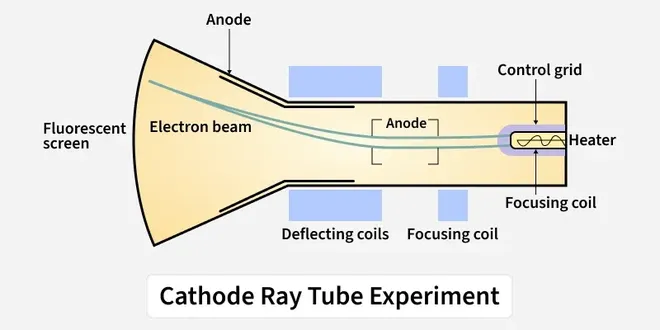
In this experiment, a glass discharge tube containing a gas at low pressure was fitted with a cathode (negative electrode) and an anode (positive electrode). When a high voltage was applied across the electrodes, rays were emitted from the cathode and moved towards the anode, producing a fluorescent glow on a zinc sulphide (ZnS) screen placed behind the anode.
Observations and Conclusions
- The rays traveled from the cathode to the anode and produced fluorescence, confirming their existence.
- When an electric field was applied, the rays bent towards the positive plate, indicating they were negatively charged.
- The rays caused rotor blades placed in their path to rotate, showing that they consisted of particles with mass.
From these observations, Thomson concluded that cathode rays are made of negatively charged particles, which he named electrons. He also determined the charge-to-mass ratio (e/m) of the electron.
Later, Millikan’s oil-drop experiment measured the charge of an electron as 1.6 × 10⁻¹⁹ C, and its mass was calculated as 9.11 × 10⁻³¹ kg.
Plum Pudding Model
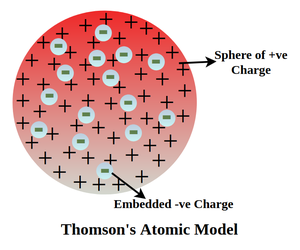
After discovering electrons, Thomson proposed a model of the atom known as the Plum Pudding Model. According to this model, an atom is a uniform sphere of positive charge with negatively charged electrons embedded within it. The positive charge balances the negative charge of electrons, making the atom electrically neutral. The model is called the plum pudding model because it resembles a pudding with plums (electrons) embedded in it.
Limitations of Thomson’s Atomic Model
- The model failed to explain the stability of the atom.
- It could not explain the arrangement of electrons properly.
- Later discoveries of subatomic particles and experiments showed that the atom has a central nucleus, which contradicted Thomson’s model.
3. Rutherford’s Atomic Model
Ernest Rutherford, a student of J. J. Thomson, proposed a new model of the atom, Rutherford's Atomic Model, after discovering the atomic nucleus. His work brought a major change in the understanding of atomic structure. Rutherford proposed his model on the basis of the famous alpha-particle scattering experiment, also known as the gold foil experiment.
Alpha-Particle Scattering Experiment
Rutherford used a radioactive substance, radium bromide (RaBr), which emits alpha (α) particles having a positive charge of +2. These α-particles were directed towards a very thin gold foil. To observe the scattering of particles, a zinc sulphide (ZnS) screen was placed around the foil, which produced flashes when struck by α-particles.
Observations
- Most of the α-particles passed straight through the gold foil without any deflection.
- Some α-particles were deflected through small angles.
- Very few α-particles were deflected back in the direction from which they came.
Conclusions from Observations
- Since most α-particles passed through undeflected, most of the atom is empty space.
- The deflection of some α-particles showed that positive charge is concentrated in a small region, not spread uniformly.
- The backscattering of a few α-particles indicated that almost all the mass and positive charge of the atom is concentrated in a very small, dense central region, called the nucleus.
Rutherford proposed that electrons revolve around the nucleus in circular orbits, similar to planets revolving around the Sun. The electrons are held in orbit by electrostatic attraction between the positively charged nucleus and negatively charged electrons.
-660.webp)
Main Features of Rutherford’s Atomic Model
- An atom has a small, dense, positively charged nucleus at its center.
- Most of the mass of the atom is concentrated in the nucleus.
- Electrons revolve around the nucleus in circular orbits.
- The atom is electrically neutral, as the positive charge of the nucleus balances the negative charge of electrons.
Limitations of Rutherford’s Atomic Model
- According to electromagnetic theory, a revolving electron should continuously lose energy and finally fall into the nucleus, making the atom unstable, which is not observed.
- The model did not explain the arrangement of electrons in different orbits.
- It failed to explain the line spectrum of atoms, as revolving electrons should produce a continuous spectrum.
4. Bohr’s Atomic Model
Niels Bohr, a student of Ernest Rutherford, proposed Bohr’s atomic model in 1913 to overcome the limitations of Rutherford’s model. This model is based on Planck’s quantum theory and is one of the most widely used models for explaining atomic structure, especially for hydrogen-like atoms.
According to Bohr, an atom consists of a small, positively charged nucleus at the center, around which electrons revolve in fixed circular orbits, also called energy shells. Unlike Rutherford’s model, Bohr stated that electrons are not free to move anywhere in the atom but can exist only in certain permitted orbits. Each orbit has a definite and fixed amount of energy, and the energy of an orbit increases with its distance from the nucleus.
Electrons closer to the nucleus possess lower energy, while electrons in orbits farther away have higher energy. To remain in a particular orbit, an electron must have energy exactly equal to that orbit’s energy level.

Postulates of Bohr’s Atomic Theory
- Electrons move only in certain fixed circular orbits called stationary orbits.
- Each orbit has a definite, quantized energy.
- An electron does not emit or absorb energy as long as it remains in the same orbit.
- An electron can move to a higher energy level by absorbing energy and to a lower energy level by emitting energy.
- The energy of an electron increases with the increase in distance from the nucleus.
Limitations of Bohr’s Atomic Model
- The model is applicable only to single-electron species such as H, He⁺, Li²⁺, and Be³⁺.
- It could not explain the fine structure of spectral lines observed with high-resolution spectrometers.
- Bohr’s theory failed to explain the Stark effect (effect of electric field) and Zeeman effect (effect of magnetic field).
Learn More,
5. Quantum Mechanical Model of Atom
Quantum mechanics is the branch of physics that deals with the motion and kinematics of microscopic objects. Since atoms are of below microscopic size, the limitations of Bohr's Atomic Model motivated the scientists to give a more general and accurate atomic model based on quantum theory. The quantum mechanical model of the atom basically uses the following two theories to explain the structure of the atom:
- Dual Behaviour of Matter
- Heisenberg Uncertainty Principle
Dual Behaviour of Matter
The dual behavior of matter was proposed by French physicist de Broglie. He stated that every matter, irrespective of its size, exhibits both wave-like properties and particle-like properties. He meant to say that just like a photon has both wavelength and momentum, similarly an electron will have both wavelength (λ) and momentum (p). He called these waves matter waves. The relation between wavelength and momentum is given by
λ = h/p
where,
- λ is Wavelength
- p is Momentum
- h is Planck's Constant
Heisenberg Uncertainty Principle
Heisenberg's Uncertainty Principle states that when a microscopic particle is in motion, it is impossible to find the exact position and momentum of the particle simultaneously. He meant that at a time we can find either position or momentum, i.e., if the exact position is known, then momentum is uncertain and vice versa. It is represented as
Δx.Δp ≥ h/4π
where,
- Δx is Uncertainty in Position
- Δp is Uncertainty in Momentum
- h is Planck's Constant
From the formula, it means that if Δ for the position is very small, i.e., if the position is known exactly, then Δp will be very large; hence, physically, we will have a blurred image of the measurement. Hence, it talks about probability, which is the basis of the quantum mechanical model of the atom.
Although the above two concepts are important for understanding the quantum mechanical model of the atom, it is equally important to know the Schrödinger wave equation, which was the most fundamental equation of quantum mechanics related to the energy of the system.
Schrödinger Wave Equation
The Schrödinger wave equation gives the equation for the total energy of the system (an atom or a molecule) whose energy doesn't change with time, i.e., there is no loss or gain of energy. Mathematically, Schrödinger Wave Equation is represented as
Hψ = Eψ
where
- H is Hamiltonian Operator in Mathematics
- E is the Total Energy of the System
- ψ is a Wave function
The solution of the Schrödinger Wave Equation gives the value of E and ψ.
Postulates of Quantum Mechanical Model of Atom
The quantum mechanical model states the following about structure of the atom:
- The energy of electrons in atoms is quantized, i.e., the energy level of an electron is an integral multiple of the smallest energy quantity.
- Quantized energy levels exist due to the wave-like properties of electrons, and their solution can be given by the Schrodinger wave equation.
- Since it is impossible to find the position and momentum of an electron simultaneously, therefore we talk about the probability of different physical points related to the electron.
- An atomic orbital of an atom is represented by the wave function ψ. Each orbital can be occupied by two electrons at maximum. When an electron occupies an orbital, it is represented by ψ.
- The quantum model states that there is an electron cloud around the nucleus inside an atom. The probability of finding an electron inside an atom is given by |ψ|2, which is called the Probability Distribution Function.
Quantum Numbers
Quantum numbers are a set of numerical values used to describe the position, energy, and behavior of an electron in an atom. They arise from the solutions of the Schrödinger wave equation and are essential for completely describing an electron in an atomic orbital.
To specify the location and state of an electron inside an atom, four quantum numbers are required. These quantum numbers help distinguish between different orbitals and electrons. Orbitals with smaller quantum numbers are closer to the nucleus, smaller in size, and have a higher probability of finding an electron.
The four quantum numbers are
- Principal quantum number (n)—describes the main energy level and size of the orbital.
- Azimuthal (orbital angular momentum) quantum number (l)—describes the shape of the orbital.
- Magnetic quantum number (mₗ)—describes the orientation of the orbital in space.
- Spin quantum number (mₛ)—describes the direction of electron spin.
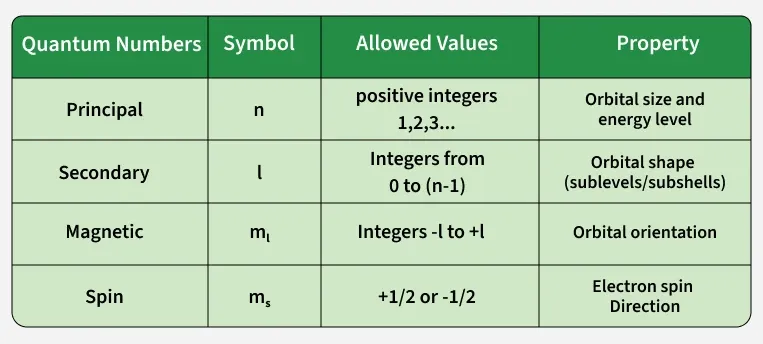
Together, these four quantum numbers completely describe all the properties of an electron in an atom.
1. Principal Quantum Number (n)
The principal quantum number is denoted by the symbol n and represents the main electron shell (energy level) of an atom. It describes the most probable distance of an electron from the nucleus and also indicates the energy of the electron. A larger value of n means the electron is farther from the nucleus and has higher energy, which also implies a larger atomic size.
The value of the principal quantum number can be any positive integer, such as 1, 2, 3, ….
- n = 1 represents the innermost shell, which has the lowest energy and is called the ground state.
- Negative values or n = 0 are not allowed, because an atom cannot have shells with zero or negative energy.
When an electron absorbs energy, it moves from a lower energy shell to a higher one, causing an increase in the value of n. This process is called absorption.
When an electron loses energy, it moves back to a lower shell, leading to a decrease in the value of n. This process is known as emission.
| n | Shell |
|---|---|
| 1 | K |
| 2 | L |
| 3 | M |
| 4 | N |
2. Azimuthal Quantum Number (l)
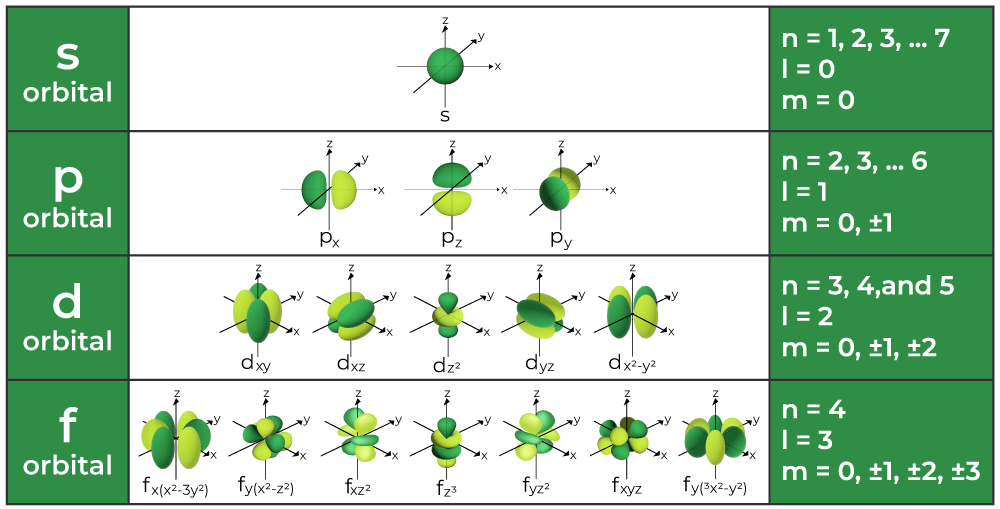
The azimuthal quantum number, also called the orbital angular momentum quantum number, is denoted by l. It describes the shape of an orbital and indicates the number of angular nodes present in that orbital.
The value of l depends on the principal quantum number (n) and can take only whole-number values from 0 to (n − 1). Each value of l corresponds to a specific subshell with a characteristic shape:
- l = 0 → s subshell
- l = 1 → p subshell
- l = 2 → d subshell
- l = 3 → f subshell
Example 1:
If n = 3, the possible values of l are 0, 1, and 2, which correspond to the 3s, 3p, and 3d subshells.Example 2:
If n = 5, the possible values of l are 0, 1, 2, 3, and 4. When l = 3, the electron occupies an f subshell, which has three angular nodes.
| n | l | Subshell Notation |
|---|---|---|
| 1 | 0 | 1s |
| 2 | 0 | 2s |
| 2 | 1 | 2p |
| 3 | 0 | 3s |
| 3 | 1 | 3p |
| 3 | 2 | 3d |
3. Magnetic Quantum Number (ml)
The magnetic quantum number is denoted by mₗ. It determines the orientation of orbitals in space and also gives the total number of orbitals present in a subshell. In other words, while the azimuthal quantum number (l) tells us the shape of the subshell, the magnetic quantum number explains how many orbitals of that shape exist and how they are oriented with respect to an external magnetic field.
The value of mₗ depends on the azimuthal quantum number (l). For a given value of l, the magnetic quantum number can take integral values ranging from −l to +l, including zero.
Example:
If n = 4 and l = 3 (f-subshell), the possible values of mₗ are:
−3, −2, −1, 0, +1, +2, +3This shows that the f-subshell has 7 orbitals.
Relation Between l and m ₗ
The total number of orbitals in a subshell is given by the formula:
4. Spin Quantum Number (ms)
The electron spin quantum number is denoted by mₛ and is independent of the principal (n), azimuthal (l), and magnetic (mₗ) quantum numbers. It describes the direction of spin of an electron about its own axis.
The electron spin quantum number can have only two possible values:
- mₛ = + ½ → spin up (↑)
- mₛ = − ½ → spin down (↓)
The
- +½ value indicates that the electron is spinning in one direction,
- while the −½ value indicates the opposite direction.
In general, the value of the electron spin quantum number is written as ± ½.
Isotopes
Isotopes are the atoms of the same elements that have the same atomic number but different mass numbers. Examples are C-12, C-13, and C-14. Here all are carbon atoms and have the same atomic number, i.e., 6, but different mass numbers. This difference in mass numbers can be understood from their atomic structure.
Atomic Structure of Isotopes
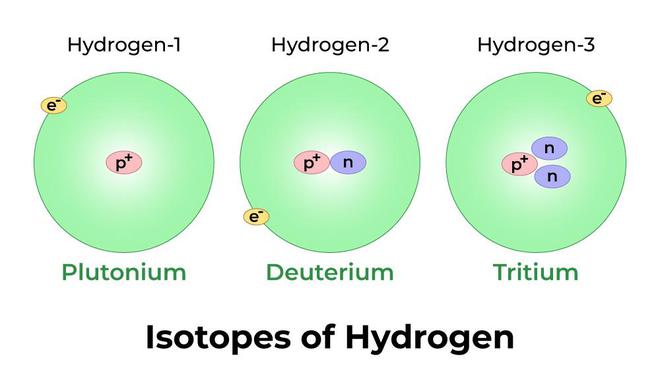
The isotopes of an atom have the same atomic number, which means that the number of protons is the same. Also, their chemical properties are the same because their electronic configuration is the same. The difference in mass number arises due to the difference in the number of neutrons present inside the nucleus. Hence, the atomic structure of isotopes comprises the same number of electrons and protons but a different number of neutrons. We can understand this with the example of isotopes of hydrogen illustrated below:
To describe the structure of an isotope, the element's symbol is used along with the atomic number and the mass number of the isotope. To give an example, hydrogen has 3 isotopes named protium, deuterium, and tritium. The atomic configuration of three isotopes of hydrogen is tabulated below:
| Isotopes of Hydrogen | Atomic Number | Mass Number | No. of Electrons | No. of Protons | No. of Neutrons |
|---|---|---|---|---|---|
| Protium | 1 | 1 | 1 | 1 | 0 |
| Deuterium | 1 | 2 | 1 | 1 | 1 |
| Tritium | 1 | 3 | 1 | 1 | 2 |
The stability of isotopes is different. The half-lives are also different. But they generally have similar chemical behavior because they have the same electronic structures. The pictorial representation of isotopes of hydrogen can be seen below:
Electronic Configuration of Elements
The electronic configuration of elements refers to the arrangement of electrons in different energy levels. The rule for the arrangement of electrons is governed by the following three laws:
Aufbau Principle
Aufbau is a German word that means 'to build.' The Aufbau principle states that the electronic arrangement of an element is done by filling electrons in ascending order of energy of subshell. It means electrons first enter subshells of lower energy and then of higher energy levels. The energy of a subshell is determined by adding the principal quantum number and the azimuthal quantum number, i.e., (n+l). If two subshells have the same (n+l) value, then the subshell having a lower value of n is of lower energy. Hence, electrons enter in the order of 1s, 2s, 2p, 3s, 3p, 4s, and 3d...

Hund's Rule
Hund's Rule states that electrons in the subshell are filled in the manner that in the first attempt of filling the subshell, it is half-filled, i.e., each orbital has one electron, and then the pairing of electrons is done. This is because half-filled and fully filled orbitals are more stable than incompletely filled orbitals.

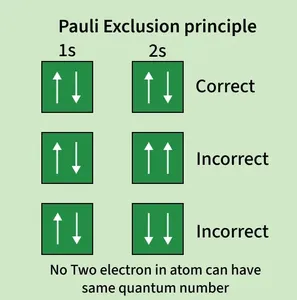
Pauli Exclusion Principle
The Pauli Exclusion Principle states that an orbital can have a maximum of two electrons with opposite spin. This is because if two electrons of the same spin are in an orbital, then all four quantum numbers will be the same, which is not possible as per the quantum mechanical model of the atom.